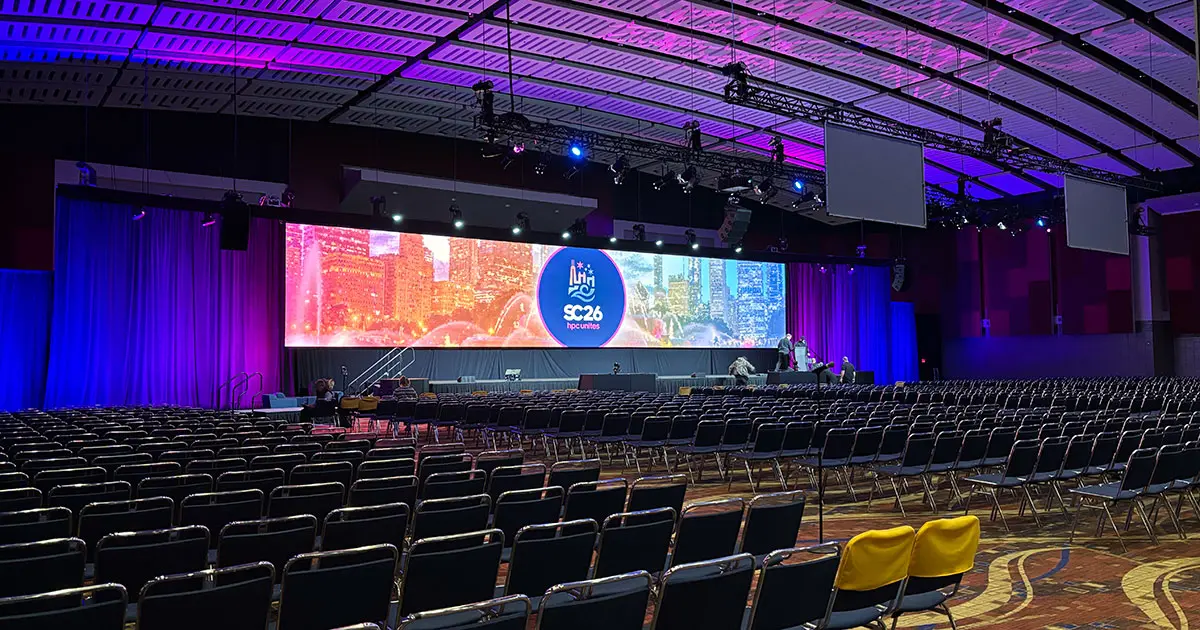
During the SC26 conference, a 35-kilometer fiber-optic network connecting Northwestern University’s Evanston and Chicago campuses to McCormick Place simultaneously carried conventional internet data and quantum entangled photons. Led by Prem Kumar of the McCormick School of Engineering, the team distributed entanglement across the network while coordinating equipment at three locations and automatically correcting for changing conditions.
This demonstration builds on research published in Optica Quantum in July 2026, where the team previously distributed entanglement over 24.4 kilometers of fiber alongside telecommunications signals. “If quantum signals can share the fiber that already carries internet traffic, we can expand quantum networks without the expense of building a separate fiber network,” Kumar said.
Entangled Photons Distributed Across 35 Kilometers of Chicago Fiber
This extended the range of entanglement distribution beyond the team’s previous 24.4-kilometer success, achieved in summer 2025 and detailed in Optica Quantum in July 2026. The latest experiment involved coordinating equipment across three distinct locations and implementing automated adjustments to compensate for fluctuating fiber conditions, a critical step toward stable, long-distance quantum communication. Researchers measured entanglement fidelity, a key indicator of quantum signal quality, confirming the viability of sharing fiber with conventional data transmission.
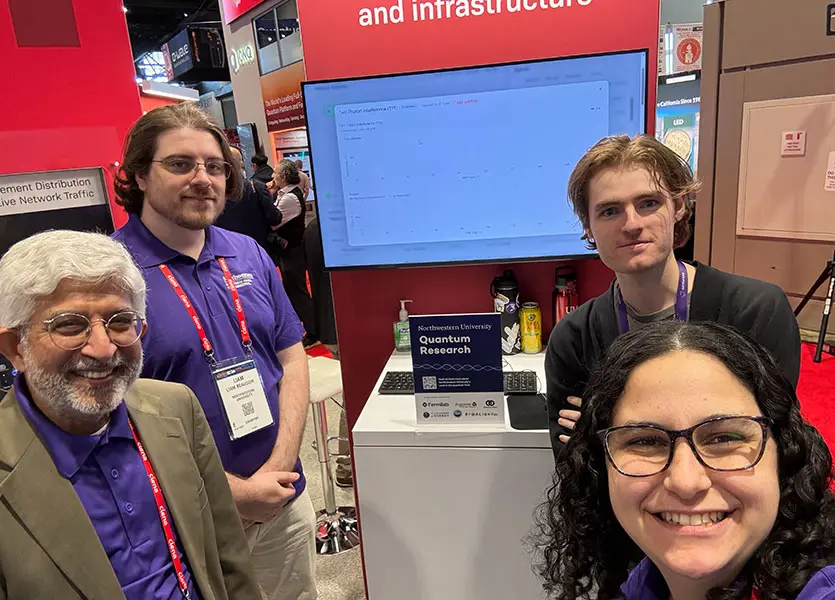
The connection to McCormick Place carried live conference traffic, allowing researchers to test quantum signals alongside data serving actual users. This co-existence is central to the team’s strategy for scaling quantum networks without requiring dedicated infrastructure. Dever Professor of Electrical and Computer Engineering at the McCormick School of Engineering.
The experiment originated photons at the StarLight communications exchange on Northwestern’s Chicago campus, sending one of each entangled pair north to Evanston over approximately 24.5 kilometers of fiber. Successful entanglement distribution required precise matching of photon detections, despite the differing paths each photon took. The team’s approach involved a remotely controlled source, mounted at StarLight, and real-time correction for signal degradation.
“By testing that approach across three sites, we hope to learn how to connect more sites and, eventually, link quantum processors in different locations so they can work together,” Kumar said. This work is part of a broader effort to move quantum networking technology beyond the laboratory and into practical applications.
If quantum signals can share the fiber that already carries internet traffic, we can expand quantum networks without the expense of building a separate fiber network.
Prem Kumar, Chair and John A. Dever Professor of Electrical and Computer Engineering at the McCormick School of Engineering
Ciena Equipment Expands Network Capacity to C and L Bands
The expanded network now uses both the C and L bands of the optical spectrum, a change facilitated by equipment provided by Ciena, and is expected to roughly double the classical data capacity achieved in earlier experiments. Precise timing and automated adjustments are critical to maintaining entanglement across the three sites, requiring coordination of reference clocks with precision measured in trillionths of a second.
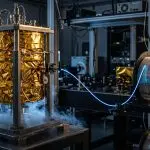
Students are actively involved in assembling and integrating the expanded system, tackling the challenge of interoperability across the metropolitan network. One photon from each entangled pair originated at a remotely controlled source at the StarLight communications exchange, with its partner traveling 24.5 kilometers to a laboratory in Evanston.
This configuration allowed researchers to test the co-existence of quantum and classical signals on the same fiber infrastructure. The team plans to use White Rabbit, a synchronization technology, to coordinate the three-site system and intends to integrate software developed to support continuous operation with minimal manual intervention. Following the SC26 demonstration, they aim to extend entanglement distribution to, pursuing a connection initially envisioned in 2019 as part of the Illinois Express Quantum Network.
The ability to reliably distribute entanglement over longer distances is important for linking quantum processors in different locations, enabling collaborative quantum computation. Researchers must precisely match detections of entangled photon pairs, despite variations in their transmission paths. Real-time polarization correction, combined with Argonne software, is intended to minimize the need for hands-on intervention.
We are working to bring Northwestern’s quantum network out of the laboratory and into the real world.
Gina Talcott, the lead graduate student working on this project in the Kumar lab at Northwestern

See today’s quantum computing news on Quantum Zeitgeist for the latest breakthroughs in qubits, hardware, algorithms, and industry deals.