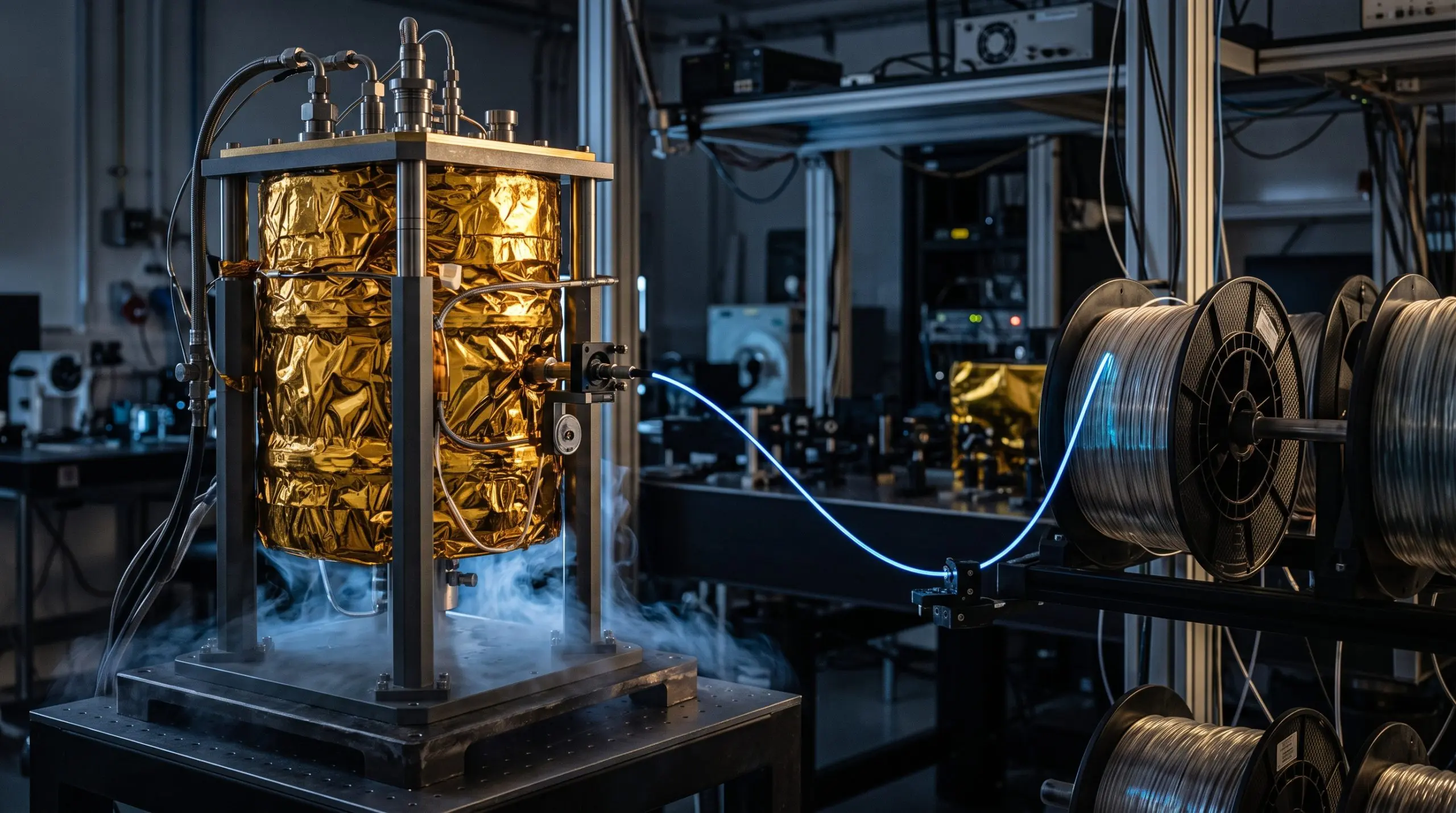
Researchers from Shanghai Jiao Tong University and the Hefei National Laboratory have achieved a record 19.48 Mbps key rate per user in a fully passive quantum access network. This new network uses a surprising approach, generating quantum keys with a thermal light source rather than relying on single-photon emitters. The demonstrated protocol extends passive state preparation continuous-variable quantum key distribution to point-to-multi-point networks, enabling high-key-rate, stable and low-resource implementations. This fully passive design is compatible with existing optical infrastructure, offering a potential solution for secure local area networks in homes and mobile devices.
Passive State Preparation (PSP) Extends CVQKD to Point-to-Multi-Point Networks
A record-breaking key generation rate of 19.48 Mbps per quantum network unit was experimentally achieved using a new fully passive quantum access network protocol. This demonstration, detailed in recent work, marks an advance in continuous-variable quantum key distribution (CVQKD) by extending its reach from point-to-point systems to point-to-multi-point networks. The network uses a hybrid channel combining 5 kilometers of single-mode fiber with a free-space segment exhibiting an average attenuation of -4 dB, resulting in an overall average attenuation of -10.96 dB.
This configuration allows for high-speed, stable and resource-efficient quantum communication. The architecture of this quantum passive optical network (QPON) integrates high key rates with the capacity of passive networks, dividing the system into quantum line terminals (QLT) and quantum network units (QNU) connected by passive optical components like single-mode fibers and 1:N passive splitters.
This design circumvents limitations of traditional quantum access networks, which often require a trade-off between key rate and the number of connected network units. The inherent characteristics of passive quantum state preparation and distribution enable optimization of both security performance and network scalability. Researchers found that under standard experimental conditions, the contribution of typically exceeds that of I(:B_i), simplifying the secure key rate calculation and ensuring that correlations among QNUs do not negatively impact protocol performance.
The system employs a thermal source for generating quantum keys, a departure from typical approaches relying on single-photon sources. A beam splitter divides the thermal source signal with a 99:1 splitting ratio to minimize excess noise associated with passive state preparation. This approach suggests a potentially simpler and more cost-effective method for building quantum networks, as thermal sources are easier to implement than single-photon emitters.
This compatibility provides a promising solution for implementing local area quantum access networks in settings like homes or for mobile terminals. “The PSP-QPON extends the scope of PSP-CVQKD from PTP to PTMP networks, which provides a high key rate, high system stability, and low resource consumption system,” the researchers state.
The team’s work addresses a critical gap in passive quantum access networks, specifically the extension of the PSP CVQKD protocol to scalable networks, a key prerequisite for large-scale deployment. This advancement allows for a future where quantum-secured communication can be smoothly integrated into existing communication infrastructure.
Hybrid Channel Implementation with Single-Mode Fiber and Free-Space Segments
The demonstrated system achieved a record 19.48 Mbps key generation rate per quantum network unit, a significant advancement for passive quantum access networks. This hybrid approach allows for practical implementation without requiring active repeaters, a major obstacle in scaling quantum communication infrastructure. The network’s design incorporates several key components to optimize performance and compatibility with existing systems. Amplified spontaneous emission, local oscillators, bandpass filters, and polarization controllers work in concert to prepare and transmit quantum signals.
Polarization maintain beam splitters and polarization beam splitters manage signal polarization, while a variable optical attenuator modulates the signal strength before transmission. The use of an integrated coherent receiver at the receiving end further enhances signal detection and key generation. Detailed analysis of the system’s performance revealed specific parameters at each receiver. These measurements demonstrate the system’s ability to maintain a reasonable key rate even with varying signal loss across multiple users.
The experimental setup used red, blue and yellow fibers to denote the local oscillator, quantum signal, and polarization multiplexing signal, respectively. This configuration allows for efficient signal transmission and minimizes interference. The researchers state.
Record 19.48 Mbps Key Rate Achieved Per Quantum Network Unit
The demonstrated system uses passive state preparation, a technique that minimizes resource consumption and enhances network stability. This design allows for efficient multi-user access without the signal degradation typically associated with active modulation, a key factor in achieving the reported data rate. Researchers optimized noise suppression and signal compensation algorithms to maintain stable operation even with varying attenuation levels across the network. In a one-to-four point-to-multi-point network configuration, the proposed protocol delivered the 19.48 Mbps secure key rate per user, a figure that emphasises its potential for practical quantum key distribution networks.
The network’s compatibility with existing classical optical communication infrastructure offers a pathway for smooth integration into local area networks, potentially enabling quantum-secured connections for home or mobile users. The team’s work provides a high-rate, scalable and cost-effective solution for constructing practical quantum key distribution networks.
Optimized Noise Suppression and Signal Compensation for Hybrid Channels
Maintaining signal integrity across a four-user network proved critical to achieving the reported 19. These algorithms ensure stable operation even when signal strength varies between each receiver, a common challenge in practical fiber optic deployments. The design deliberately avoids active components within the optical path, preventing signal degradation that can limit performance and scalability in quantum key distribution (QKD) systems. To accurately measure and calibrate for noise, the system uses a polarization-maintained optical switch at each receiver, alternating between signal detection and shot noise calibration.
This allows for real-time acquisition of shot noise data, ensuring an accurate quantification of the local oscillator intensity for each data frame. By suppressing statistical errors in single measurements, the system achieves a more precise understanding of the noise environment, improving key generation efficiency.
The optical switch diverts a portion of the signal to an integrated coherent receiver (ICR) for synchronous measurement, a technique that enhances the accuracy of the noise assessment. Beyond noise mitigation, a machine learning-based signal demodulation algorithm significantly improves the signal-to-noise ratio (SNR) by using the concept of continuous temporal mode. This approach correlates sampling points between the sender and each receiver, effectively decreasing excess noise and enhancing the clarity of the quantum signal.
Parameter estimation, including the efficiency of the reconciliation algorithm (β), channel transmittance (T), and electrical noise at each receiver (v_el), are all factored into the secure key rate (SKR) calculation. The system’s performance was validated through extensive testing.
PSP-QPON Design Enables Scalable Multi-User Access
Achieving a key generation rate of 19. The system’s design prioritizes high key rates, stability and reduced resource consumption, offering a pathway toward practical quantum key distribution networks. This configuration allows for compatibility with existing classical optical communication networks, simplifying integration and reducing the need for extensive modifications to current infrastructure. Beyond simply achieving a high key rate, the PSP-QPON’s passive optical splitting design avoids signal degradation typically caused by active components, supporting efficient access for multiple users simultaneously.
In a 1-to-4 point-to-multi-point network configuration, the system delivered a secure key rate of 19.48 Mbps per user, demonstrating a significant improvement over traditional PSP-CVQKD systems that often sacrifice key rate for network scale. The PSP-QPON achieves a fully passive network with a high bit rate and large quantum network unit capacity, overcoming limitations of earlier quantum access networks that struggled to balance key rate and network expansion.
Compatibility with Existing Classical Optical Communication Infrastructure
The experimental network achieved full compatibility with existing classical optical communications infrastructure, eliminating the need for modifications to deployed systems. This integration simplifies adoption by using established fiber optic cabling and components already present in local area networks, a departure from previous quantum access network designs requiring specialized hardware. The researchers demonstrated this compatibility using a hybrid channel combining free-space transmission with single-mode fiber, mirroring the architecture of conventional broadband networks.
This approach circumvents a major obstacle to widespread quantum network deployment: the cost and complexity of replacing existing infrastructure. The system’s design allows for smooth coexistence with classical signals, transmitting quantum keys alongside standard data streams without interference. This is particularly significant for applications like secure home or mobile access, where retrofitting existing networks is far more practical than building entirely new ones.
The team’s work addresses the challenge of achieving high-speed linear modulation with stability under real-world conditions, a limitation of earlier quantum access networks based on active protocols or Stokes operator coding. The passive nature of the demonstrated network is central to its compatibility and scalability. Unlike active systems that require powered repeaters or switches, the PSP-QPON relies on optical splitters to distribute quantum signals, reducing both energy consumption and system complexity.
This passive architecture allows for a larger quantum network unit capacity, facilitating multi-user access without compromising security or performance. The final key generation rate reached a record-breaking 19.48 Mbps per quantum network unit, a figure that emphasises the potential of this approach for practical quantum communication.


See today’s quantum computing news on Quantum Zeitgeist for the latest breakthroughs in qubits, hardware, algorithms, and industry deals.