
Slurm version 26.11 now directly manages quantum processing units (QPUs) thanks to a new plugin interface for hierarchical resources (HRES). Pasqal has connected Slurm to the Quantum Resource Management Interface (QRMI), allowing the workload manager to schedule access to Pasqal QPUs alongside traditional high-performance computing resources. This integration enables a hybrid HPC-QC workflow where “researchers request the QPU in the batch scripts they already write,” according to Pasqal, and administrators manage it through Slurm like any other resource. CINECA is already running jobs on a Pasqal QPU, Sol, using this new system.
Slurm HRES Plugin Integrates Pasqal QPUs as Scheduleable Resources
Slurm version 26. This release enables Slurm to schedule and allocate time on Pasqal QPUs alongside conventional CPU and GPU resources, a step beyond earlier integrations focused on emulation, the company says. The integration, developed with IBM, relies on the Quantum Resource Management Interface (QRMI) to facilitate communication between Slurm and the quantum hardware. The HRES-QRMI integration simplifies access for users by requiring only a change to job requests; instead of the –qpu=PASQAL_LOCAL command alongside a site license, users now specify –resources=PASQAL_LOCAL:1.
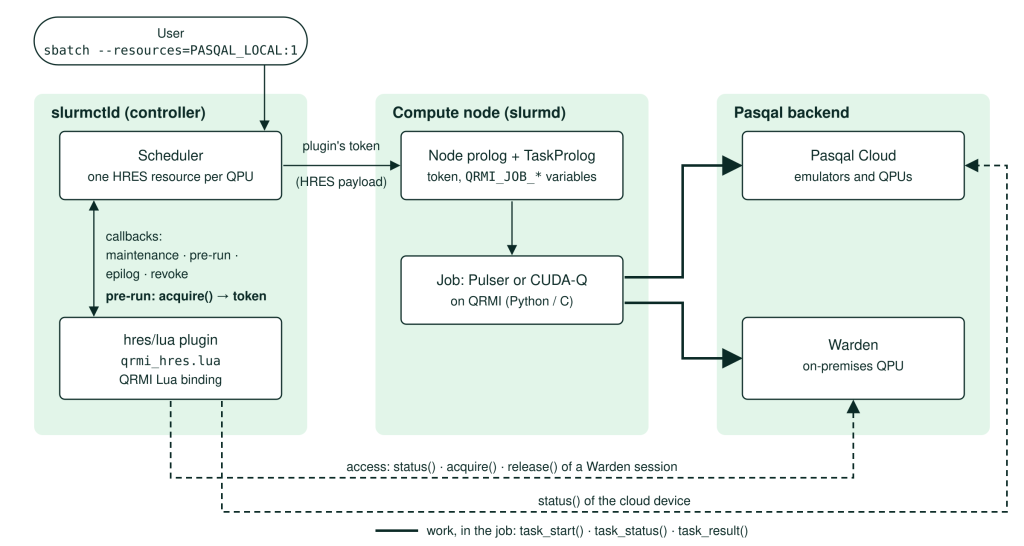
Administrators define the QPU as a resource within Slurm’s resources.yaml file, specifying the number of concurrent jobs permitted and the location of the QRMI plugin. This configuration allows for centralized management of quantum resources, mirroring the established practices for traditional HPC infrastructure. Access is automatically provisioned before user code executes and revoked upon job completion or cancellation, eliminating the need for users to directly manage QPU sessions.
The system’s design prioritizes compatibility with existing quantum software frameworks. Programs written using Pulser or NVIDIA CUDA-Q require no code modifications to run on the Pasqal QPU, as the underlying environment remains consistent. This smooth transition is facilitated by the QRMI interface, which handles the communication and credential management between the classical and quantum components. NVIDIA CUDA-Q is used to move a program from GPU emulation directly to the Pasqal QPU within a single Slurm workflow, demonstrating a unified hybrid computing experience, according to the company.
“Quantum enhances the HPC stack,” reflects the potential for tightly integrated workflows. The HRES plugin’s adaptability extends beyond Pasqal QPUs; the same plugin supports QPUs from multiple providers through QRMI. This modular approach minimizes the effort required to integrate new quantum hardware into existing HPC environments.
The move from the earlier SPANK plugin to HRES was intentionally streamlined, building upon the foundation of QRMI to ensure a smooth transition for administrators and users. Site administrators retain control over resource allocation, defining policies for sharing and concurrency within a single configuration file.
Hybrid HPC-QC Workflows Managed by Slurm and QRMI
fundamentally alters how high-performance computing clusters integrate quantum hardware, introducing a plugin interface for hierarchical resources that allows direct scheduling of quantum processing units alongside conventional cores. This release marks a departure from earlier quantum integration methods, which often relied on licensing or temporary environment modifications, and instead embeds quantum resource management within the core workload manager. This integration extends beyond mere scheduling; the system actively monitors the status of each quantum processor through QRMI at intervals defined by the site administrator, automatically disabling a resource within Slurm if the QPU becomes unavailable.
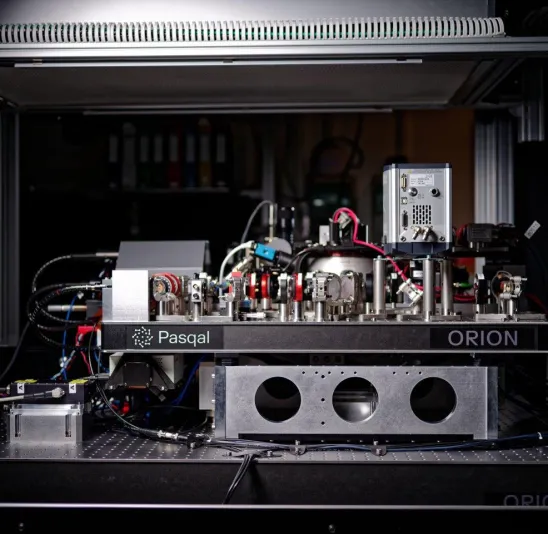
This proactive check ensures that jobs are not submitted to faulty or offline quantum hardware, enhancing the reliability of hybrid workflows. Site administrators maintain granular control over resource allocation, setting policies that govern concurrent access and overall QPU use.
QRMI Enables Unified Access to IBM and Pasqal QPUs
This release marks a step toward mainstream integration, as it allows a widely used workload manager to schedule jobs across both classical and quantum hardware. This integration simplifies access to Pasqal QPUs for researchers, moving beyond complex configurations to a system where quantum resources are treated as part of the overall HPC environment. CINECA has run jobs on Sol this way, using the QRMI SPANK plugin, and plans to use CUDA-Q on the same path.
The transition from existing SPANK plugins to the new hierarchical resource system is designed to be minimal, building directly on the foundation of QRMI. Users now request the QPU through standard Slurm resource specifications, such as –resources=PASQAL_LOCAL:1, while administrators define the quantum resource within Slurm’s configuration files. The underlying mechanism involves QRMI handling access tokens for scheduled jobs, acquiring them when a job begins and releasing them upon completion.
A site administrator defines each QPU as a hierarchical resource in Slurm, specifying the nodes with access and the maximum number of concurrent jobs. This configuration, detailed in the resources. “Moving from the SPANK plugin to HRES is a small step, and that is a result of building on QRMI from the start,” reflects the ease of adoption for existing installations. The integration extends to NVIDIA CUDA-Q, allowing developers to smoothly transition programs between GPU emulation and execution on the Pasqal QPU.
By using cudaq.set_target(“pasqal”, machine=”qrmi”), a CUDA-Q program automatically runs on the assigned QPU, utilizing the access credentials prepared by Slurm. This capability is further enhanced by CUDA-Q’s GPU emulation feature, activated with cudaq.set_target(“pasqal”, emulate=True)`, enabling developers to test and debug quantum programs on classical hardware before deploying them to the QPU. This unified workflow represents an advancement in hybrid computing, streamlining the development and execution of quantum applications.
On-Premises QPU Access Controlled via Slurm and Warden Sessions
Slurm’s hierarchical resource system now manages access to quantum processing units through a process initiated before user code runs, and terminated upon job completion or cancellation. This ensures users do not directly manage quantum processing unit sessions, simplifying operation for on-premises quantum hardware. Site administrators define concurrency limits within a single configuration file, integrating quantum resources alongside conventional cluster resources. This applies to both cloud-based and on-premises QPUs, limiting simultaneous job access.
The plugin acquires access tokens, opening a Warden session for each job’s user, and then passes the token to the job’s nodes. During a job’s lifecycle, Slurm calls the HRES plugin, which in turn calls QRMI at key moments.
When a job is scheduled and nodes are allocated, the plugin obtains access, initiating a Warden session. Conversely, upon job completion or cancellation, the plugin releases access, ending the session. An example entry for an on-premises QPU behind Warden includes parameters like a maintenance cycle of 10 and a job count of one, limiting access to a single job at a time. The user’s quantum program, written using Pulser or CUDA-Q, accesses the QPU through QRMI, utilizing either an access token for on-premises hardware or Pasqal Cloud credentials.
Testing confirmed the system’s functionality with competing jobs waiting their turn, cancellation releasing access and Warden sessions ending with their respective jobs. These tests extended to a physical QPU, FRESNEL_CAN1, Pasqal’s QPU in Canada, accessed through Pasqal Cloud and CINECA’s experience with Sol, previously deployed using the SPANK plugin, validates the workflow.
Source: https://www.pasqal.com/blog/enabling-hybrid-gpu-qpu-workflows-with-slurm-hres-and-pasqal-qpus/



See today’s quantum computing news on Quantum Zeitgeist for the latest breakthroughs in qubits, hardware, algorithms, and industry deals.