For thirty years, the promise of quantum computing has centered on exponentially faster factorization and search, a framing that FirstQFM’s Adam Wesołowski argues is now hindering progress. The Stockholm-based company, founded in 2025, is developing AI foundation models to optimize quantum hardware and redefine what is possible. “Can a system that contains a quantum computer beat the best system that does not?” Wesołowski asks, proposing a new benchmark focused on overall machine capabilities, including energy use, cost and solution quality, rather than solely computational speed.
Quantum Hardware Operation Requires Constant Machine Learning
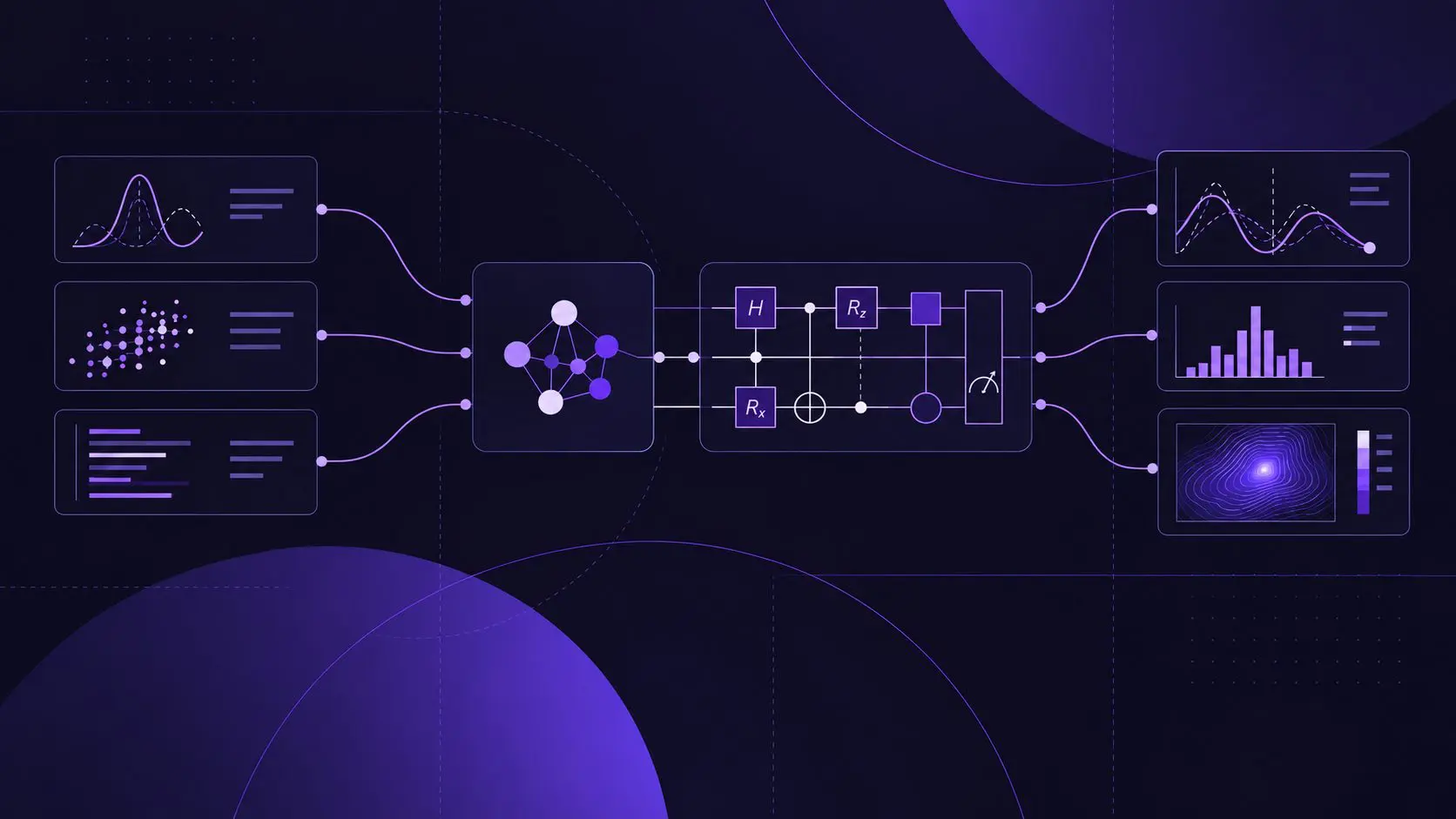
AI foundation models are now integral to maintaining stable operation of near-term quantum hardware, predicting calibration drifts and suggesting corrective pulse sequences before errors accumulate. FirstQFM, a Stockholm-based company, develops these models, analyzing qubit behavior in real-time using telemetry from superconducting and photonic systems. This constant machine learning intervention addresses a critical challenge: the inherent fragility of quantum systems, where sensitivity to the environment and computation are intertwined physical properties.
The company’s approach moves beyond viewing the quantum processor as a direct competitor to the classical CPU, instead positioning it as a specialized component within a larger, AI-operated machine. This shift in perspective redefines what constitutes progress in quantum computing, prioritizing overall machine performance over solely achieving faster computation times.
Adam Wesołowski of FirstQFM explains that the first measurable quantum advantage may not be speed, but rather improvements in energy efficiency, hardware footprint, or answer quality per unit cost, the company says. “The objective, then, is the strongest overall machine, one with capabilities we did not have, running reliably at lower cost, producing better solutions to problems people actually care about,” he states. This focus acknowledges that industrial problems rarely require the astronomically large problem sizes needed to realize the asymptotic speedups traditionally associated with quantum computing.
A million-fold constant factor penalty from error correction, Wesołowski notes, could negate a quadratic speedup, rendering it useless despite the theoretical advantage. The core of FirstQFM’s technology lies in machine learning foundation models that operate beneath the quantum software stack.
These models analyze real-time data to forecast which qubits are performing optimally, identify pairs that should be avoided in a computation, and determine when a device requires offline recalibration. These are forecasting and scheduling problems, and improvements in these areas deliver most of the system’s performance gains, with AI likely to improve almost all of it, according to FirstQFM. The company’s models also extend into the algorithms themselves, proposing decompositions of complex problems and identifying the most challenging subproblems for the quantum hardware to address.
This allows the quantum device to focus on a handful of tangled subproblems containing only a few dozen binary variables, a size current hardware can manage, and where the device’s ability to find low-energy configurations may prove valuable. FirstQFM’s approach uses the inherent properties that make machine learning effective, as quantum computing generates its own quality signal, at scale and automatically, providing a clear reward for learning.
You can count the gates, simulate the fidelity, and compare predicted syndromes against measured ones, creating a feedback loop that continuously optimizes performance. This contrasts with many other fields where quality signals are subjective or difficult to obtain. A research collaboration with Chalmers University of Technology further strengthens its position within the Swedish quantum ecosystem. The models do not aim to replace classical solvers entirely; instead, they function as advisors, providing guidance to a classical processor that polishes and validates the quantum output.
The quantum processor is invoked only when the learned model predicts it will provide a benefit, and that benefit can be measured in any resource the deployment is constrained by, energy, hardware, solver calls, or answer quality. This selective invocation is important for practical applications, as it minimizes the overhead associated with quantum computation and maximizes its impact, the company says.
In October 2025, FirstQFM secured €1.2 million in pre-seed funding led by BSV Ventures, with participation from Almi Invest, Further than Capital and Luminar Ventures, to accelerate the development of its patent-pending models. If practical quantum advantage is to be realized, Wesołowski believes it will first be visible on an energy bill or a hardware budget, rather than on a stopwatch.
He argues, “which is where, in my opinion, the real advantage of AI-guided quantum computing will be demonstrated.” FirstQFM is actively building systems to facilitate this future advantage and extract the most from quantum computing technology, recognizing that constant machine learning is no longer optional, but a fundamental requirement for operating quantum hardware effectively. The company works with a global network of partners and experts to help move quantum computing from experimental stages to industrial use, focusing on building systems that deliver tangible benefits in the near term.
Learned Compilation Reduces Circuit Depth for Noisy Processors
Learned compilation techniques are demonstrably reducing quantum circuit depth, a critical step toward practical applications on near-term processors, according to research spearheaded by FirstQFM. The company’s approach uses machine learning to optimize circuits for execution on existing superconducting and photonic hardware, addressing a key limitation of current quantum systems, the rapid accumulation of errors, FirstQFM reports. This shift in focus, from purely asymptotic speedups to tangible improvements in resource use, represents a fundamental re-evaluation of what constitutes quantum advantage.
However, as Adam Wesołowski, a Research Scientist at FirstQFM, explains, this emphasis on asymptotic performance often obscures practical considerations. “A quadratic advantage that carries a million-fold constant factor penalty from error correction is unlikely to become useful on any realistic instances,” he states, highlighting the disproportionate impact of error mitigation overhead. Industrial applications, Wesołowski argues, rarely require the massive problem sizes needed to realize these theoretical speedups; instead, they demand solutions for moderately sized, highly structured problems where existing classical solvers are already highly optimized.
FirstQFM’s models do not aim to supplant classical computation entirely, but rather to function as intelligent advisors, guiding the quantum processor toward tasks where it can deliver a genuine benefit. This selective invocation is important for maximizing efficiency and minimizing resource consumption, particularly in the era of noisy intermediate-scale quantum (NISQ) technology.
The company’s core offering consists of machine learning foundation models that analyze and optimize qubit behavior both before and during computation, effectively acting as a layer of intelligent software beneath the quantum hardware stack, the company’s account states. The company’s work extends beyond circuit compilation to encompass hardware design and calibration. Learned search algorithms are employed to explore vast design spaces for chip layouts, qubit couplings and control pulse shapes, optimizing for multiple objectives simultaneously: coherence, connectivity, crosstalk and fabrication yield.
This approach contrasts sharply with traditional methods, which often rely on human intuition and manual optimization. Similarly, AI-driven calibration strategies dynamically adjust to qubit drift and noise patterns, maintaining optimal performance over time. Wesołowski asserts, emphasizing the potential for machine learning to automate and enhance the traditionally labor-intensive process of quantum system maintenance.
Rather than attempting to encode entire problems onto quantum hardware, the company’s models decompose complex tasks into smaller, more manageable subproblems that can be efficiently tackled by quantum subroutines. Neural networks are used to identify the most challenging aspects of a problem, and the quantum device is then deployed to address those specific bottlenecks. This approach, Wesołowski explains, allows researchers to use the strengths of both quantum and classical computation, achieving results that would be unattainable with either approach alone.
A compiler that removes 30% of circuit depth, for example, improves the performance of every program running on the machine, reducing the number of gates required and minimizing the accumulation of errors. This reduction in circuit depth is particularly critical in the NISQ era, where qubit coherence times are limited and error rates are high. Shallower circuits require fewer repetitions to achieve a target precision, reducing the overall computational cost.
The company’s vision extends beyond simply improving the performance of existing quantum algorithms, FirstQFM claims. This broader definition of advantage acknowledges that time is not the only resource that matters in real-world applications, and that improvements in other areas can be equally, if not more, impactful. FirstQFM’s approach, therefore, represents a pragmatic and forward-looking strategy for realizing the full potential of quantum computing, one that prioritizes practical utility over purely theoretical speedups.
Source: https://firstqfm.com/news/quantum-computing-future-ai