This weekend in London, Moth opened quantum computers for creatives to people with no physics background, and they sat at a row of screens dragging sliders across photographs. None of them were programmers. The pictures turned into something they had not quite expected.
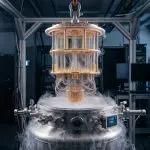
The computers in front of them did not run those calculations. Each job went over the internet to a quantum processor, a chip cooled to a fraction of a degree above absolute zero, inside a refrigerator the size of a wardrobe. The answer came back within seconds. They had walked in off the street that weekend, because Moth, a small quantum software company, had opened its building to anyone who wanted to try.
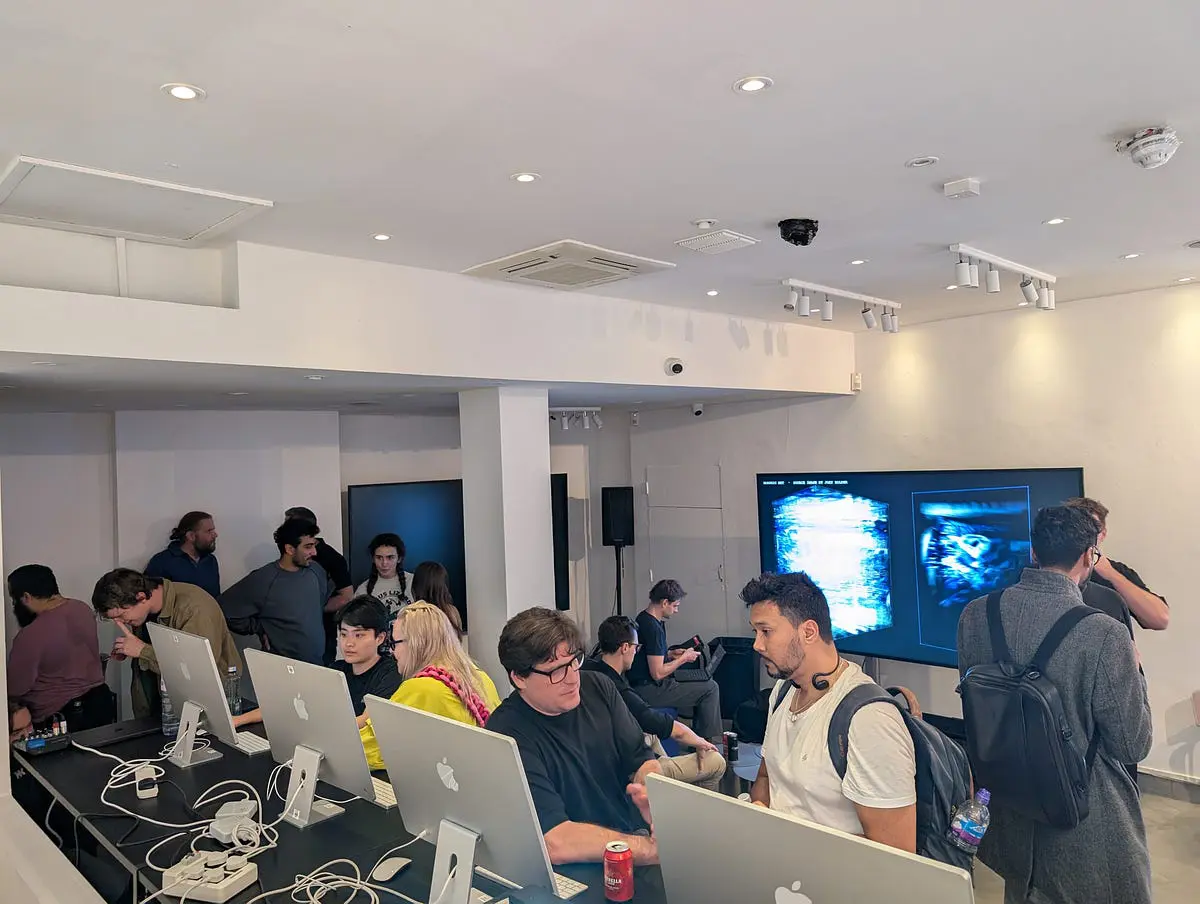
Downstairs, a hackathon ran in three-hour shifts so that more people could get a turn on the machines before Sunday, when visitors could come back and try what the teams had made. A hackathon is a weekend race, the kind where teams try to build something new against the clock. The launch party drew quantum physicists, game developers, artists, and the plainly curious, which is a wider mix than the quantum computing industry usually manages to put in one room.
The software on the screens is called Atlas, which Moth describes as a quantum computing platform for creativity, and a closed alpha has been testing it for most of the year. An alpha is a closed group of early users. The machines underneath belong to providers such as IBM and IQM, a Finnish hardware company, and they are real quantum computers that companies and research laboratories already pay to use. Nobody in the building was looking at a quantum circuit.
What a quantum computer normally asks of you
An ordinary computer stores information as bits, switches that are either off or on, zero or one, while a quantum computer stores that information in qubits. A qubit uses superposition, a property of very small objects, to hold a blend of zero and one at the same time. Entanglement is the second property. It links qubits so that the state of one cannot be described without the others.
You have to think like a physicist. The standard screen, whether it is IBM's drag-and-drop Quantum Composer or a language such as Qiskit, Cirq or Q#, is a set of horizontal lines, one per qubit. Onto those lines you place gates. A gate is one operation that nudges a qubit's state, and the arrangement of those gates is the quantum circuit, the program the machine will run.
The tutorials that come with every one of these tools follow the same route, from a gate that flips a qubit, to an entangled pair, to the quantum Fourier transform, and on toward Shor's algorithm. Shor's algorithm is the famous recipe for breaking encryption by factoring large numbers, and it has trained a generation of specialists. It is a good education for a physics student. A graphic designer or a games developer who sits through it comes out the other end with nothing they can use.
Quantum computers for creatives start with the picture
Atlas begins with a library of ready-made tools, each doing a job a creative professional would recognise, and the one most visitors gravitated to processed an image. You choose a tool, adjust its settings with ordinary controls, and watch the result change. At no point does a circuit appear.
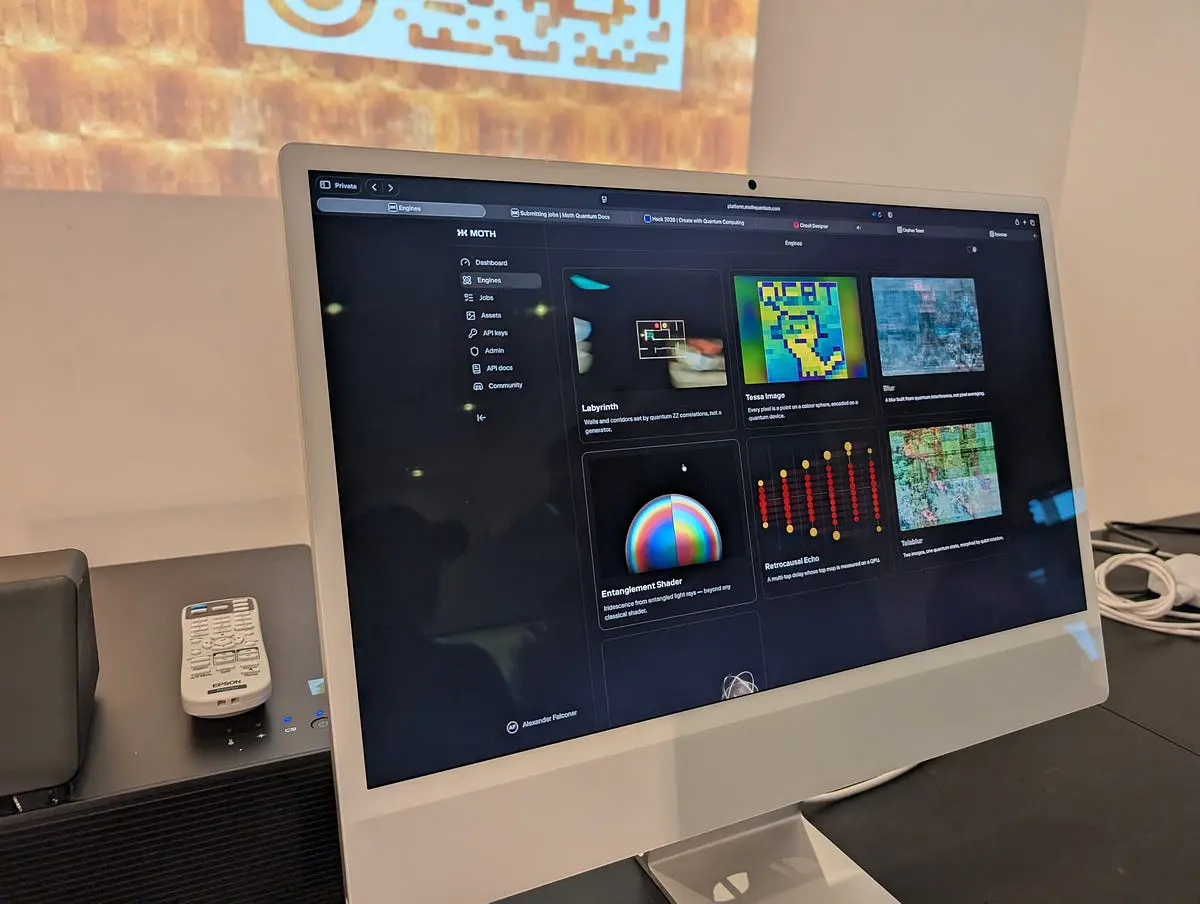
There is a circuit, out of sight. A compiler, the piece of software behind the interface, translates each tool and its current settings into the exact sequence of gates the chosen processor needs, and then sends it off. The closest comparison is Photoshop, where someone applying a filter moves a slider and looks at the picture. They have no interest in the mathematics underneath, and they would resent the software for making them look at it. Atlas treats a quantum processor the same way, as something you steer by its output.
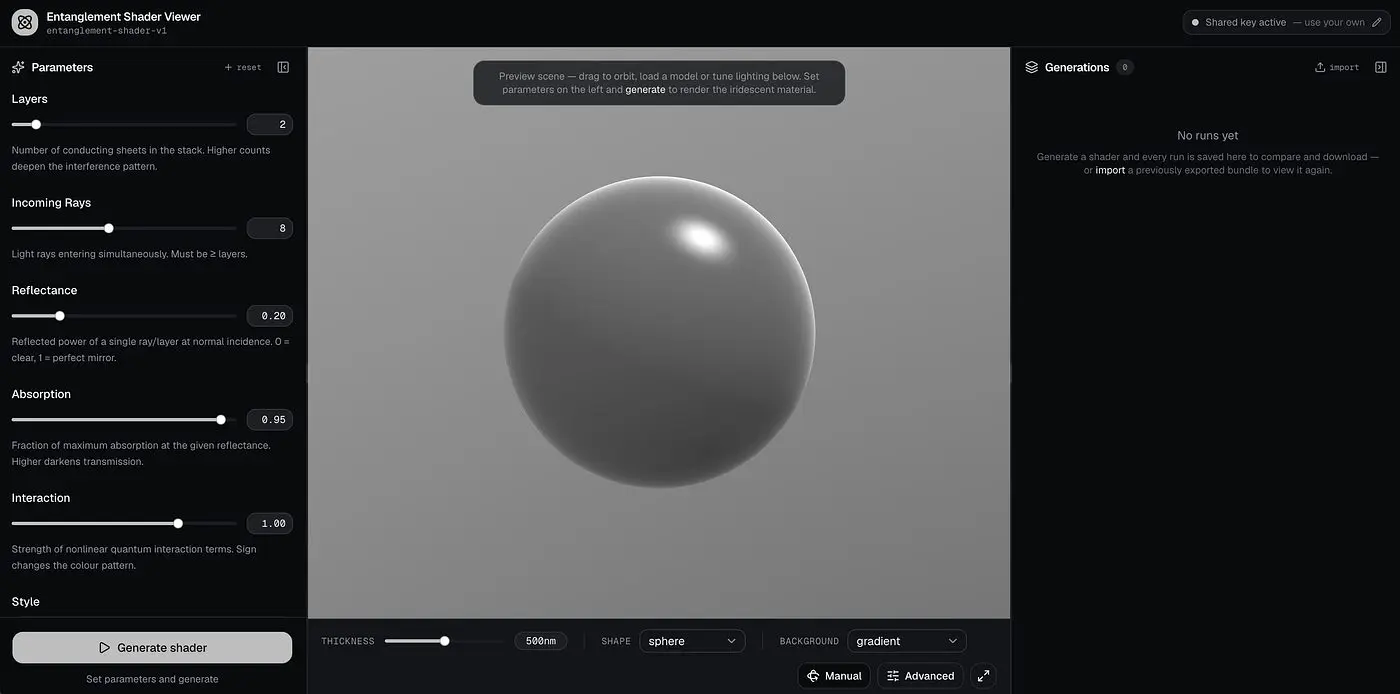
The intended user already knows Photoshop, After Effects or Ableton, and the words on screen are the words of those tools. The notation of quantum mechanics stays off the page. There is a cost, because hiding the circuit makes the tool easier to use and harder to understand, and the more technical visitors at the weekend clearly wanted to lift the lid.
Moth's answer, as far as I could gather, is that the hiding is deliberate for now, and that it will loosen as more experienced users arrive and push on it. The platform can then turn into a playground. Different machines and different algorithms would be there for anyone who asks, while the default view stays as simple as a filter menu.
Notebooks would let other people rerun the work
Moth told visitors notebooks are on the way. A notebook, the kind the Jupyter project made common, mixes code you can run, the results, and plain written explanation, so someone else can read the work and rerun it as one file. Before notebooks, the work sat in private scripts on separate laptops.
A notebook can be emailed, posted online, or handed to a class, and it still works. Databricks built a large business by selling that same idea to companies, and notebooks would do the same job for Atlas that they did for machine learning. A tool built in a notebook travels. A tool built inside a graphical interface does not travel the same way.
A hackathon team could hand its image effect to another team, a lecturer could give a worked example to students, and someone on another continent could pick up a project begun in London and carry it on. That is how a shelf of demos becomes a platform people build on, once the file can be passed along.
It is also where the hidden circuit becomes visible to anyone who wants it, because a notebook can show the compiled sequence of gates beside the output for whoever scrolls down far enough. Moth was candid that some of this is still being decided. No date was attached to that plan.
Quantum games that hide the machinery
Atlas did not appear out of nowhere, and the games Moth has already released follow the same idea, which is to show the result and bury the machinery. Quantum Backrooms, launched at the end of May, is a free browser game. Thousands of people played it on launch day.
The player wanders through endless shifting corridors, and every corridor is generated on live IBM and IQM hardware, with each qubit standing for a section of the map. The physical links between qubits, the paths along which two qubits can be made to interact, decide which routes through the maze exist. A player sees only rooms and doorways. They never learn that the layout is a portrait of a specific chip.
The game grew out of an earlier Moth project called Space Moths, and the release was timed to land the day before Backrooms, the A24 film by director Kane Parsons that inspired it, reached cinemas. That placed a quantum product in front of an audience that would never have gone looking for one.
Moth said the game was there to show Atlas, and alpha users were already on the platform when the game went live. In 2025 Moth put out a music track made with tools that generate sound on a quantum computer, and the composer Professor Eduardo Miranda, a pioneer of quantum music, advised on the work. The company says it also works on immersive games, virtual worlds, new audio formats, and tools that generate images.
The physicist who spent years making quantum computers play
James Wootton is Moth's chief scientific officer. He spent years at IBM Quantum after research work at the University of Basel. While he was there he helped establish quantum procedural generation, which means using a quantum chip's output to make game art such as landscapes and textures. He also built Quantum Blur, which takes a picture, runs it through quantum steps, and hands back a visibly changed version.
He holds a PhD from the University of Leeds and has more than 40 peer-reviewed papers, most of them in quantum error correction, the science of protecting fragile qubits from noise. He joined Moth in 2024. Atlas is, in large part, the commercial form of the outreach work he was doing at IBM.
Ilyas Khan gives Moth its weight in the industry. He founded Cambridge Quantum in 2014 and then steered its merger into Quantinuum, now one of the largest quantum computing companies in the world and listed on Nasdaq as QNT. He is still Quantinuum's founder and the head of special projects. At Moth he is co-founder and non-executive chairman, having worked the idea up with Harry Kumar before the company formally existed.
The Quantinuum founder put his own name and money behind a consumer software business, which says a good deal about where he thinks the next audience will come from. Kumar is co-founder and chief commercial officer. Sean Harpur is chief executive, Spencer Topel is chief technology officer, and Marco Stegmaier is chief financial officer. Rob Jesudason sits on the board.
Roughly two dozen people are on the staff at Moth, a mix of researchers and quantum engineers with a studio lead, a product designer, and a graphic designer. Most quantum startups fill that list with physicists, and the blend at Moth is different.
A software layer on someone else's machines
Moth was founded in London in 2022. The money came from Grow London and from Serendipity Capital, the Singapore investment firm associated with Khan, and PitchBook puts the sum at about $3.8 million. Moth owns no hardware, and it intends to own none. IBM and IQM already run the machines and already need customers for them. In time, presumably, Quantinuum's machines join that same queue.
Moth is building a second kind of value, separate from the creative tools themselves, because every tool in Atlas has to be compiled for whichever machine is available. The company has had to build a layer that sits above IBM, IQM, and whoever comes next. The layer accepts a job without caring which processor will run it, and farms the job out to the right one. The chip stays with the hardware firm.
Strangeworks was arguably too early for that job. The Austin company Strangeworks set out several years ago to build this same kind of layer, one that treats different quantum computers as interchangeable. It arrived before enough machines were there to swap between, and before enough users wanted the layer. Moth's timing is better, since several hardware firms now want jobs to run on their machines, and people have a reason to use the layer that has nothing to do with the layer itself.
The hardware makers have spent a decade and many billions building processors, and they are now looking for people to run things on them. Almost nobody outside a laboratory has a reason. A business that can create demand from artists, studios and game developers is useful to every hardware maker at once, and it needs no factory of its own.
Whether the money raised so far can carry Atlas from a closed alpha to a public launch, and pay for the notebook work, is a fair question. A further funding round would be the obvious next signal to watch for.
The application that never gets written
Quantum computing has a problem that faster hardware alone cannot solve, because nobody outside a research laboratory will touch a quantum computer when there is nothing on it they need. Because nobody touches one, nobody learns what it might be good for. The applications that would give people a reason never get written. Faster chips will not break that loop.
The usual lessons do not break the loop. A tutorial that ends by factoring a small number is an impressive piece of physics, and an entirely useless piece of software to someone who builds things for a living. Try factoring 21 with a library in Qiskit. It is heavy lifting for a result that a classical computer, or a person, reaches easily.
Today's machines make the problem worse, because they are small and prone to error, and Atlas is honest about it. It offers real chips, and tools built for what those chips can do today. The tools make patterns a normal program cannot easily copy. There is no claim of computational advantage attached to any of this, meaning no claim that the quantum chip beats an ordinary computer on the same task.
Many in the industry will call it a toy. The people who built it have spent a long time in quantum computing, and they know precisely what the hardware can and cannot do. The playfulness is the strategy, because exposure has to come before understanding, and understanding has to come before anyone writes the application that closes the gap.
Of the people who walked in off the street and moved a slider, some will want to know what happened, a smaller number will go and read about it, and a handful will write tools themselves. Generative artificial intelligence went the same way, from the first DALL-E image demonstrations in 2021 to ChatGPT the following year.
What Moth has built is a world in which quantum hardware produces something visual and familiar, using the tools and vocabulary creators already own, and a public launch is promised for later this year. Notebook support is promised for later this year too. Those will show whether that world can grow beyond a basement in London. Some of this may even find its way into visual effects, as new ways to transform images, or into watermarking that is very different from conventional techniques.


See today’s quantum computing news on Quantum Zeitgeist for the latest breakthroughs in qubits, hardware, algorithms, and industry deals.