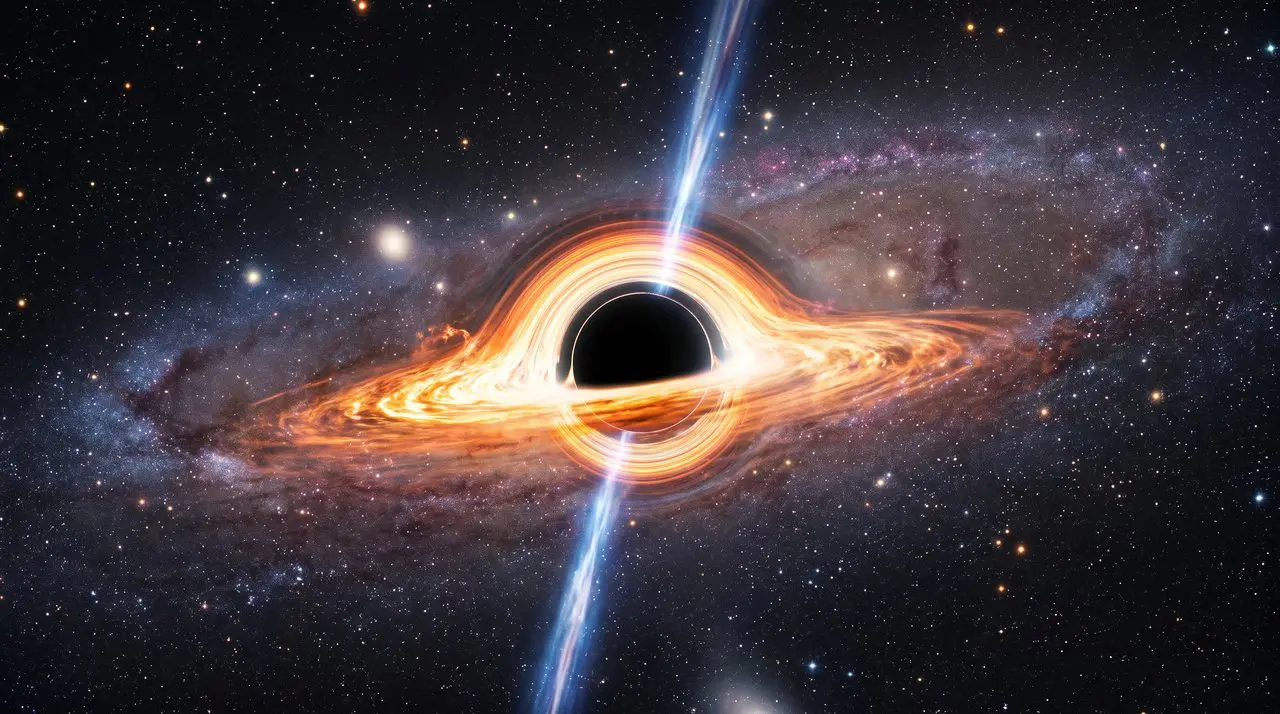
Researchers have identified a black hole existing 660 million years after the Big Bang, a period known as cosmic dawn. This black hole differs from previously observed distant objects because it is significantly gas-enshrouded and reddened, suggesting it is actively feeding within a dense cloud of gas and dust. The paper reports unique properties including a large hydrogen Balmer break and broad multi-peaked emission, modeling the source as an enshrouded black hole growing through super-Eddington accretion.
This discovery, the result of work by a team of researchers, may provide direct evidence for a theoretical mechanism for rapid black hole growth. The Balmer break strength is 7.7−1.4+2.3. This extreme value lies beyond the limits for stellar populations, suggesting a non-stellar origin for the observed light and challenging existing models of black hole formation at cosmic dawn. Observations made with the NIRSpec instrument on the James Webb Space Telescope revealed the unusual spectral signature within the UDS extragalactic field, identifying MoM-BH*-1 as the reddest source in a 250 square arcminute area.
The source’s distinctive redness is due to gas, not dust, a finding supported by intense absorption in the Balmer lines of hydrogen. This absorption indicates gas densities exceeding 109 cm-3, a condition previously observed in a limited number of sources hosting supermassive black holes. Researchers modeled the system using Cloudy spectral synthesis, embedding an accretion disk within this turbulent, dense gas to replicate the observed Balmer break and absorption features, mirroring theoretical configurations proposed for rapid black hole growth via super-Eddington accretion.
The broad Hβ emission, comparable to that of distant quasars, further supports the presence of a substantial black hole actively feeding. The observed luminosity of MoM-BH-1 is concentrated in an area less than 100 parsecs in the F356W band, with limited evidence of a contributing host galaxy. A measurement of the Hβ/[O iii] 5,008 Å ratio exceeds 10. The researchers conclude that the spectrum of MoM-BH-1 does not arise from a stellar population, highlighting the unique nature of this discovery and its potential to reshape understanding of black hole genesis in the early universe.
The source initially stood out within a 250 square arcminute field due to its extreme redness, measured as a magnitude difference greater than 2.5 between 2.77 and 3.56 micrometer wavelengths. This unusual coloration prompted spectroscopic follow-up using the NIRSpec instrument, confirming a redshift of 7.7569 with a small uncertainty of ±0.0013, confirmed with the [O iii] 4,960, 5,008 Å doublet. The team’s analysis of NIRCam data revealed MoM-BH*-1 to be a point source, and remarkably faint at shorter wavelengths where detection exceeded 3 sigma.
This disappearance in bluer light is directly attributable to an enormous Balmer break, a sharp drop in flux where hydrogen atoms absorb light, and is a key indicator of the object’s unusual properties. Analysis of the NIRSpec data further revealed broad, multi-peaked emission in the hydrogen-beta line alongside deep absorption features, a combination not previously observed in such distant objects. This configuration aligns with theoretical models proposing rapid black hole growth through super-Eddington accretion, where material falls onto the black hole at a rate exceeding the Eddington limit.
The unusual spectral signature of MoM-BH-1 challenges conventional understanding of black hole formation and early galaxy evolution. Analysis of the NIRSpec data revealed an exceptional Balmer break in the spectrum of MoM-BH-1, exceeding previously reported values for objects at comparable redshifts. The unusual spectral characteristics of MoM-BH*-1 extend beyond the Balmer break; the observed broad, multi-peaked Hβ emission, coupled with the strong Balmer line absorption, points to extremely dense gas surrounding the black hole.
These conditions, with hydrogen atom densities exceeding 109 cm-3, suggest a unique environment where hydrogen atoms with populated energy levels are abundant. The spectrum of MoM-BH*-1 presents a contrast to expectations for objects at cosmic dawn; rather than a clear view of an actively accreting black hole, observations reveal a source heavily modified by surrounding gas. Detailed analysis of NIRSpec data demonstrates exceptionally deep absorption features in both the Hβ and Hγ Balmer lines, occurring simultaneously with broad Hβ emission, a combination rarely observed in the early universe.
This density is far beyond what is typically seen in the vicinity of distant active galactic nuclei. The unusual spectral signature extends beyond simple absorption; the observed broad, multi-peaked emission lines further complicate the picture. Modeling with Cloudy spectral synthesis suggests this arises from an accretion disk embedded within this extremely dense gas. The team’s modeling indicates turbulent velocities are present to match the observed line widths, suggesting a dynamic and chaotic gas environment.
This configuration is not merely a passive shroud, but an active component shaping the observed spectrum and potentially influencing the black hole’s growth. This measurement, detailed in recent work, establishes MoM-BH-1 as an outlier among previously observed high-redshift objects, including other ‘little red dots’ exhibiting broad Balmer lines. Researchers compared MoM-BH-1 to a compilation of these LRDs and quiescent galaxies at similar redshifts, finding no comparable strength in Balmer break signatures.
The team’s analysis indicates this exceptional strength isn’t attributable to typical stellar processes, but rather points to a unique configuration surrounding the black hole. Intense absorption in these lines suggests extremely dense gas, with a density exceeding 109 cm-3. If MoM-BH*-1 were to merge with a neighboring luminous source, its spectral signature would closely resemble those of the recently discovered ‘little red dots’, suggesting a potential evolutionary link between these enigmatic objects and rapidly growing black holes in the early universe.
This finding suggests that estimates of black hole mass based on line widths may be significantly overestimated. The team’s modeling, utilizing the Cloudy spectral synthesis code, demonstrates that the observed characteristics are best explained by a supermassive black hole embedded within a dense, turbulent gas envelope.
The observed redness of the source is due to gas, not dust, further supporting the scattering-driven model and highlighting a unique environment for black hole growth in the early universe. This mechanism offers a new perspective on understanding the rapid growth of supermassive black holes at cosmic dawn and the potential for overestimating their masses based on traditional kinematic measurements.



See today’s quantum computing news on Quantum Zeitgeist for the latest breakthroughs in qubits, hardware, algorithms, and industry deals.