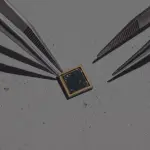
Dafei Jin of the University of Notre Dame is among 21 researchers receiving a $1.35 million grant over five years from the Gordon and Betty Moore Foundation’s Experimental Physics Investigators Initiative. Jin plans to trap single barium ions atop atomically thin solid helium, a novel approach to building a platform for long-distance quantum information exchange. He will manipulate these ions as the environment shifts between vacuum, superfluid helium and solid helium, optimizing quantum control and readout.
“I’m very excited about the opportunities this award offers,” said Jin, who also holds a concurrent appointment in the Notre Dame College of Engineering. “I can work on a high-risk, high-reward project that can open new directions in quantum physics and potentially transform quantum technologies.”
Moore Foundation Funds Jin’s Platform for Long-Distance Quantum Exchange
The Moore Foundation’s initiative provides each of this year’s 21 scientists with $1.35 million over five years, providing flexibility to accelerate physics research. This new platform is designed to encode quantum information in photons for transmission over distances exceeding hundreds of miles, a critical step toward scalable quantum networks. Electrons proved inadequate for long-range quantum communication, prompting a transition to ions as information carriers. The initiative’s emphasis on flexible, sustained support is intended to encourage innovation beyond the scope of typical federal grants, allowing researchers to pursue unconventional avenues of inquiry.
Theodore Hodapp, program director for the foundation’s initiative, explained that the foundation’s goal is to “accelerate progress at the frontier of experimental physics by giving brilliant mid-career scientists the kind of flexible, sustained support that federal grants rarely can.” This freedom, Hodapp added, “lets them take on risky, high-reward experiments and follow ideas when research results lead them down new pathways.” Jin also anticipates enhanced collaboration with other scientists supported by the Moore Foundation. “Second, I can exchange ideas and seek collaborations with leading scientists in the cohorts that the Moore Foundation has been establishing,” he stated. Catherine Mader, program officer for the Initiative, expressed enthusiasm for the potential impact of these awards, noting that “it is inspiring to witness the development of new scientific discoveries brought about by these awards.”
Second, I can exchange ideas and seek collaborations with leading scientists in the cohorts that the Moore Foundation has been establishing.


See today’s quantum computing news on Quantum Zeitgeist for the latest breakthroughs in qubits, hardware, algorithms, and industry deals.