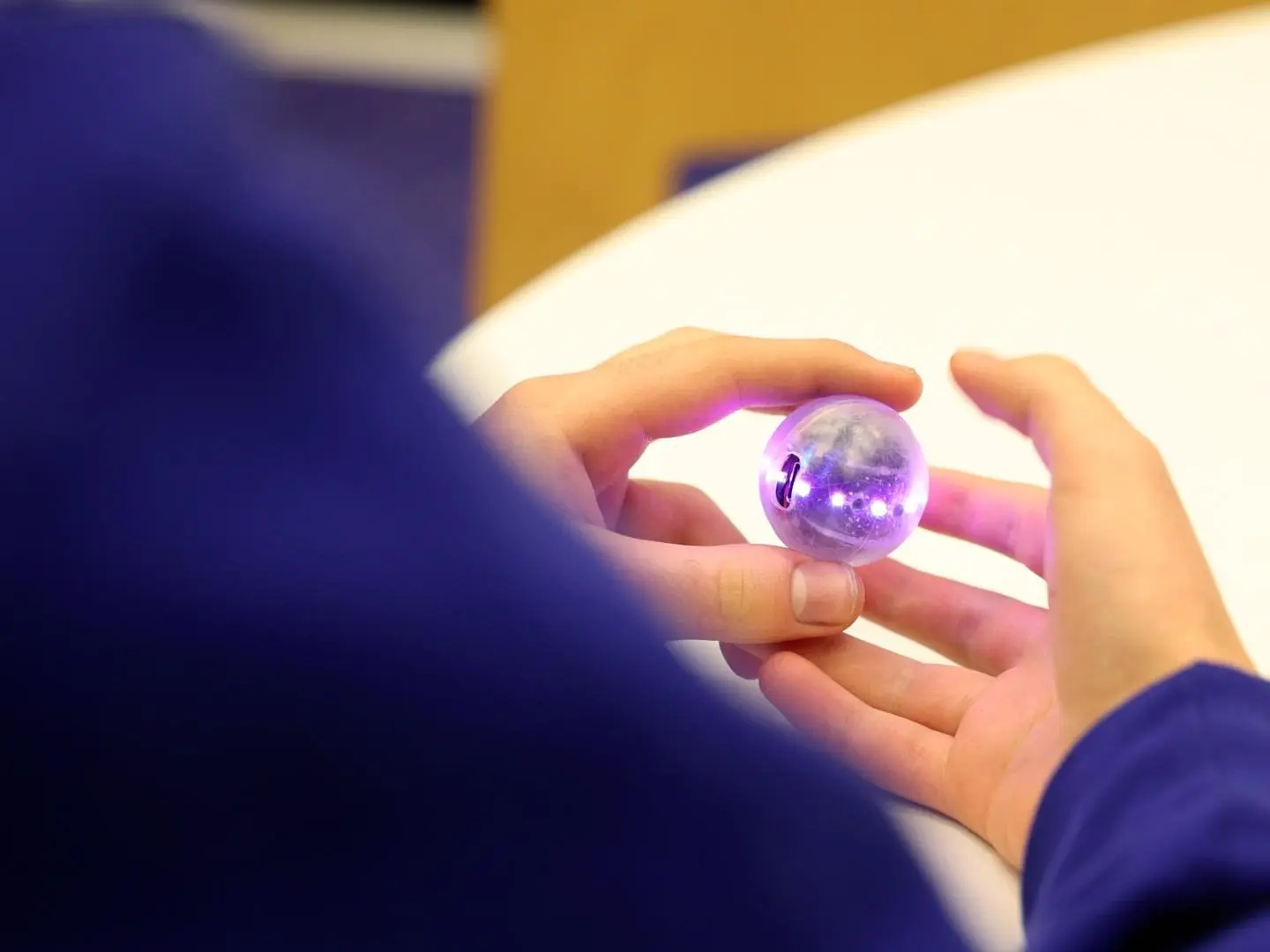
Stefan Krastanov of UMass Amherst and Carlos Errando Herranz of Delft University of Technology have co-created the Qbead, a “small luminous ball” designed to physically demonstrate quantum computing concepts at a scale accessible to students. Unlike standard binary bits, the Qbead simulates qubits, which can exist as 1, 0, or a combination of both, without requiring mastery of complex mathematics. The Qbead aims to bypass both years of study and the need for “costly multimillion-dollar experiments” by offering a hands-on learning tool.
Qbead Simulates Quantum Bits for Intuitive Learning
The Qbead uses an inertial measurement unit and Bluetooth connectivity to physically represent quantum states, allowing users to interact with simulated qubits without prerequisite coursework in advanced mathematics. This approach bypasses the need for extensive study in linear algebra, probability theory and quantum mechanics, subjects Stefan Krastanov of UMass Amherst acknowledges are “necessary to gain mastery over nature and create these technologies,” but which traditionally require significant time investment.
The device demonstrates concepts like quantum state teleportation at a scale designed for broad accessibility, even for younger learners. Built around a Seeed XIAO nRF52840 Sense Arduino board, the Qbead’s hardware facilitates a hands-on experience with quantum phenomena, offering a tangible alternative to abstract theoretical models.
Krastanov explains the Qbead “is meant to mimic the behavior of a quantum bit (a qubit) at a scale at which a kid can engage with it,” distinguishing it from the complex infrastructure typically associated with quantum computing research. The development of the Qbead is not solely focused on educational outreach; Krastanov emphasizes its connection to ongoing research at the NSF Center for Quantum Networks. “A lot of the research work we do builds upon the simpler concepts we teach through the Qbead,” he said, suggesting a bidirectional relationship where the toy informs and is informed by investigations.
The team envisions widespread use beyond formal educational settings, with plans to deploy the Qbead in museum installations, hands-on outreach activities and lectures in the classroom, whether in K-12 or graduate school. This broader application aims to democratize access to quantum computing concepts, removing barriers created by both the complexity of the subject matter and the expense of “costly multimillion-dollar experiments”.
The building blocks of computing machines, especially future machines like quantum computers, are frequently not particularly intuitive.
Stefan Krastanov, assistant professor in the Manning College of Information and Computer Sciences at UMass Amherst



See today’s quantum computing news on Quantum Zeitgeist for the latest breakthroughs in qubits, hardware, algorithms, and industry deals.