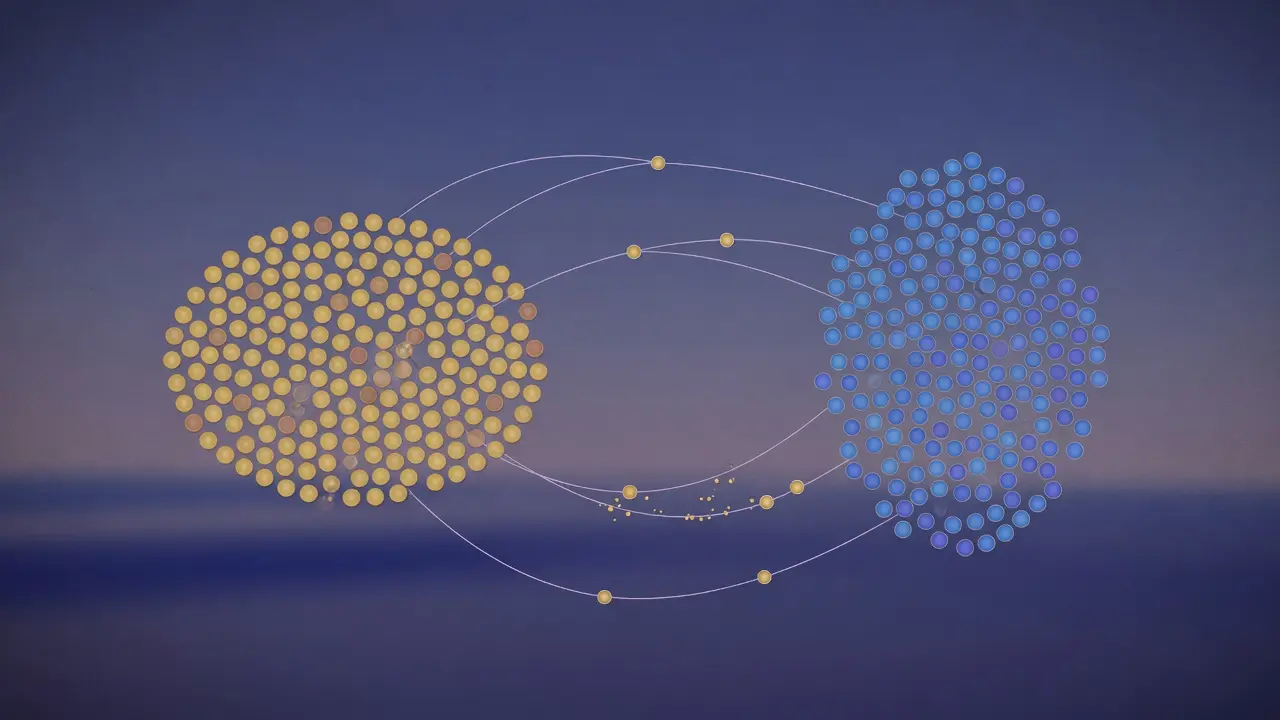
Researchers at the University of Edinburgh have detailed a new protocol to guarantee the quality of entanglement distributed through quantum repeaters, a vital step toward a functioning quantum internet. The work demonstrates that certifying a 1% misreport rate on 1,000,000 pairs of entangled particles requires testing between 10,000 and 170,000 pairs, a significant overhead for ensuring data integrity.
This “cut-and-choose” protocol certifies error above a pre-agreed minimum noise level, yielding a quality-of-service guarantee, though the researchers note the main cost is memory, requiring the simultaneous storage of 100,000 to 1,000,000 pairs, far beyond current quantum memory capabilities.
Entanglement Swapping Security: Threat Model and Limitations
The work reveals that a node intentionally misreporting its measurement outcome introduces a security vulnerability not present with standard quantum noise, fundamentally altering the expected behavior of entanglement swapping. Unlike scenarios where a relay simply introduces random errors, a dishonest node exerting influence over the delivered quantum state poses a unique threat to secure communication. Researchers found that simply adding “honest noise” to the system does not resolve this vulnerability unless a defined fraction of potentially misreported pairs are acknowledged as flawed, establishing a trade-off between accuracy and practical usability.
This limitation stems from the inability to distinguish between a misreport and inherent readout noise, meaning any certification protocol must accept a minimum error level. The team’s proposed “cut-and-choose” protocol addresses this by randomly testing a subset of entangled pairs to certify the remaining, untested pairs, offering a quality-of-service guarantee.
A failure during testing confirms the node did not deliver the agreed-upon entanglement quality. Implementing this protocol currently requires holding between 100,000 and 1,000,000 entangled pairs in quantum memory simultaneously, a capacity exceeding the capabilities of current technology. This memory demand arises because certifying a 1% misreport rate necessitates retaining a significant number of pairs for testing, highlighting a major practical obstacle for long-distance quantum communication.
The protocol’s finite-size guarantee ensures that the untested pairs remain available for use, even after certification, unlike verification schemes that destroy the state during the process. The study’s threat model focuses on intermediate nodes within a quantum network that perform quantum operations correctly but may intentionally misreport classical outcomes to end users. This scenario reflects the architecture of many planned quantum networks, where users supply the qubits and relays perform measurements. The researchers write that their findings are relevant to real-world implementations.
The team’s approach differs from device independence, which assumes untrusted quantum devices but trusts the classical software controlling them, instead focusing on a more detailed threat model. The researchers demonstrate that the ideal functionality of entanglement swapping cannot be fully realized when an adversary can influence the reported outcomes, as it introduces a level of control not present with purely random noise.
This finding highlights the importance of robust certification protocols to ensure the security and reliability of quantum communication networks. The work proposes a pathway to establish trust in untrusted intermediaries, providing a foundation for building a secure quantum internet.
Cut-and-Choose Protocol for Certifying Entangled Pairs
The work addresses a critical vulnerability in quantum networks where intermediate nodes, while performing operations correctly, could falsely report outcomes to end users. This potential for misreporting undermines the security and usability of entanglement swapping, a process essential for extending quantum communication distances. The researchers demonstrate that achieving ideal entanglement swapping functionality is impossible when an intermediary can influence the delivered quantum state by manipulating classical reports.
This highlights a fundamental trade-off between the accuracy of the entanglement and the number of usable pairs available for quantum applications. Since no test can distinguish a misreport from readout noise, the protocol certifies the error above a pre-agreed minimum noise level, which is the misreport rate under their threat model.
The memory demands of this certification process, however, currently exceed the capabilities of existing quantum technology. The study states that “the main cost is memory,” and that “1% requires holding 100,000 to 1,000,000 pairs at once, far beyond the capacity of today’s quantum memories.” A 10,000-qubit memory can certify 14% of 470,000 delivered pairs, but at the cost of a weaker certification rate.
The research focuses on a specific threat model involving intermediate nodes performing quantum operations faithfully but potentially misreporting classical outcomes. The team’s findings suggest that even with faithful quantum operations, the integrity of the delivered entangled state is not guaranteed without robust certification protocols.
👉 More information
🗞 When lies look like noise: certifying untrusted entanglement swapping
✍️ Maria Gragera Garces, Chris Heunen and Mahesh K. Marina (University of Edinburgh, Edinburgh, United Kingdom)
🧠 ArXiv: https://arxiv.org/abs/2611.26436v1



See today’s quantum computing news on Quantum Zeitgeist for the latest breakthroughs in qubits, hardware, algorithms, and industry deals.