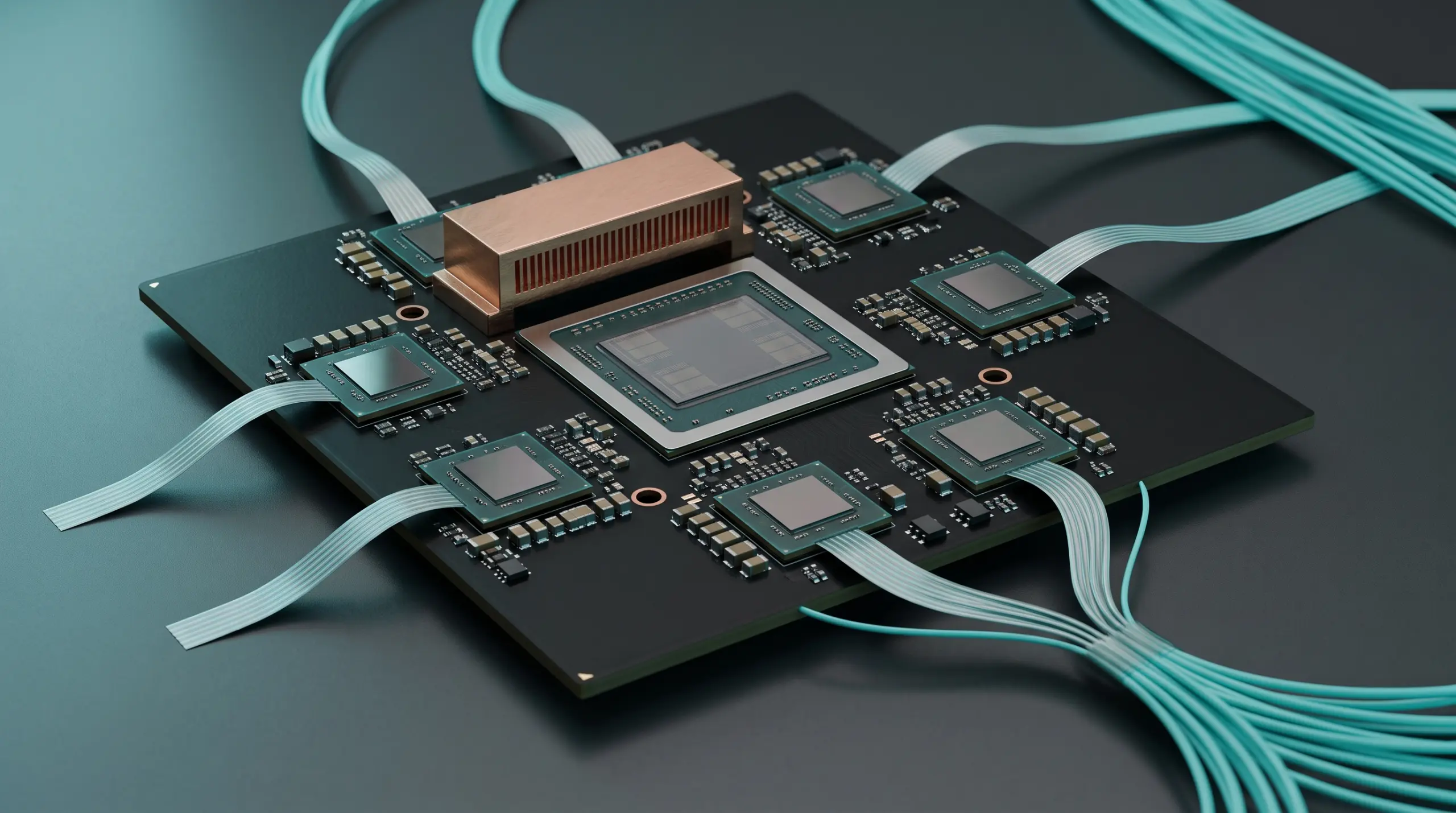
This approach moves signal processing onto the chip itself, rather than relying on external amplifiers and bulky isolators that introduce hardware overhead and noise. The resulting platform allows frequency-multiplexed resonators to interact through engineered couplings, creating a tunable architecture capable of manipulating quantum readout data in situ. The work shows enhanced fidelity and suppression of measurement-induced decoherence, establishing the hybridized SNAIL as a promising component for future quantum processors.
Embedded SNAIL Amplifier for High-Fidelity Quantum Readout
Conventional dispersive readout architectures traditionally rely on external amplifiers, introducing hardware overhead and limiting on-chip processing capabilities. Frequency-multiplexed resonators, essential for addressing multiple qubits, can now interact through engineered couplings, a feature enabled by the SNAIL’s unique properties. This interaction allows for the creation of a system where readout information is processed directly on the chip, reducing latency and complexity. The ability to couple multiple resonators to a single embedded SNAIL amplifier addresses a central challenge in quantum-state readout as the number of qubits per chip increases.
This is a departure from conventional dispersive readout, which exhibits a narrow high-fidelity region dependent on a delicate balance between signal integration time and qubit decay. The work shows that the embedded SNAIL platform is a viable path toward simplifying hardware complexity in quantum computing.
Conventional Dispersive Readout Limitations & Hardware Overhead
Conventional dispersive readout architectures face inherent limitations stemming from reliance on off-chip components, specifically bulky isolators and external amplifiers, which contribute significantly to hardware overhead and restrict on-chip signal processing capabilities. These components not only consume valuable cryogenic volume but also introduce thermal load and flux noise near sensitive qubit structures, impacting performance. The conventional approach infers qubit state from frequency shifts in a microwave resonator, a technique widely adopted but increasingly constrained by these physical limitations as systems scale.
This is a departure from simply linking equivalent quantum modules; the SNAIL functions as an active interface between the high-quality readout mode and the lossy output, allowing for dense integration and directional gain without the need for external isolators. Theoretical modeling and numerical optimization reveal that the embedded SNAIL platform not only enhances fidelity but also actively suppresses measurement-induced decoherence, a critical factor in maintaining qubit coherence during readout.
The system’s transient response is engineered through discrete pulse sequences, selectively activating specific interaction terms for fixed durations, a technique that contrasts sharply with the steady-state operation enforced by continuous-wave drives in conventional dispersive readout. The results establish the hybridized SNAIL as a promising building block for scalable and coherent quantum-state readout in processors, offering a path toward simplifying hardware complexity and improving overall system performance.
SNAIL Architecture: On-Chip Integration of Readout Functions
This integration enables coherent and directional processing of readout signals on-chip, sidestepping the hardware overhead of discrete components and allowing for dense integration without signal loss. The design uses a protocol, temporally separating information accumulation from signal extraction to improve efficiency. This approach enables selective addressing of individual qubits through distinct frequency-conversion processes into the SNAIL, allowing for sequential multi-qubit readout through a common output channel.
This reduces the hardware footprint while maintaining coherent on-chip processing, though the number of parametric interactions grows quadratically with the number of coupled modes, a factor considered in the system’s design. While the system can support parallel frequency-multiplexed readout, the current focus is on the sequential protocol, which avoids the crosstalk and frequency shifts that complicate readout and gate operations.
The embedded SNAIL architecture redefines the readout stage as an active, programmable layer within the quantum device, capable of manipulating information before it leaves the cryogenic environment. This allows for noiseless amplification of the signal at the source, a critical step in enhancing quantum efficiency. The platform’s design permits dynamic control over signal flow, amplification and noise shaping, establishing a foundation for future scalable quantum processors.
“Catch-Process-Release” Protocol for Readout Signal Processing
By temporally separating information gathering from signal extraction, a new readout architecture maximizes fidelity and minimizes hardware demands within superconducting quantum processors. This protocol, enabled by embedding a Superconducting Nonlinear Asymmetric Inductive eLement (SNAIL) amplifier directly onto the processor chip, fundamentally alters how readout signals are handled. The system’s design allows for the construction of readout sequences resembling compiled unitary gates, manipulating the signal before it encounters lossy transmission lines.
This manipulation includes directional amplification, selective noise shaping and programmable conversion of the readout signal. The embedded SNAIL achieves this performance through a weak hybridization that enables tunable, pulsed frequency-multiplexed parametric interactions, permitting unitary manipulation of the readout field with minimal loss.
The researchers define a vector of quadrature operators to describe the system’s dynamics, demonstrating that the evolution of mean quadrature amplitudes and the covariance matrix fully characterize the process. The platform’s architecture is described as transforming the readout chain from a passive signal extractor to an active information-processing layer integrated directly into the quantum hardware. This integration mediates interactions and enables a new level of control over the readout process itself.
Theoretical Modeling of the Hybridized SNAIL Platform
Numerical optimization revealed the platform’s ability to suppress measurement-induced decoherence, a critical obstacle to scaling quantum systems, by enabling coherent and directional processing of signals directly on the chip. The architecture uses a nonlinear Superconducting Nonlinear Asymmetric Inductive eLement (SNAIL) coupled to both a readout resonator and a fast output resonator, allowing for frequency-multiplexed interactions and efficient amplification even with modest pump strengths.
The theoretical framework employed a Hamiltonian system and Lie perturbation theory to analyze the system’s dynamics, demonstrating that the SNAIL’s nonlinearity facilitates interactions between resonators. The model considered representative parameters: a readout resonator at 6.0 GHz with a 0.1 MHz decay rate, a SNAIL at 4.0 GHz with a 1.0 MHz decay rate, and an output resonator at 7.5 GHz with a 20.0 MHz decay rate, assuming a dispersive shift around 3 MHz.
This detailed parameterization allows for benchmarking the theoretical model against potential experimental realizations. The platform’s potential extends beyond simple amplification; nonlinear interactions inherently couple resonator modes, opening avenues for more sophisticated on-chip information processing. These interactions could support multi-state discrimination, dynamic noise suppression and adaptive measurement strategies tailored to fluctuating quantum environments. The architecture offers a route to mitigating crosstalk, supporting entangled-state discrimination, and implementing error-aware or feedback-enhanced protocols.
Robustness and scalability remain key considerations for practical implementation, with potential challenges arising from parameter drifts, residual nonlinearities and inter-resonator crosstalk. As the architecture expands to accommodate multiple qubits, constraints related to frequency crowding, control complexity, and calibration overhead will become increasingly relevant. While a full characterization of these effects requires detailed experimental analysis, the theoretical work highlights important tradeoffs and considerations for scaling the platform.
The researchers acknowledge that the system’s performance will delicately depend on experimental details, but the theoretical foundation provides a strong starting point for future development and optimization. The model’s predictions suggest a significant advancement in quantum readout technology, offering a path toward compact, coherent and programmable quantum processors.
By processing the readout signal directly on the quantum chip, a new architecture maximizes fidelity and simplifies hardware requirements, moving beyond limitations of conventional dispersive readout.
👉 More information
🗞 High-fidelity quantum readout processing via an embedded SNAIL amplifier
✍️ Leon Bello, Boris Mesits, Michael Hatridge and Hakan E. Türeci
🧠 DOI: http://link.aps.org/doi/10.1103/nq9c-ftrm




See today’s quantum computing news on Quantum Zeitgeist for the latest breakthroughs in qubits, hardware, algorithms, and industry deals.