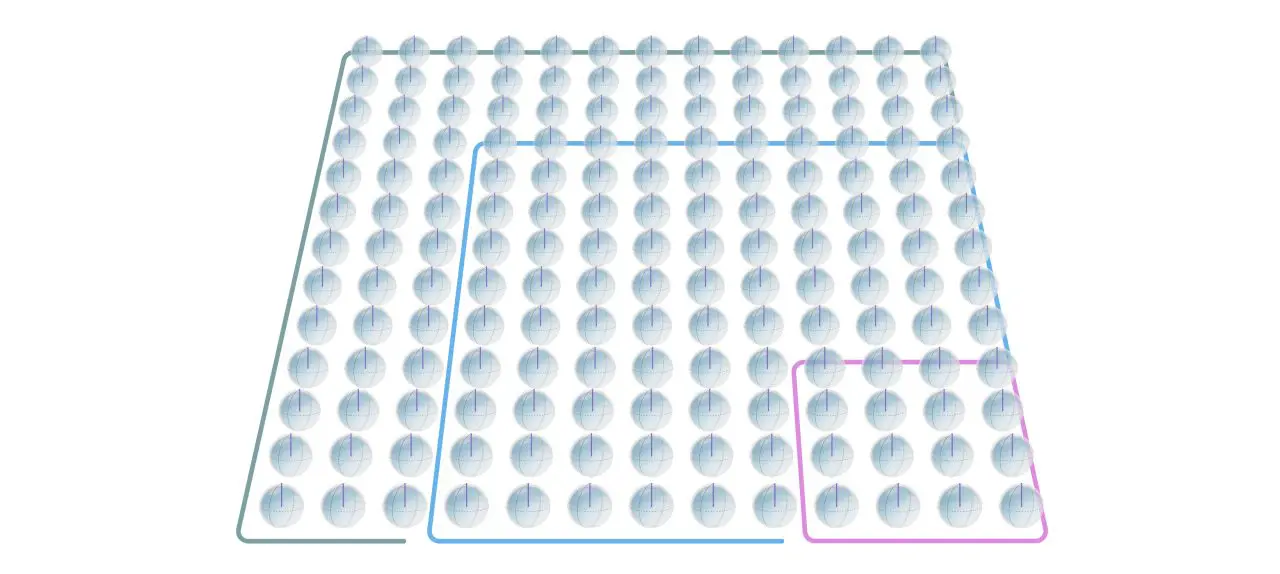
Microsoft Quantum researchers are introducing the definition of scalable logical qubits, essential for quantum computers to move beyond limited demonstrations and tackle complex real-world problems, the company says. Utility-scale computing demands executing long algorithms with error rates physical qubits cannot sustain, necessitating error correction and the creation of logical qubits, preserved through repeated correction and capable of universal operations.
“Logical qubits are needed to achieve this goal,” say Matthias Troyer, Chetan Nayak, and John Martinis, outlining a need for hundreds or thousands of replicable logical qubits for applications like materials science and cryptanalysis. The team characterizes these qubits along dimensions of reliability, scale, capability, and performance, with a focus on low-latency real-time decoding and feedback.
Scalable Logical Qubits Defined for Utility-Scale Computing
Defining a scalable logical qubit requires introducing a definition to make progress measurable and comparable, a benchmark Microsoft Quantum researchers have now formalized alongside dimensions for assessing progress toward utility-scale quantum computing. Beyond simply creating a logical qubit, the team, including Dr. Matthias Troyer, Dr. Chetan Nayak, and Dr. John Martinis, has outlined characteristics necessary for qubits preserved through repeated error correction cycles, capable of universal operations with minimal delay, and replicable to the scale of hundreds or thousands as applications demand.
This focus on replicability moves beyond proof-of-concept demonstrations toward the engineering challenges of building a functional quantum computer. The researchers characterize these scalable logical qubits along four coupled dimensions, reliability, scale, capability, and performance, recognizing that improvements in one area may necessitate trade-offs in others.
Capability, they explain, extends beyond basic state preparation and measurement to encompass memory, Clifford operations, universal gate sets, and measurement-conditioned control flow, all operating under repeated error correction with fault-tolerant implementations and classical processing fast enough to maintain a feedback loop. This level of functionality raises the bar beyond the criteria established for physical qubits, demanding primitives that function reliably even while actively correcting errors. Microsoft Quantum’s approach, using topological qubits via Majorana zero modes, aims to fundamentally lower error rates compared to conventional qubit technologies, though demonstrated error-corrected computation remains a key milestone.
The need for a more precise definition stems from the broad range of demonstrations currently labeled as such, often lacking clear alignment with the requirements of running long, valuable algorithms, according to the company. “Demonstration of logical qubits and repeated error correction with better-than-physical error rates,” is a critical step, but insufficient on its own to signal progress toward utility-scale computing, according to the team.
Assessing progress requires evaluating not just how many logical qubits have been realized, but also how their number can be increased while maintaining acceptable error rates, and what control architecture is needed to support the scale and quality required for real-world applications, the company says. Microsoft’s internal funding supports this long-term research, and partnerships with Atom Computing and QuNorth on the Magne project aim to deliver a quantum computer with 50 logical qubits and over 1,200 physical qubits by late 2026.
The team’s framework emphasizes assessing progress along the envelope of these four dimensions, reliability, scale, capability, and performance, rather than focusing solely on individual numbers. This approach allows for a more nuanced understanding of advances made in one or multiple areas, and helps identify where further improvements are needed.
For example, while increasing the number of physical qubits used to encode a logical qubit can improve reliability, it also impacts scalability and performance. “Disentangling Hype from Practicality: On Realistically Achieving Quantum Advantage,” is a central theme, and the researchers believe a common language for assessing progress is essential for guiding the field toward its ultimate goal.
Low-latency real-time decoding and feedback is defined as a critical characteristic of scalable logical qubits, alongside reliability, scale, and capability, highlighting that the speed of error correction is as important as its accuracy. This is particularly important for measurement-conditioned control flow, where program execution branches based on measurement outcomes, demanding rapid classical processing to stay within the quantum feedback loop.
The team also points to the need for “Hardware-efficient quantum error correction via concatenated bosonic qubits,” as a potential pathway toward achieving these performance goals. The definition of scalable logical qubits, they argue, provides a goal-oriented framework for tracking progress and clearly identifying the next steps needed to enable practical applications of quantum computing.
What are the logical error rates? Are they better than physical, and how can they be further decreased by increasing the number of physical qubits used for the logical qubit?
Four Dimensions of Scalable Logical Qubit Characterization
A scalable logical qubit must achieve logical error rates better than those of its underlying physical counterparts under repeated error correction, according to a new framework proposed by researchers, and must demonstrate a clear path to improvement as resources increase. This definition moves beyond simply demonstrating a logical qubit to establishing measurable criteria for progress toward utility-scale quantum computing, where long, complex algorithms demand error rates current physical qubits cannot sustain. Capability, the least intuitively obvious dimension, requires logical qubits to move beyond basic storage and measurement to support universal computation with measurement-conditioned branching, enabling program execution to alter course based on quantum results.
Framing capability explicitly helps determine where a logical-qubit demonstration sits on the path to an architecture capable of supporting arbitrary algorithms as systems scale, and is crucial for applications requiring dynamic control flow. “State preparation and measurement: prepare logical qubits in specified initial states and measure them with well-characterized error models,” is a necessary foundation for this capability, alongside the ability to store quantum information for extended durations.
Progress toward scalable logical qubits is fundamentally shaped by trade-offs between fidelity, qubit count, cycle time, compilation overhead, and decoding latency, meaning a single headline number, such as a specific error rate, offers limited insight without understanding the operating conditions. While speed is currently a key performance metric, the ultimate goal is cost-effective reliability, and these metrics are tightly coupled; improving one often impacts the others.
This collaborative effort reflects a broader industry trend toward hybrid approaches, using the strengths of different qubit modalities to accelerate progress. “Demonstration of a Logical Architecture Uniting Motion and In-Place Entanglement,” exemplifies the ongoing exploration of novel architectures.
The researchers state a scalable logical qubit should require no more than O(Nlogϵ-1) physical qubits to realize N logical qubits with a logical error rate of ϵ, offering a quantifiable target for resource optimization. “Improved quantum processor logical error rates via correction and detection,” is a key focus, alongside the development of architectures supporting “Universal quantum computation with ideal Clifford gates and noisy ancillas.” This goal-oriented definition of a scalable logical qubit provides a practical way to connect current demonstration milestones to the requirements of utility-scale applications, and the framework is intended to foster a common language for evaluating different approaches.
Quantum Error Correction & The Threshold Theorem
Scalable logical qubits, preserved for extended computations through repeated quantum error correction, are now defined by a set of characteristics beyond simply demonstrating their existence. Microsoft Quantum researchers are introducing a definition of these qubits to make progress measurable and comparable, characterizing them by reliability, scale, capability, and performance, acknowledging that applications like simulating quantum systems and materials demand hundreds, even thousands, of replicable logical qubits, the company states.
This focus moves the field past theoretical possibility toward concrete engineering targets for utility-scale quantum computing. The threshold theorem, initially proven by Peter Shor in 1996, established that quantum errors could be suppressed to arbitrarily low levels through redundancy, forming the basis for quantum error correction (QEC). This principle, akin to classical error correction, encodes information across multiple physical qubits to create a single, more robust logical qubit.
Recent advancements, described as a “Cambrian explosion” of new code developments, particularly around quantum low-density parity-check (QLDPC) codes, combined with rapid hardware progress, are now bringing utility-scale quantum computing within reach. “Fault-tolerant quantum computation with a neutral-atom processor,” researchers report, is a key step in this progression. While increasing physical qubit fidelity remains foundational, it is not the sole path to scalable error correction. Selective error detection with post-selection and error-mitigation techniques applied at the logical level can reduce overheads alongside QEC.
This framework, detailed in publications like “Assessing requirements to scale to practical quantum advantage,” allows for meaningful comparison of different error correction schemes. The scalable logical qubits that will enable utility-scale quantum computing, as the researchers state, are not merely a theoretical construct, but a tangible goal driving the field forward.
A scalable logical qubit is a logical qubit with a path to meet the requirements for utility scale.
Resource Requirements for Utility: Qubit Count and Error Rates
Achieving utility-scale quantum computation demands more than simply building larger quantum processors; it necessitates a shift in how qubit performance is measured and reported, according to new criteria outlined by Microsoft Quantum researchers. While demonstrations of quantum error correction are increasing, a clear definition of what constitutes a truly scalable logical qubit remains elusive, hindering comparisons between different platforms and obscuring progress toward practical applications.
The team proposes a goal-oriented definition, framing a scalable logical qubit as one with a defined path to meet the resource demands of complex algorithms. The requirements for these scalable logical qubits are substantial.
Applications aiming to simulate quantum systems, materials, or chemical reactions will require hundreds, potentially thousands, of high-quality qubits sustained through circuits involving billions of operations, all while maintaining error rates low enough to ensure reliable results without excessive repetition. Microsoft Quantum anticipates the “low end” of utility beginning around 100+ qubits with error rates on the order of 10-10, while more demanding applications, such as large-scale cryptography, will necessitate exceeding 1000 qubits with error rates of 10-15 or better. Reliability, in this context, means achieving logical error rates that not only surpass those of physical qubits but also demonstrate a clear trajectory toward the 10-12 to 10-15 range needed for targeted applications.
However, qubit count and runtime present inherent tradeoffs. “With a fixed physical-qubit budget, one can allocate resources toward more logical qubits with modest improvements, or fewer logical qubits with substantially lower logical error rates,” the researchers explain. A platform’s ability to balance these factors will be critical for scalability. Simply reporting a logical qubit count or error rate in isolation provides an incomplete picture. Instead, a comprehensive evaluation of how these factors evolve as more physical qubits are devoted to the logical qubit is essential.
Improving physical-qubit fidelity remains foundational, as lower physical error rates increase the margin to threshold, reduce the code distance required for a given logical error rate, and can decrease both space and time overhead. The company’s strategic partnership with Atom Computing, demonstrated through the co-demonstration of 24 entangled logical qubits, exemplifies this collaborative approach, the company’s account states.
The team’s definition requires a scalable logical qubit to support a universal set of fault-tolerant logical operations, enabling measurement-conditioned control flow, through low-latency real-time error correction, and to be an instance of a code family with predictable error rate reduction as physical qubit count increases. “Surface Codes: Towards Practical Large-Scale Quantum Computation,” they add, is a key area of focus.
With a fixed physical-qubit budget, one can allocate resources toward more logical qubits with modest improvements, or fewer logical qubits with substantially lower logical error rates.
QLDPC Codes and Progress Towards Fault-Tolerant Operations
The definition of a scalable logical qubit now hinges on more than just error correction; it requires a demonstrable path to operating hundreds or thousands of such qubits simultaneously. Scale, in this context, isn’t merely about increasing qubit count, but about maintaining logical fidelity and acceptable operation latencies as the system expands, the researchers explain. Adding more logical qubits should not degrade functionality or introduce correlated errors that undermine the benefits of error correction.
“There is no single path to these logical qubits; credible approaches must advance along all of these axes,” the researchers state, emphasizing the need for a multi-faceted strategy. Capability demands universal, fault-tolerant operations with low-latency real-time decoding and feedback, enabling arbitrary programs and control flow.
This speed of operation is critical, as fast logical cycles and efficient gate synthesis are essential to keeping wall-clock runtime and cost practical at scale. The team highlights the importance of considering end-to-end latency, not just the duration of a single error-correction cycle, when evaluating performance. This focus on speed distinguishes the current approach from earlier work that primarily emphasized error reduction. Microsoft’s internal work, informed by its pursuit of topological qubits via Majorana zero modes, is exploring architectures that address these challenges, Microsoft Quantum claims.
The introduction of the QUOPS metric represents a step towards benchmarking logical qubits, but the researchers argue that a more comprehensive definition is needed to accurately assess progress. The team draws on foundational work in quantum error correction, citing early code families like CSS codes and the surface code, as well as contributions from researchers like Shor, Steane, and Kitaev.
References to “Multiple-Particle Interference and Quantum Error Correction,” and “Fault-Tolerant Quantum Computation by Anyons,” demonstrate the lineage of this research. However, they emphasize that progress requires moving beyond theoretical foundations to address the practical challenges of building and scaling a fault-tolerant quantum computer. “Accuracy threshold for postselected quantum computation,” and “Quantum Computations: Algorithms and Error Correction,” are also cited as key areas of ongoing exploration. Recently, there has been a “Cambrian explosion” of new code developments around QLDPC codes.
logical qubit is used today for a wide range of demonstrations that incorporate some elements of quantum error correction, and those definitions are often confusing or not clearly aligned with what is ultimately needed to run long, valuable algorithms.
A scalable logical qubit should not require more than0(Nlogϵ-1) physical qubits to realizeNlogical qubits with logical error rateϵ.




See today’s quantum computing news on Quantum Zeitgeist for the latest breakthroughs in qubits, hardware, algorithms, and industry deals.