Physicists at the University of Oxford have contributed to a confirmation that quantum entanglement, Albert Einstein’s “spooky action at a distance”, persists even within the fleeting existence of some of the most massive particles created by science. Using the Large Hadron Collider at CERN, an international collaboration detected entanglement in pairs of Z bosons, particles that vanish in a fraction of a second after being produced by collisions of thirteen trillion electron volts.
This demonstration extends entanglement to energies far beyond previous tests, and as Professor Alan Barr commented, “We’re used to thinking of entanglement as something delicate, seen in laboratory experiments with single photons.” The finding published in Physical Review Letters on September 11, 2026 has implications for technologies that use entanglement, including quantum computing and secure communication networks.
Higgs Boson Decay Reveals Z-Boson Entanglement
The ZH → μμcc process, observed in event displays at CERN, marks a detection of entanglement involving Z bosons decaying into two muons alongside a Higgs boson decaying into two charm quarks, extending entanglement to the highest energies yet probed. Researchers reconstructed the angles of emitted electrons and muons following Z boson decay to infer the original bosons’ spins and verify quantum linkage, a feat demanding precise tracking within the ATLAS detector.
These Z bosons, existing for only a fraction of a second, originate from Higgs boson decay created by colliding protons at 99.99% the speed of light, generating collision energies of thirteen trillion electron volts. This demonstration builds on CERN’s growing investment in quantum technologies, exemplified by the Quantum Technology Initiative launched in 2020, which explores how quantum computing can accelerate particle physics data analysis and simulation.
CERN actively partners with companies like IBM Quantum and Google Quantum AI, deploying IBM quantum computers for LHC data analysis and participating in quantum simulation programs through Amazon Braket and the IBM Quantum Network, a collaboration supported by over 17,000 scientists and engineers from 113 countries. The recent award to a UChicago team for an AI filter at CERN’s collider, as reported on September 8, highlights the connection between advanced computing and particle physics research.
“This measurement demonstrates the scientific power of the ATLAS collaboration and the unique capabilities of CERN’s Large Hadron Collider,” said Professor Daniela Bortoletto, the UK coordinator for producing modules for the upgraded ATLAS detector’s pixel system. The ability to observe entanglement with comparatively massive particles like Z and Higgs bosons differentiates this work from prior experiments focused on single photons, which are far lighter and easier to manipulate.
Published in Physical Review Letters on September 11, 2026, the findings not only confirm a fundamental aspect of quantum mechanics but also open avenues for technologies that use entanglement, including quantum computers capable of manipulating multiple qubits simultaneously, and ultra-secure communication networks.
ATLAS Detector Tracks Particle Spins at Thirteen TeV
The ATLAS experiment detected quantum entanglement within the decay products of Higgs bosons, specifically observing the ZH → μμcc process, a decay chain yielding two muons and two charm quarks. This observation extends entanglement studies beyond photons and lighter particles, probing its persistence at energies previously unexplored and confirming its presence in systems with complex decay pathways. This confirmation builds on earlier work at CERN, which demonstrated entanglement between pairs of top quarks, the heaviest known elementary particles.
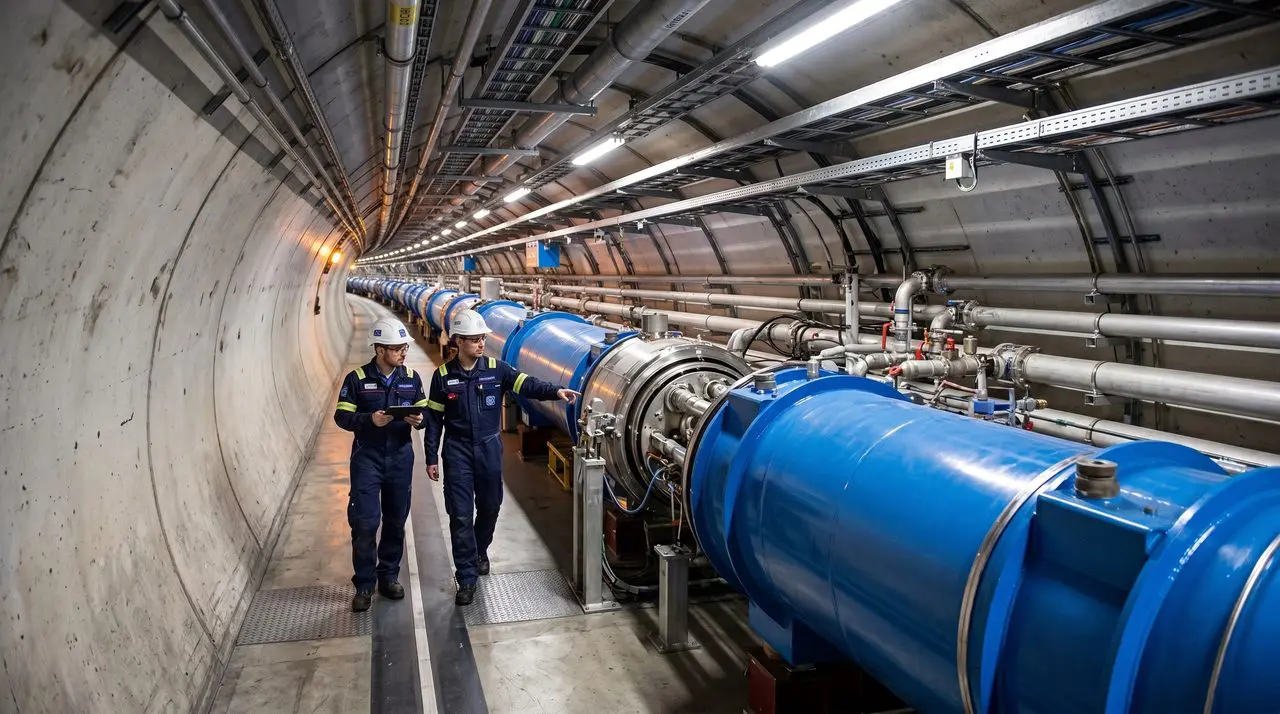
CERN’s Quantum Technology Initiative applies quantum computing to LHC data analysis, using superconducting magnet expertise developed for the collider to advance qubit development. The upgraded ATLAS detector, incorporating modules developed by researchers at the University of Oxford, helped precisely track the decay products of the Z bosons. These collaborations, alongside recent reports of the UChicago team winning an award for their AI filter for collider data, signal a growing convergence between high-energy physics and quantum information science, potentially unlocking new avenues for data processing and analysis.
Oxford Physicists Confirm Entanglement at Extreme Energies
Measurements of Z-boson pair entanglement within Higgs boson decays at the ATLAS experiment confirm the phenomenon extends to comparatively massive particles, a finding published September 11, 2026 in Physical Review Letters. This builds on earlier work, demonstrating quantum links persist at energies far beyond those previously tested, and offers insight into the fundamental nature of reality.
Professor Alan Barr, co-leading a project exploring quantum mechanics at high energies at Oxford University, noted it’s a reminder that the rules governing quantum computers also operate throughout nature, even within the extreme energies of the Large Hadron Collider. The ATLAS detector precisely tracked the electrons and muons left behind by the decaying Z bosons, allowing for the spin reconstruction necessary to verify the quantum link.
Beyond empirical testing, Barr’s project investigates the philosophical implications of these measurements, probing what they reveal about the fundamental nature of reality. The organization, founded in 1954 and headquartered in Geneva, Switzerland, also transfers superconducting magnet expertise to qubit development, participating in the EU Quantum Flagship.


See today’s quantum computing news on Quantum Zeitgeist for the latest breakthroughs in qubits, hardware, algorithms, and industry deals.