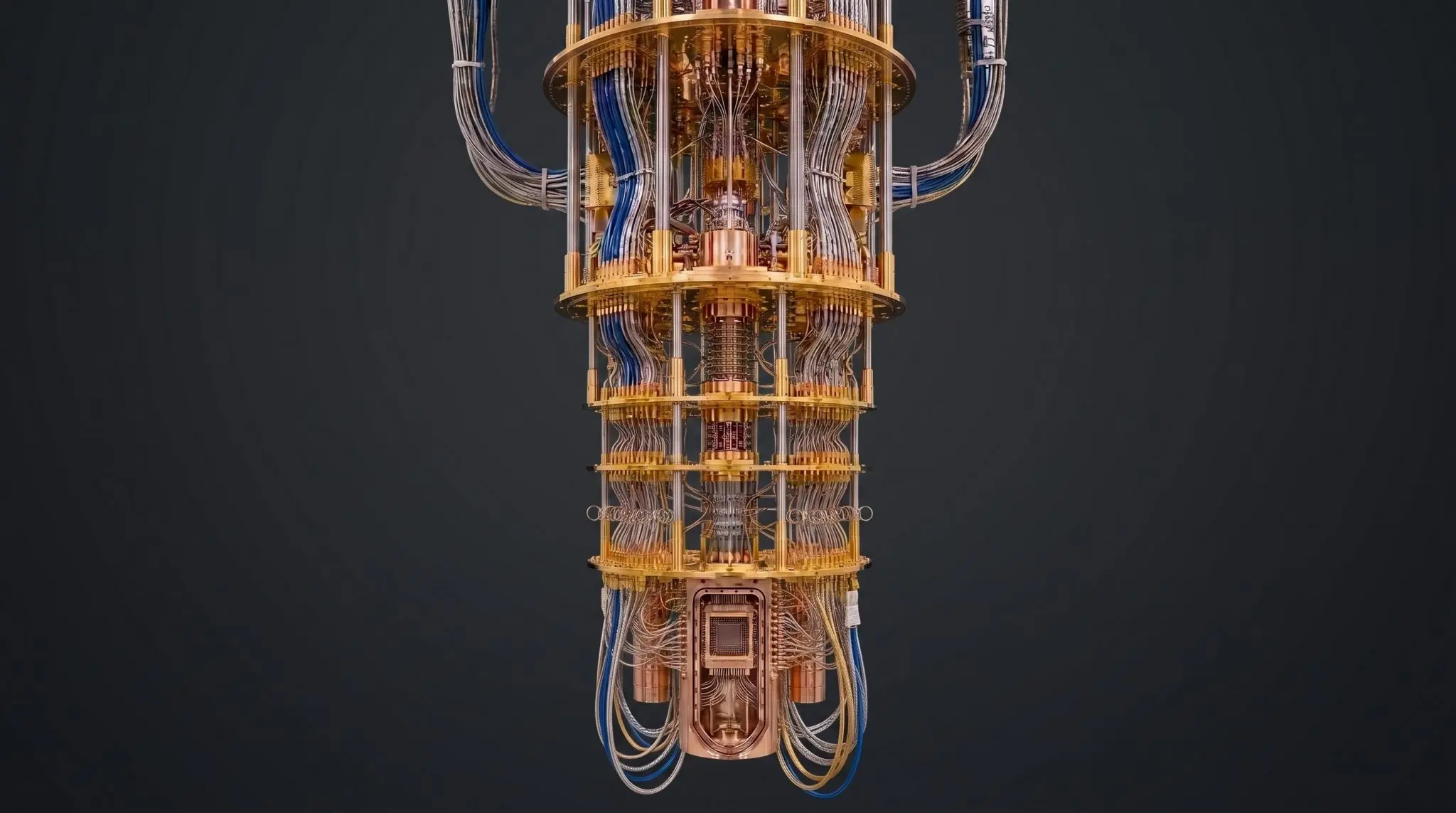
A superconducting circuit is usually designed twice. It begins as a target quantum functionality, often expressed through a lumped-element circuit and its Hamiltonian. This model specifies the energy levels, interactions and control processes the device should realize. Researchers then translate it into a physical microwave structure of metal pads, cavities, Josephson junctions, drive lines and packaging in two or three dimensions.
The translation remains more manual than it should be. For the static problem, tools such as black-box quantization and energy-participation-ratio analysis can extract mode frequencies and nonlinear couplings from electromagnetic simulations. External microwave drive makes the problem harder: a tone at a physical port propagates through the package, excites electric and magnetic fields, and produces charge modulation, flux modulation or both. The same port also carries thermal fluctuations and electronic noise into the circuit, while providing a channel for energy to dissipate.
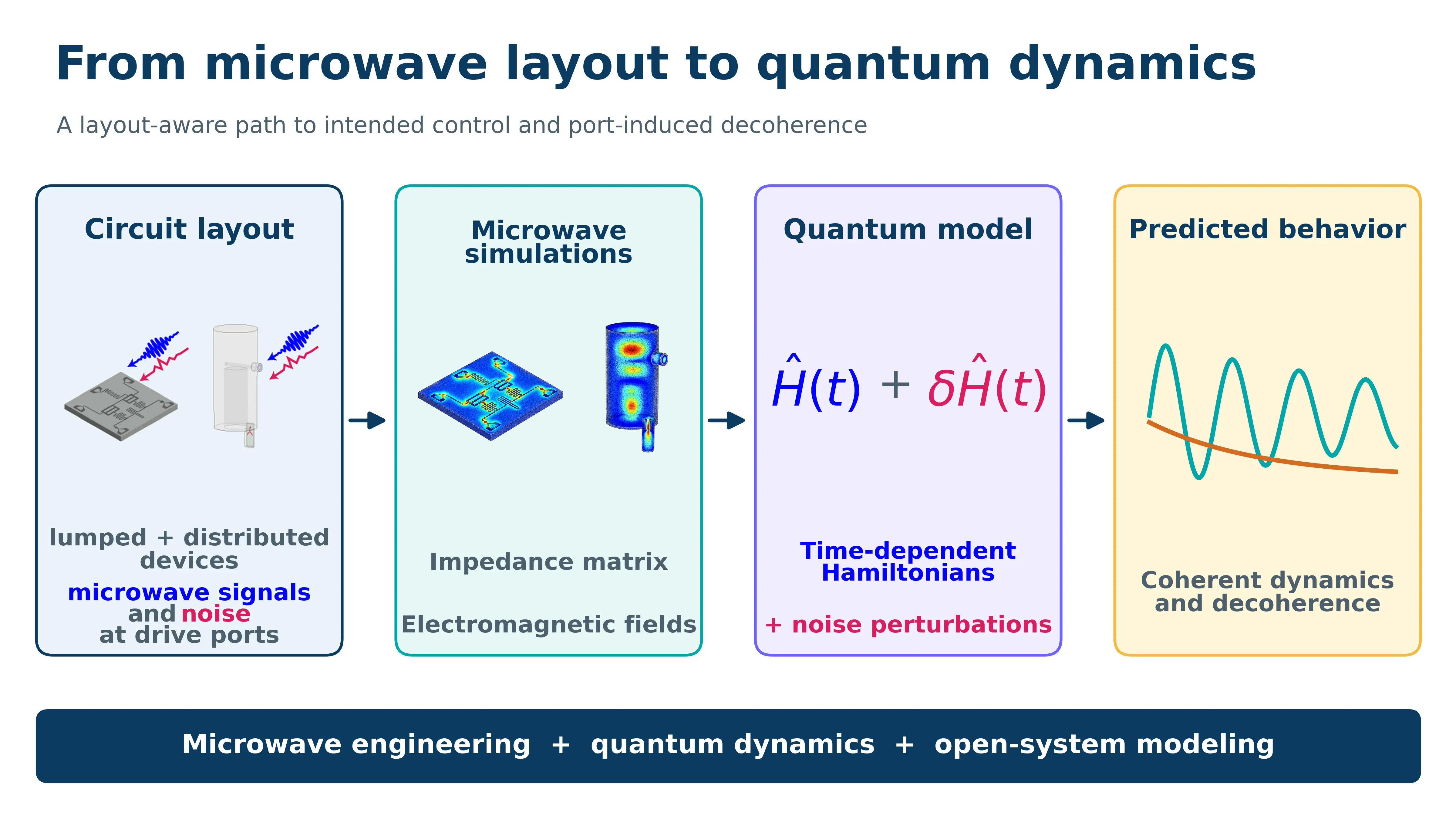
In work published in PRX Quantum, our team developed a systematic, layout-aware route from standard microwave simulations to the time-dependent Hamiltonian and port-induced decoherence of a driven Josephson circuit. The framework keeps circuit intuition central while tying the quantum model directly to the device that will be fabricated and measured.
Microwave drives are everywhere in superconducting quantum systems, preparing states, implementing control operations, activating interactions and enabling measurement. In theory, each drive is often represented by a compact Hamiltonian term calibrated from experiment. In the physical device, however, the signal propagates through a complex microwave environment, where it can split along multiple paths, interfere and be filtered before establishing the electromagnetic field that drives the circuit. The Josephson nonlinearity turns this field response into useful quantum dynamics, including coherent transitions, beamsplitter interactions, squeezing and AC Stark shifts. The same control environment can also activate spurious interactions and open new relaxation or dephasing channels.
A common solution is to reduce the device to an equivalent lumped-element circuit and derive the driven Hamiltonian from that model. This becomes awkward for distributed geometries, multiple junctions and modes, or drives where the electromotive force induced by a time-dependent magnetic field matters.
Our framework skips that intermediate reduction. Starting from the simulated microwave response of the full physical layout, it directly extracts the drive terms that produce coherent dynamics and the noise perturbations that cause relaxation and dephasing, without first representing the device as an equivalent lumped-element circuit.
Three routes from microwave simulation to H(t)
We developed three complementary methods for this layout-to-dynamics mapping. They use different representations of the simulated electromagnetic response, with different practical advantages depending on the device and the quantity of interest, while keeping the quantum model tied to the physical layout and its ports.
The displaced-frame method starts from the classical phase displacement induced across each Josephson junction. It is particularly convenient for calculating parametric interactions and drive-induced frequency shifts, where a classical displacement stimulates the Josephson nonlinearity. The irrotational-gauge method produces a laboratory-frame Hamiltonian in which the applied electromagnetic field appears as an effective phase modulation of the junctions. This form is useful for direct transitions and for connecting voltage fluctuations at a physical port to relaxation and dephasing.
The overlap method takes a field-centered view. It projects the driven displacement field from a finite-element simulation onto the normal-mode fields of the undriven circuit. The overlap gives a mode-resolved drive amplitude. Working directly with spatial fields makes the method applicable to distributed devices such as three-dimensional cavities, at the cost of greater computational demand.

Coherent control and decoherence from the same response
A microwave port is both a control channel and a connection to the environment. Its complex electromagnetic response determines how an applied tone reaches the Josephson circuit and filters voltage fluctuations entering through the same port. At thermal equilibrium, this captures the spirit of fluctuation-dissipation: the coupling that lets energy leave also carries fluctuations back in.
We call this mapping port-voltage noise response, or PVNR. The simulated susceptibility between a source voltage and the drive parameters in H(t) sets the strength and phase of coherent control. Applied to a voltage-noise spectrum, the same susceptibility produces δH(t), which Fermi’s golden rule or Floquet-Markov theory converts into relaxation and dephasing rates.
In our paper, we chose a minimal example as a benchmark where an explicit master equation can still be constructed. A transmon couples to two strongly coupled, nearly degenerate modes sharing one lossy port, so a single voltage fluctuation reaches it through two pathways with a fixed relative phase. PVNR captures this interference directly from the layout-level microwave response and efficiently predicts the resulting relaxation and dephasing. The master equation agrees only when its reduced model includes the correct correlated dissipation; assigning independent dissipators gives the wrong behavior between the resonances. More complicated distributed filter networks may not admit a clean, faithful lumped-element reduction, while PVNR bypasses that step and avoids a full multimode master-equation simulation.
From hardware design to Circ2H(t)
For quantum-hardware teams, the payoff is a tighter loop between physical layout and quantum performance. A direct path from layout to the driven Hamiltonian H(t) and its noise perturbations δH(t) lets candidate geometries be judged by the dynamics they will support. Alongside static frequencies and participation ratios, design teams can compare intended drive strengths, parasitic charge or flux modulation, coupling to unwanted modes, and decoherence entering through the same ports.
That makes electromagnetic simulation a more powerful form of virtual prototyping, catching problems before they require a new fabrication run or another cryogenic cooldown. It also brings the quantum circuit, package, filters and control lines into one coupled design problem.
Recent work on machine-learning-assisted inverse design has demonstrated a promising workflow for translating target static Hamiltonian parameters into candidate layouts within established circuit families. A broader opportunity is to bring the same inverse-engineering mindset to driven quantum hardware, where the microwave environment must be shaped for both the interaction one wants and the decoherence one can tolerate.
To make the framework usable beyond the paper, we are developing Circ2H(t), “circuit to H of t”, as a software package for the electromagnetic-to-Hamiltonian workflow. An initial Zenodo release includes code, tutorials and example simulation resources, and we are preparing a more user-friendly open-source package. Development will focus on broader validation and compatibility with existing simulation and control tools.
The longer-term ambition is a practical digital twin of a quantum processor: a model tied to the physical hardware that predicts its behavior under control. Like any hardware model, its predictive power will depend on how faithfully the simulation captures the fabricated device and its microwave environment. Measurements will still be needed to calibrate quantities that cannot be known precisely in advance. Even before that goal is reached, a faster route from desired quantum functionality to working hardware could shorten the design cycle.
Further reading
- PRX Quantum paper, Y. Lu et al., “Systematic Construction of Time-Dependent Hamiltonians for Microwave-Driven Josephson Circuits”
- Preprint on arXiv (arXiv:2512.20743)
- Initial Circ2H(t) release on Zenodo
About the author
Yao Lu leads the Superconducting Quantum Hardware Group and the System Design Focus Area at the Superconducting Quantum Materials and Systems Center (SQMS) at Fermilab. He is also a CASE Scientist Affiliate at the University of Chicago’s Pritzker School of Molecular Engineering.




See today’s quantum computing news on Quantum Zeitgeist for the latest breakthroughs in qubits, hardware, algorithms, and industry deals.