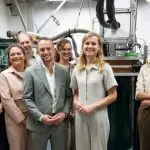
Researchers at Ludwig-Maximilians-Universität München (LMU) are developing perovskite films, less than two micrometers thick and notably black, for potential use in applications ranging from building facades to satellites. These ultrathin layers efficiently absorb sunlight and can be applied to metal foils, plastic films, and glass, offering a versatile platform for future solar technologies.
“We’re primarily developing fundamental materials and device principles needed to solve challenges that industry cannot yet address,” explains Dr. Erkan Aydin, head of LMU’s research group for innovative photovoltaic technologies. The work receives funding from the German Research Foundation, which supports the e-conversion Cluster of Excellence, enabling efforts to improve perovskite stability and reliability for broader use.
Perovskite Materials: From Ural Origins to Solar Cell Applications
Perovskite materials, initially identified in 1839 within a rock sample sourced from the Ural Mountains, are now central to advancements in both solar energy and quantum technologies. German mineralogist Gustav Rose first analyzed the calcium and titanium oxide, naming the mineral “perovskite” after the Russian statesman Lev Perovski, though its potential remained largely unexplored for over a century. Researchers are leveraging the unique crystalline structure, denoted ABX₃, to create ultra-thin films with exceptional light-absorbing properties, pushing the boundaries of photovoltaic efficiency.
The versatility of perovskites stems from the ability to modify their composition, altering the spectrum of light they capture. Modern iterations developed by teams like the one led by Dr. Erkan Aydin at Ludwig-Maximilians-Universität München (LMU), utilize mixed-cation perovskites based on formamidinium, methylammonium, and cesium, alongside lead and halide combinations like iodine and bromine. These multi-component perovskites demonstrate both higher efficiency and improved stability compared to earlier materials.
Aydin explains, “We’re able to optimize the perovskite cell so that it specifically harvests the spectral range that silicon barely absorbs,” highlighting a key advantage in maximizing energy conversion. Laboratory results currently demonstrate single-junction perovskite cells exceeding 27 percent efficiency, a rate of improvement rarely seen in solar cell technologies. Beyond terrestrial applications, LMU researchers are focused on developing cells capable of withstanding space conditions. Conventional solar cells used in satellites are often costly and slow to manufacture, representing a significant portion of mission expenses, particularly for emerging commercial satellite networks.
Aydin’s group is therefore focused on developing perovskite-based solar cells capable of withstanding the harsh conditions of space, including intense radiation, vacuum environments, and extreme temperature fluctuations. “The aim is to ensure that our perovskite components will also work in the kind of harsh environment you get in space,” he states, emphasizing the need for robust materials capable of enduring repeated thermal cycles that can cause cracking or weaken connections.
The research at LMU extends beyond solar cells, encompassing the exploration of perovskite quantum dots, nanocrystals exhibiting extraordinary optical properties. Quinten Akkerman, leading the Quantum Dot Synthesis and Characterization research group at the Nano-Institute Munich, is investigating these quantum dots for applications in LEDs, mini-lasers, and crucially, quantum technologies. These dots can emit individual light particles in a controlled manner, making them essential for quantum communication and computing.
Akkerman’s project, CONTROL, recently received a 1.5 million euro Starting Grant from the European Research Council (ERC) for redesigning the synthesis of perovskite quantum dots and improving their optical characteristics and surface chemistry. These advancements, alongside work by Professor Alexander Urban on precisely controlled nanocrystal growth and optical properties, aim to integrate these light emitters into the next generation of optoelectronic and quantum devices. These thin film components are generally less than two micrometers thick, facilitating integration into diverse applications.
All these properties make perovskites a unique material platform.
Dr. Esma Ugur, head of the LMU research group for fundamental studies of energy-harvesting technologies
LMU Research Focus: Enhancing Stability in Perovskite Solar Cells
Perovskite films measuring less than two micrometers thick are central to Ludwig-Maximilians-Universität München’s (LMU) efforts to expand the applications of this promising solar cell material, extending beyond terrestrial use to include deployment on satellites and wearable electronics. Beyond improving durability, LMU scientists are also focused on maximizing energy conversion efficiency. Esma Ugur, whose research focuses on understanding why perovskite solar cells lose performance over time, is building a research program that investigates the fundamental processes limiting their long-term stability. “To do this, we need to understand which mechanisms make the components vulnerable,” she says. The team is optimizing perovskite cells to harvest the portion of the solar spectrum that silicon struggles with, leading to efficiencies exceeding 27 percent in the lab for single-junction perovskite cells.
Professor Alexander Urban, also at the Nano-Institute Munich, is contributing to this effort with a tool that combines automated chemical synthesis, high-throughput characterization, and data-driven modeling. This allows for extremely precise control over nanocrystal growth and optical properties, a critical step toward realizing practical applications for perovskite quantum dots in optoelectronics and quantum technologies.
Our aim is to build material systems that are even more robust and have a longer lifespan.
Dr. Esma Ugur, head of the LMU research group for fundamental studies of energy-harvesting technologies
Quantum Dot Synthesis: Advancing Perovskite Optoelectronics
These quantum dots, measuring only a few nanometers, demonstrate quantum mechanical behaviors allowing controlled emission of individual light particles, a characteristic essential for secure quantum communication and the development of quantum computers. This level of control is a critical step toward integrating perovskite quantum dots into advanced optoelectronic and quantum devices, moving beyond theoretical potential toward practical application. The team’s approach focuses on fundamental aspects, aiming to create materials with tailored properties for specific technological needs.
Beyond quantum technologies, LMU researchers are also focused on developing cells capable of withstanding space conditions, with applications like facades, wearable electronics, and even powering satellites, where the lightweight and efficient nature of perovskite films offers significant advantages. “With many commercial satellites, the energy supply makes up a significant proportion of the costs,” Aydin explains, highlighting the potential for perovskite solar cells to reduce the financial burden of space missions.
The versatility of perovskites stems from their unique crystal structure, first identified in 1839 with the analysis of a rock from the Ural Mountains. While initially calcium titanate, the “perovskite” designation now encompasses a class of crystals with the general formula ABX₃, allowing for a wide range of elemental compositions and tunable properties. “All these properties make perovskites a unique material platform,” says Dr. Esma Ugur, head of the LMU research group for fundamental studies of energy-harvesting technologies, underscoring the potential of these materials to revolutionize both energy generation and quantum technologies.
In the laboratory, single-junction perovskite cells can now reach efficiencies exceeding 27 percent.
Dr. Erkan Aydin, head of the LMU research group for innovative photovoltaic technologies
German Funding Fuels LMU’s e-conversion Cluster of Excellence
This investment allows scientists to address fundamental challenges hindering the widespread adoption of perovskite solar cells, moving beyond laboratory efficiencies toward commercially viable and durable products. This adaptability extends beyond energy generation; the materials’ unique optical properties are also attracting attention for quantum technologies. The origins of perovskite research trace back to 1839, when German mineralogist Gustav Rose first analyzed a rock sample from the Ural Mountains, identifying calcium titanate and establishing the foundational crystal structure.
In solar cells, our thin film components are generally less than two micrometers thick.
Dr. Erkan Aydin, head of the LMU research group for innovative photovoltaic technologies




See today’s quantum computing news on Quantum Zeitgeist for the latest breakthroughs in qubits, hardware, algorithms, and industry deals.