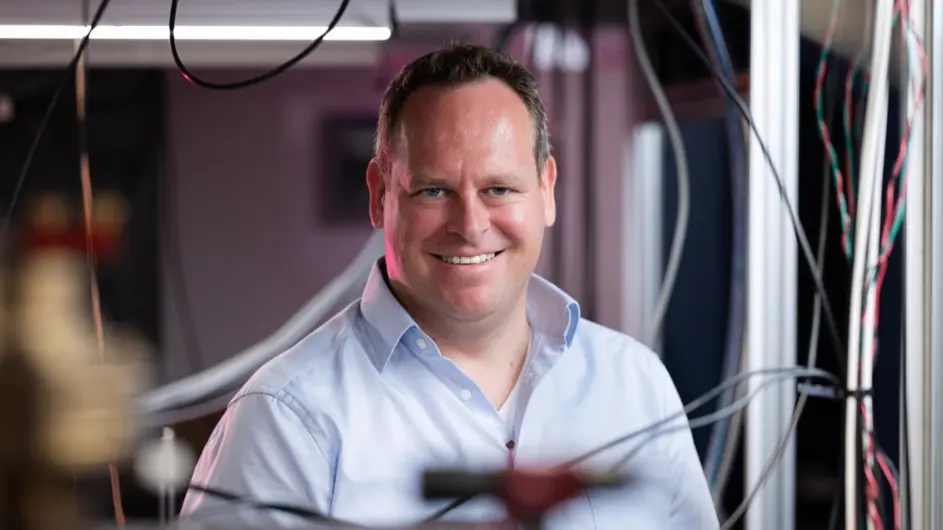
Columbia physicist Sebastian Will is recognized as a 2026 American Physical Society Fellow for realizing a Bose-Einstein condensate of dipolar molecules and developing a microwave shielding technique. Will and his team achieved the first molecular BEC in 2024, building on the first atomic BEC from 1995 and unlocking new avenues for exploring exotic forms of quantum matter.
The microwave shielding protects molecules, allowing them to be cooled to just a few billionths of a degree above absolute zero. “It’s a tremendous honor to be recognized by the APS,” says Will, adding that the breakthroughs were made possible by his dedicated team.
Microwave Shielding Enables Ultracold Molecular Bose-Einstein Condensates
This technique safeguards molecules from collisions that would otherwise disrupt the cooling process and prevent the formation of the condensate, a state of matter where individual particles behave as a single quantum wave. The shielding’s effectiveness is demonstrated by the team’s recent observation of self-bound quantum droplets of molecules, a phenomenon made possible by the control over molecular interactions. The creation of a molecular BEC in 2024 built upon the initial realization of atomic BECs in 1995, but presented unique challenges due to the complex nature of molecules.
Unlike atoms, molecules possess internal structures and exhibit strong, long-range dipolar interactions, offering researchers a new platform to investigate exotic quantum states. These interactions, carefully controlled by the microwave shielding, allow for the exploration of quantum matter regimes previously inaccessible with atomic BECs.
Will’s team published their findings on extreme loss suppression in an ultracold molecular gas in Science in 2026, detailing the improvements enabled by this shielding. “These breakthroughs were made possible by the creativity, dedication, and hard work of our outstanding team of students and researchers—this is also a recognition for them,” said Will.
The team’s subsequent realization of ultrastable ultracold molecular gases, detailed in Nature Physics in 2023, further demonstrates the potential of this technology to unlock new avenues of research into strongly interacting quantum matter. These advances promise to expand understanding of fundamental physics and potentially lead to novel quantum technologies.
See today’s quantum computing news on Quantum Zeitgeist for the latest breakthroughs in qubits, hardware, algorithms, and industry deals.