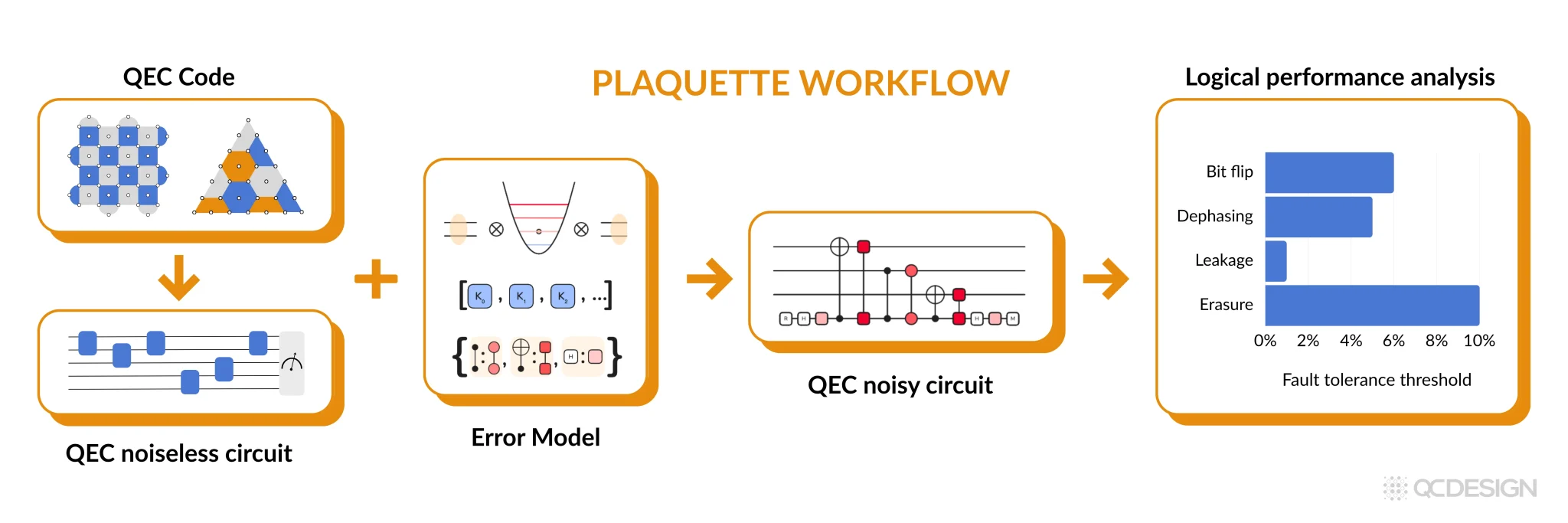
Researchers led by Raul Conchello Vendrell and fourteen colleagues have introduced Plaquette, a framework designed to assess the performance of fault-tolerant quantum computers using realistic hardware imperfections. Unlike traditional simulations that often rely on simplified noise models, Plaquette directly incorporates physical errors such as superconducting transmons leaking from their computational state, neutral atom scattering, and trapped ion heating. The framework integrates four distinct sampler classes, including a new “XPauli” sampler, allowing for comprehensive evaluation across various error types and validation against full-state simulations. The team’s report indicates that a hardware error model can be specified once using Kraus operators, Hamiltonian-Lindblad dynamics, or experimentally reconstructed quantum channels, then automatically compiled for use across all sampler types; this flexibility is crucial for accurately estimating logical performance and reliable error budgets. Plaquette offers a direct link between a device’s physical characteristics and the quantum computer built upon it.
Plaquette addresses the limitations of simplified noise models commonly used in quantum computing simulations; hardware noise frequently deviates from purely stochastic Pauli errors, demanding more sophisticated approaches to accurately predict fault-tolerant performance. This focus on real-world hardware constraints, rather than idealized scenarios, is central to Plaquette’s design. These classes, stabilizer sampling, the new XPauli sampler, near-Clifford samplers, and full-state simulation, enable a comprehensive evaluation of fault-tolerant quantum computer performance across a range of error types, moving beyond the constraints of traditional stabilizer simulations. Validation of the XPauli and near-Clifford samplers against full-state simulation demonstrates their accuracy, achieving statistical parity while Pauli twirling methods can fall short depending on the specific error model employed. This capability is crucial because the discrepancy between Plaquette’s simulations and those relying solely on Clifford-only approximations varies significantly depending on the quantum platform and the nature of the noise process, meaning accurate thresholds, error budgets, and overhead estimates necessitate the most precise simulation available.
Current approaches to simulating fault-tolerant quantum computers often rely on simplified noise models, particularly those based on stochastic Pauli errors, but these fail to capture the full complexity of real-world hardware imperfections. Researchers are now expanding beyond these limitations with frameworks like Plaquette, which directly incorporates the physics of device-specific errors into performance evaluations. A key validation within Plaquette focuses on the XPauli sampler’s ability to accurately model leakage and coherent errors, issues that plague several quantum computing modalities. Specifically, the framework addresses challenges like superconducting transmons leaking out of the computational subspace, scattering in neutral atom systems, and motional heating in trapped ions, alongside errors caused by miscalibrated control signals. The team demonstrated the framework’s efficacy using error models derived from leakage in superconducting qubits, scattering in neutral atoms, and heating in trapped ions, revealing discrepancies between Plaquette’s results and those from Clifford-only simulations that vary depending on the platform and noise process; reliable thresholds and overhead estimates, therefore, require the most accurate simulation available.
Source: https://arxiv.org/abs/2607.08767


See today’s quantum computing news on Quantum Zeitgeist for the latest breakthroughs in qubits, hardware, algorithms, and industry deals.