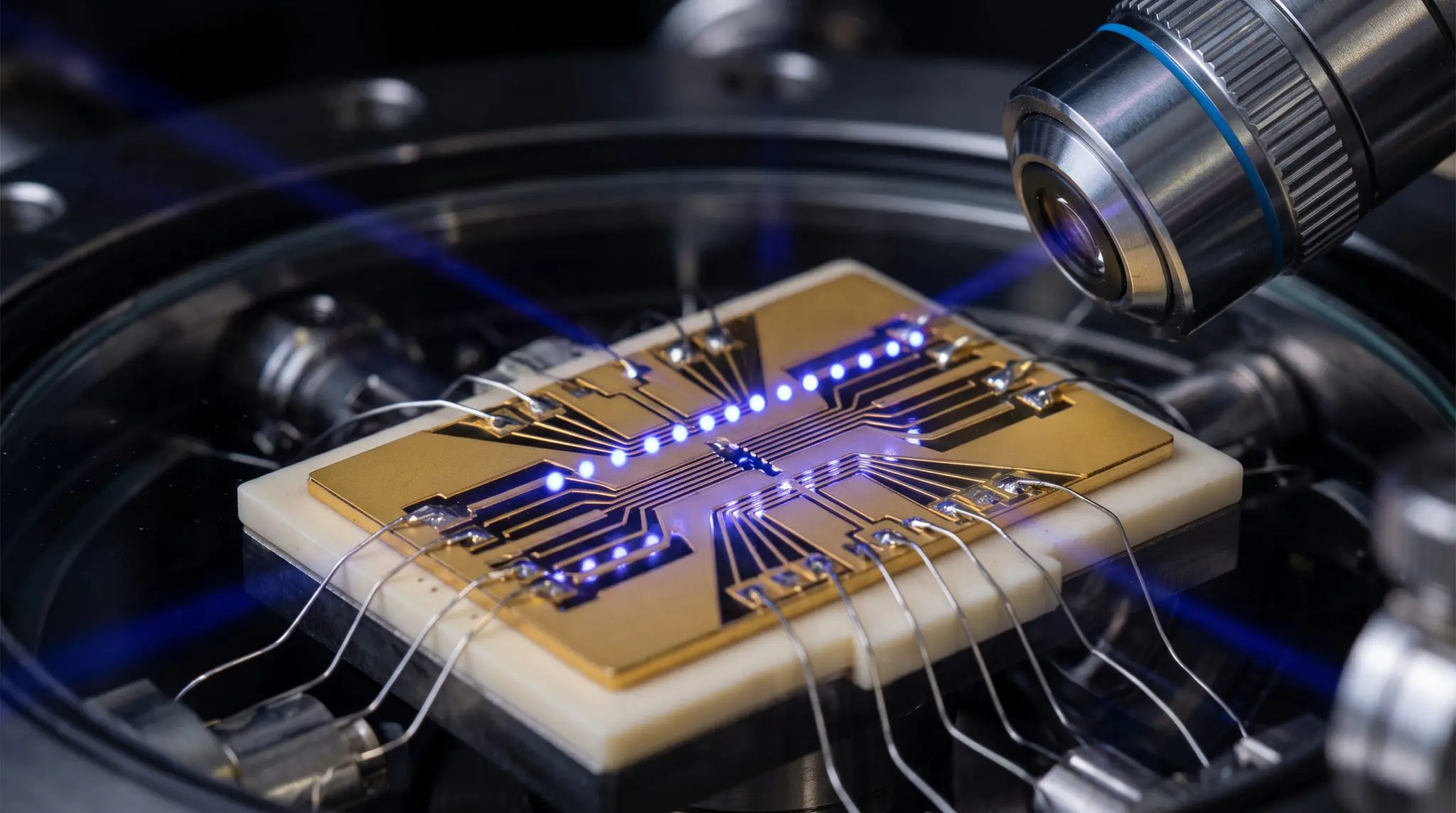
Sandia National Laboratories has developed an approach to quantum processing with QSCOUT, a trapped-ion system employing a linear chain of Yb-171 ions as its qubit register. This choice of isotope establishes a foundation for precise control, and the architecture provides all-to-all qubit connectivity, a potentially significant advantage because it allows any qubit to directly interact with any other within the chain. QSCOUT utilizes qubit states defined by a transition energy of approximately 12.6 GHz, requiring precise microwave technology for control. The team reports developing a qubit-boson gate set for hybrid continuous-discrete variable quantum computing, utilizing Jaqal to operate the system and offering pulse-level control through the JaqalPaw interface.
QSCOUT Qubit and Motional State Definition
A single chain of ytterbium ions forms the heart of QSCOUT, a novel quantum processor achieving all-to-all connectivity within a single, linear chain of Yb-171 ions. Sandia National Laboratories researchers have detailed the system’s approach to quantum processing, focusing on a hybrid continuous-discrete variable scheme. Unlike many developing platforms relying on trapped electrons or alternative elements, QSCOUT employs Yb-171 ions as its qubit register. The system defines qubit states using |S1/2, F=0, mF=0⟩ = |0⟩qubit and |S1/2, F=1, mF=0⟩ = |1⟩qubit, but does not utilize them for qubit operations. To clarify terminology, the team uses spin to denote qubit states and integers to represent motional states within the Fock basis, defining |0⟩qubit as and |1⟩qubit as. These states are then referred to as |↓⟩ and |↑⟩, streamlining Jaqal code implementation.
The system leverages the collective motion of the ion chain, specifically, the motional modes or phonon modes, as quantum harmonic oscillators, or qumodes. Raman transitions, driven by two counter-propagating tones (ω1 and ω2), address individual qubits while a larger beam globally interacts with the entire chain. Up to two tones with independent control over amplitude, phase, and frequency modulation can be applied to each beam, with four tones possible in specific instances. The researchers note that an N-ion register has N “flavors of collective motion,” resulting in a total of 3N modes, though access is limited to 2N radial modes due to the laser alignment. These motional states, existing in an infinite-dimensional Hilbert space, are practically truncated around |n=10⟩ given current readout limitations.
Yb-171 Qubit Addressing with Raman Transitions
The pursuit of stable and scalable quantum computation has increasingly focused on ion trap technology, yet the specific choice of ion remains a critical engineering decision. While trapped electrons and other elemental ions are frequently discussed, QSCOUT distinguishes itself by employing ytterbium-171 (Yb-171) ions as its qubit register. QSCOUT utilizes a single, linear chain of Yb-171 ions as a qubit register with all-to-all connectivity, a configuration that allows any qubit to directly interact with any other, a significant advantage over systems requiring complex routing schemes to facilitate interactions. Addressing individual qubits within this chain relies on a sophisticated Raman transition technique. QSCOUT drives these transitions using two tones, ω₁ and ω₂, where the difference between their frequencies (ω₁ − ω₂ ) matches the carrier transition frequency for the qubit.
This method allows for precise manipulation of the qubit states, defined as |↓⟩ and |↑⟩, representing the |0⟩ and |1⟩ qubit states respectively. These motional modes are accessed by driving the Raman transition with counter-propagating beams, one global and the others tightly focused on individual ions. The team has developed a qubit-boson gate set and supports pulse-level control in Jaqal via the JaqalPaw interface. The elliptical trap confinement results in differing energies for radial modes, categorized into upper and lower manifolds, refining control over qubit interactions.
Sandia National Laboratories researchers are meticulously mapping the vibrational landscape within QSCOUT, their trapped-ion quantum processor, focusing on the precise indexing of radial modes crucial for complex gate operations. The team’s approach centers on harnessing the collective motion of these ions, utilizing what they describe as “flavors of collective motion,” to encode and manipulate quantum information. QSCOUT utilizes a single, linear chain of Yb-171 ions as a qubit register with all-to-all connectivity. The radial modes, arising from the ions’ confinement, can be indexed from 0 to N-1 for an N-ion register. These modes aren’t uniform in energy; the researchers note the trap confinement is “elliptical,” creating distinct “upper and lower manifolds.” The upper manifold consistently exhibits higher energy levels than the lower. Motional states exist in an infinite-dimensional space, but truncating around |n=10⟩ is recommended given current readout limitations. The team’s detailed mapping of these radial modes, including identifying the center-of-mass mode (mode 0) and the tilt mode (mode 1), supports implementation of the qubit-boson gates available on QSCOUT.
Beyond the promise of quantum speedup, QSCOUT’s architecture presents concrete engineering choices that distinguish it from other trapped-ion systems. The use of Yb-171 establishes a foundation for precise control, and the architecture provides all-to-all connectivity. Jaqal, or Just Another Quantum Assembly Language, serves as the crucial interface for controlling these gates.
The pursuit of scalable quantum computation often hinges on precise control at the atomic level, yet the methods for achieving this control are diverse. While many approaches focus on manipulating electrons or photons, Sandia National Laboratories has engineered a system, QSCOUT, centered around the unique properties of ytterbium-171 ions. This use of Yb-171 establishes a foundation for precise control, and the system’s architecture achieves all-to-all connectivity within a single, linear chain of these ions, a significant advantage over systems where qubit interactions are limited by physical routing constraints. Approximately 12.6 GHz is the transition frequency, dictating the microwave technology required to interface with the qubits and demanding specialized equipment for accurate control. Specifically, the qubit states |0⟩ and |1⟩ are referred to as |↓⟩ and |↑⟩ respectively. The Jaynes-Cummings gate is described by the equation JC(θ,ϕ)=exp[-iθ(eiϕσ−a†+e−iϕσ+a)]. The Jaynes-Cummings gate effectively swaps qubit and motional state information.
QSCOUT’s ability to address each of its Yb-171 ions individually represents a significant advance in trapped-ion quantum computing. QSCOUT utilizes a linear chain of Yb-171 ions as a qubit register with all-to-all connectivity. The qubit states are |S1/2, F=0, mF=0⟩ = |0⟩qubit and |S1/2, F=1, mF=0⟩ = |1⟩qubit, with a transition energy of approximately 12.6 GHz. The system distinguishes between “upper and lower manifolds” based on the energy of the radial modes. The available gate set includes the Jaynes-Cummings (JC) and Anti-Jaynes-Cummings (AJC) gates, which manipulate Fock states conditioned on qubit spin. Additionally, QSCOUT supports conditional displacement and rotation gates, offering further control over the motional states. Conditional beamsplitter and squeeze gates are currently in development, promising an expanded repertoire of quantum operations. Truncating the Fock basis around |n=10⟩ is recommended given current readout limitations.
Source: https://arxiv.org/abs/2607.08560

See today’s quantum computing news on Quantum Zeitgeist for the latest breakthroughs in qubits, hardware, algorithms, and industry deals.