The trapped-ion physicist who built a business out of being indifferent to which qubit wins. Michael Biercuk took the one position in this industry that does not require picking the winning hardware.
He built a business on not picking a winning qubit. Michael Biercuk founded Q-CTRL to sell control software that works across hardware types. That position does not require betting on superconducting, ion or atom.
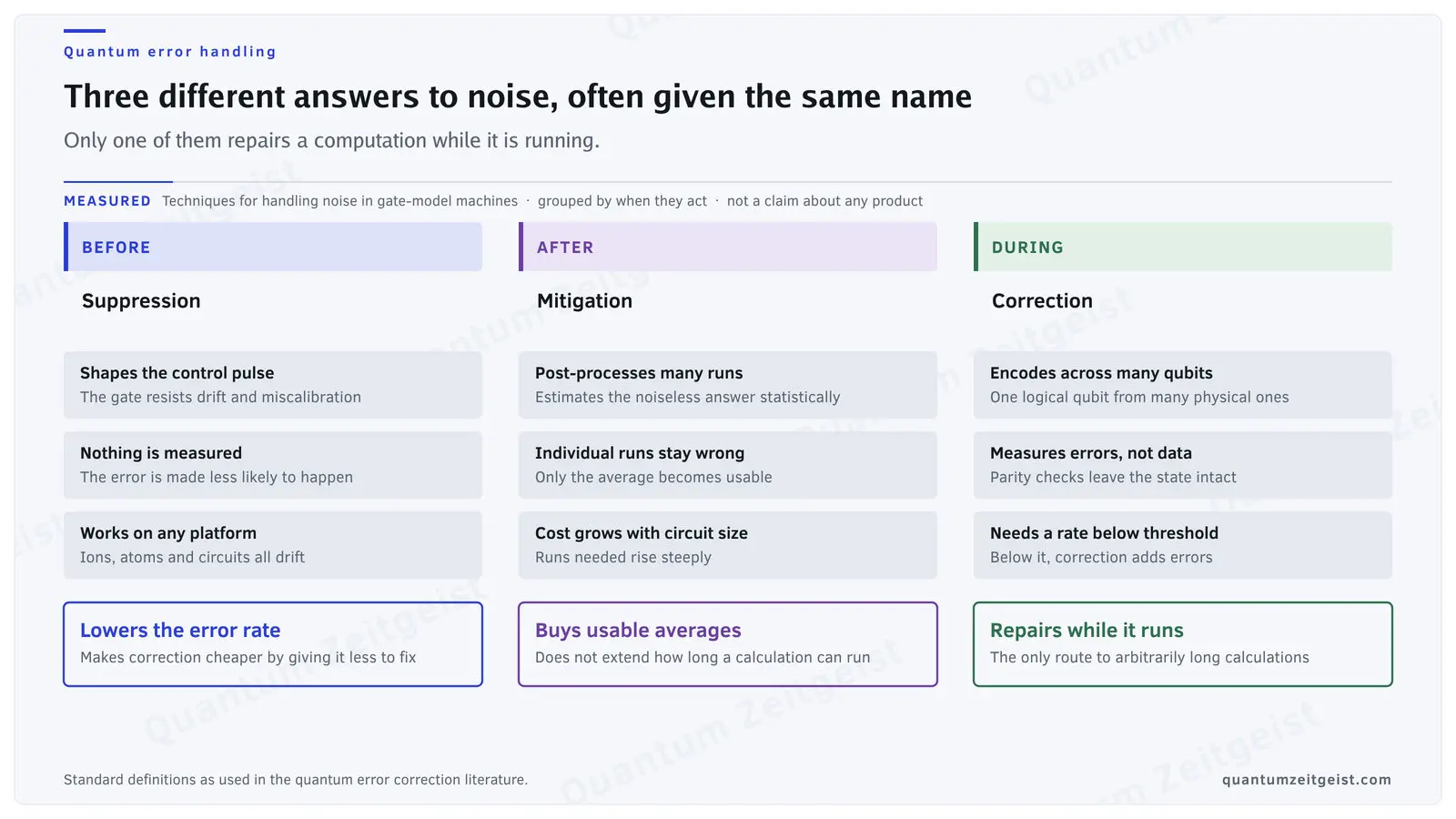
Error suppression is not error correction. Suppression shapes control pulses so fewer errors happen. Correction detects and fixes errors after the fact, and the two solve different parts of the problem.
The customers compete with each other. Q-CTRL sells to hardware makers who are rivals. A software layer can be neutral in a way a chip company cannot.
The customers with names came from sensing, not computing. The defence and navigation work has produced a named government partner and defence-linked investors, while the computing side has so far produced benchmarks and integrations. Q-CTRL publishes no revenue split, so which side pays more is not on the public record.
Control engineering became a discipline of its own. Techniques from classical control theory turned out to transfer to qubits. That transfer is why the field exists as a specialism.
The same control methods set a record for the smallest force ever measured. The Australian Museum’s 2015 Eureka Prize citation named both his error suppression work and a force measurement at the level of yoctonewtons. Q-CTRL has since been paid for both uses of the technique.
Michael Biercuk is an experimental physicist who founded Q-CTRL in Sydney in 2017 and still runs it as chief executive. He also holds a chair in quantum physics at the University of Sydney and directs its Quantum Control Laboratory. The company sells software that shapes the control signals sent to a quantum computer so that fewer errors happen, and it sells that software to hardware makers who compete with one another.
His route to the company ran through physics at the University of Pennsylvania and a doctorate at Harvard. Programme management at DARPA followed, and then a fellowship in the ion storage group at the National Institute of Standards and Technology in Boulder. The Boulder years produced the 2009 Nature paper on which the business rests. It showed that the right sequence of microwave pulses, chosen by feedback from the machine itself, could cut the errors in a trapped-ion memory by orders of magnitude without touching the hardware.
That result matters commercially because it does not care which kind of qubit it is applied to. In a single announcement in September 2024 Q-CTRL said its Fire Opal software would run natively inside IBM Quantum services, Rigetti’s cloud service, Oxford Quantum Circuits devices and Diraq’s silicon processors. Three of those are superconducting machines and one uses silicon spin qubits, and each is competing to have its own architecture prevail. Q-CTRL is indifferent to which of them does, and that indifference is the business model.
The customers with names, though, have come from a different direction altogether. The company sells a magnetic navigation product that fixes position without any satellite signal. It announced a partnership with the Australian Department of Defence in July 2023, and its investors include Lockheed Martin Ventures, In-Q-Tel and Airbus Ventures. Its press kit puts the capital raised to date at 133 million US dollars, as at September 2026, and publishes no split between the two sides of the business.
The physics came from a 1950 magnetic resonance trick
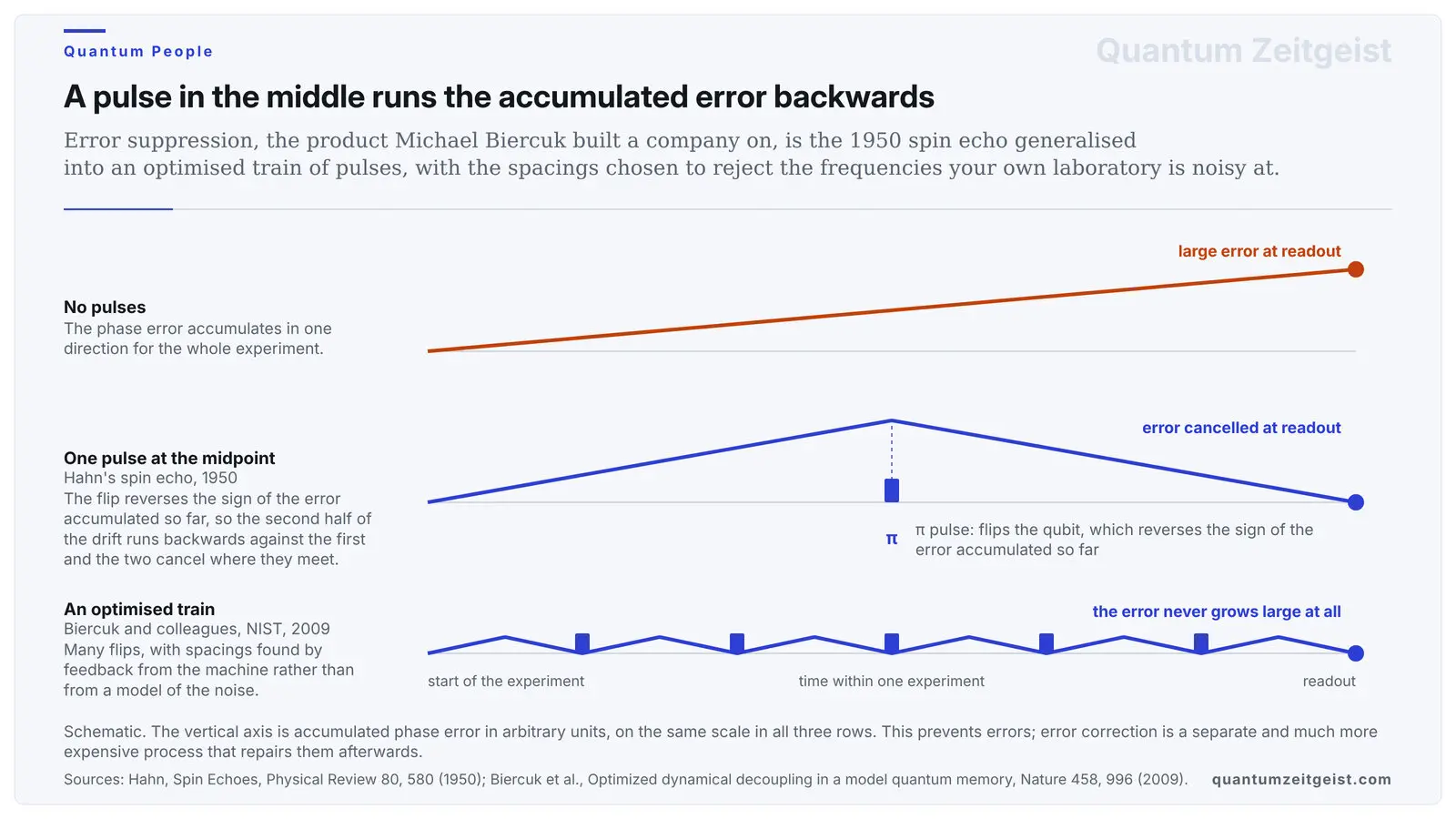
The experiment behind that paper used roughly a thousand beryllium ions, held in a Penning trap by a superconducting magnet, and the magnet was the problem. The group measured the noise in its own field directly and found that it rose steeply at low frequencies, which means the field wandered slowly and every wander smeared the phase of the qubits. Building a quieter magnet is expensive, slow and never quite finished, so Biercuk and his colleagues took the other route.
The trick is older than quantum computing and comes from nuclear magnetic resonance. Suppose a qubit is drifting out of phase because the field around it is slightly wrong. Flipping the qubit halfway through the experiment makes the second half of the drift run backwards against the first half, and the two errors cancel where they meet. Erwin Hahn published the effect in Physical Review in 1950 under the name spin echoes. Biercuk’s NIST paper names it explicitly as the basis of what the group was doing, and compares its own sequences against the established CPMG variant of the spin echo.
Modern error suppression, the discipline Michael Biercuk went on to commercialise, is that idea generalised and then optimised hard. Instead of one flip at the midpoint you apply a carefully spaced train of pulses, each one folding a slice of accumulated error back on itself. The spacing is chosen so that the sequence acts as a filter, rejecting the frequencies at which your particular laboratory happens to be noisy. The 2009 result went further and found those spacings by real-time experimental feedback, so the sequences did not need to know the noise spectrum in advance.
Suppression prevents errors, correction repairs them
Error correction and error suppression are frequently confused, and they solve different halves of the problem. Correction spreads one logical qubit across many physical ones so that faults can be detected and repaired after they happen. That works, but it is expensive in hardware nobody yet has in quantity. Suppression is preventative and cheap, shaping the control signals so that fewer errors occur in the first place, and it runs on the machines that exist today.
The two are complementary rather than rival, because a lower physical error rate makes correction dramatically less costly when it arrives. Q-CTRL argues this openly in its own technical writing. In a piece published on 11 May 2026 the company wrote that “the resource inefficiency of QEC makes it a net negative today”. In the same passage it said that error suppression and error-robust compilers “can both augment the efficiency of QEC and deliver better machine performance before QEC arrives”.
That piece was co-authored by Michael Biercuk and the company’s vice president of product, Alex Shih. On the company’s account the technique generally introduces more errors than it fixes today, and it does so despite what the authors call incredible scientific progress validating that it really can work.
Why Q-CTRL sells to companies that compete with each other
A hardware team could in principle write its own control software, and the largest have built pulse-level tools of their own. A serious manufacturer buys instead because calibration and pulse shaping is a specialism, and it consumes engineers who would otherwise be building the machine. The work also has to be redone every time the device changes. Q-CTRL’s pitch is that this layer is infrastructure, in the sense that nobody builds their own database engine any more. The cost of it can then be spread across an entire industry rather than carried by one manufacturer alone.
At Q-CTRL we’ve had a single-minded focus on how infrastructure software can help deliver the best possible performance from quantum hardware
Michael J. Biercuk, quoted in Q-CTRL’s announcement of four native hardware integrations, 10 September 2024
In the same announcement Biercuk said of the four manufacturers that “These partnerships have been built over the long-term through trusted relationships and real demonstrations of what’s possible, and they’re built to last.” Every additional platform Q-CTRL integrates with widens the evidence that its methods work on any hardware, and that in turn makes the next integration easier to sell. None of the manufacturers gains an advantage over the others by buying it, because they can all buy it.
Any customer could build the layer itself
A control layer that works everywhere is a layer that any one of its customers could decide to replicate for itself, and the two largest have built pulse-level tools of their own. IBM shipped Qiskit Pulse, its interface for shaping the control signals on its own machines, in May 2019, and Rigetti released Quil-T in December 2020. Both integrated Fire Opal anyway, IBM from November 2023 and Rigetti in the September 2024 announcement. IBM then removed pulse-level access from its systems in February 2025, which took the do-it-yourself route away from its own users while the Q-CTRL integration stayed.
No hardware maker is on the public record as having built its own error suppression layer and dropped Q-CTRL, and none is on record as having tried and failed. The test that would settle the objection is a named manufacturer ending an integration in favour of an in-house tool, and it has not happened yet. The company also depends on selling into an industry that has not yet produced a commercially decisive machine, which leaves it exposed to that industry’s timetable.
The named customers arrived from the other direction
A company founded to make quantum computers work better has found its most concrete commercial traction in a product that does no computing at all. Quantum sensors exploit the same delicate atomic systems as a qubit does. For a sensor, sensitivity to the outside world is the entire point of the instrument rather than a defect to be engineered away.
Quantum sensing uses the fragility of quantum hardware as an asset to enable new ways to measure underground water, monitor space weather, and navigate without a global positioning system
Michael J. Biercuk, quoted in Q-CTRL’s Series B announcement, 30 November 2021
The engineering problem is that a sensor which notices everything also notices the vibration of the aircraft carrying it. Biercuk said in the same announcement that “like quantum computing, interference from the outside world degrades system performance when quantum sensors are taken from the lab out into the field.” The same control mathematics therefore transfers straight across.
Ironstone Opal finds position from a magnetic map
The company now sells a magnetic navigation product called Ironstone Opal, which fixes position by matching the measured magnetic field against a map rather than by receiving any satellite signal. Q-CTRL says it has been validated in air, land and maritime trials and improves inertial positioning by more than a hundredfold while eliminating drift.
Those are the company’s figures and its own characterisation of its trials, and no independent verification of them is in the public domain. What can be checked is the institutional interest. Q-CTRL’s press kit states that “in July 2023 the Australian Department of Defence announced Q-CTRL’s leading role delivering quantum-assured navigation to AUKUS allies”. The company’s own release of 11 July 2023, however, describes a partnership with Defence and does not use the word AUKUS. Its published investor list includes Lockheed Martin Ventures, In-Q-Tel and Airbus Ventures, which is a distinctive set of names for a business that began as a quantum computing spin-out.
The route ran through DARPA before Boulder
Biercuk read physics at the University of Pennsylvania and took his doctorate at Harvard in 2005. After the doctorate he worked in programme management at DARPA, which the company’s press kit describes as the source of his experience across advanced technology and national security. He moved from there to Boulder in 2008. Those years read less as a line on a curriculum vitae than as part of the explanation for why a control-software company was equipped to build a defence portfolio.
The ion storage group treated a stray field as data
The Boulder fellowship in the NIST ion storage group came next. Trapped ions punish sloppiness more than almost any other platform, and a group whose business is atomic clocks treats a stray field as a measurement problem rather than an annoyance. He carried that habit to the University of Sydney, where he is professor of quantum physics and directs the Quantum Control Laboratory. Q-CTRL was founded there as a spin-out in 2017, and he still holds both posts.
The Australian Museum gave him its 2015 Macquarie University Eureka Prize for Outstanding Early Career Researcher, citing him then as an associate professor at Sydney. Its announcement singled out both the error suppression work and his record for the smallest force ever measured, at the level of yoctonewtons. The techniques that stop a qubit forgetting are the same ones that let an instrument feel something almost immeasurably faint. Q-CTRL has since been paid for both.
What Michael Biercuk got right, and what is still unproven
The judgement Michael Biercuk made in 2017 was that the control layer would become a distinct product category rather than a feature of somebody else’s stack. On that narrow question he has been vindicated. Manufacturers building on rival and incompatible hardware now ship his software inside their own systems, which is the market’s way of conceding the point. His second judgement, that the same techniques would generalise beyond computing, has produced a defence and navigation business with a named government partner and defence-linked investors. That is more than the computing side can yet show. Whether it is also the larger half of the company is not knowable from outside, because Q-CTRL publishes no revenue.
The advantage claim is still the company’s own account
What has not been settled is the thing the whole industry is waiting on. Error suppression buys performance from machines that are still too small to earn their keep on most commercial problems, and a layer that makes those machines better does not by itself make them useful. In May 2026 Q-CTRL announced what it calls a practical quantum advantage in materials simulation, claiming a solution it describes as “3,000x” faster than the best industry-standard classical alternative. That figure is the company’s own account of its own result, and it has not been independently replicated.
Until such claims are checked by people with no stake in them, what Michael Biercuk has built is a real business standing on an unfinished industry. Hardware makers who agree on almost nothing else are so far willing to buy from the same supplier, which is the strongest evidence available that the position holds.
Frequently asked questions
Who is Michael Biercuk?
What does Q-CTRL actually sell?
How is error suppression different from error correction?
What is the spin echo and why does it matter here?
What did Biercuk do at NIST?
Why did a quantum computing company move into sensing?
What is Ironstone Opal?
How much funding has Q-CTRL raised?
Why is Michael Biercuk influential in quantum technology?



See today’s quantum computing news on Quantum Zeitgeist for the latest breakthroughs in qubits, hardware, algorithms, and industry deals.