Distributed quantum sensing experiments were previously limited by bulky optical setups hindering scalability. Entanglement-enhanced sensing of linear functions of four phase shifts is now achieved within a single integrated photonic circuit at the University of Bristol. A precision of 0.199 ±0.016 dB below the shot noise limit has been attained, compared to 0.041 ±0.018 dB using separable states; this represents a sharp advance in compact and scalable quantum sensors for applications like precise measurement and imaging.
A new method for measuring subtle changes in light utilising quantum entanglement within a single microchip created it. This overcomes limitations imposed by large optical instruments previously needed for such precise measurements, generating entangled states directly onto the silicon device itself regardless of distance between particles. Greater accuracy than traditional methods achieves employing non-entangled light with this compact design, promising advancements in sensitive measurement technologies applicable to areas like imaging and materials science.
A breakthrough in quantum sensor technology accomplished at the University of Bristol through successful performance of distributed quantum sensing within a single microchip; it addresses a key limitation, bulky optical setups formerly required for precise measurements. The approach uses entangled states of light where two particles become linked so that knowing the state of one instantly reveals the state of the other, similar to flipping two connected coins simultaneously.
Generating these entangled states directly on a silicon device demonstrated an improvement of 0.199 ±0.016 dB below the shot noise limit, analogous to static on an old radio signal which inherently limits detection of faint signals. This compact design promises advancements in sensitive measurement technologies and raises questions about future scalability and applications within imaging and materials science.
On-chip integration surpasses shot noise limits for enhanced quantum metrology
Entanglement measures achieve a precision of 0.199 ±0.016 dB below the shot noise limit, exceeding separable states which achieved only 0.041 ±0.018 dB. This breakthrough crosses a key threshold previously unattainable with bulk-optic setups hindering scalability in quantum sensing applications.
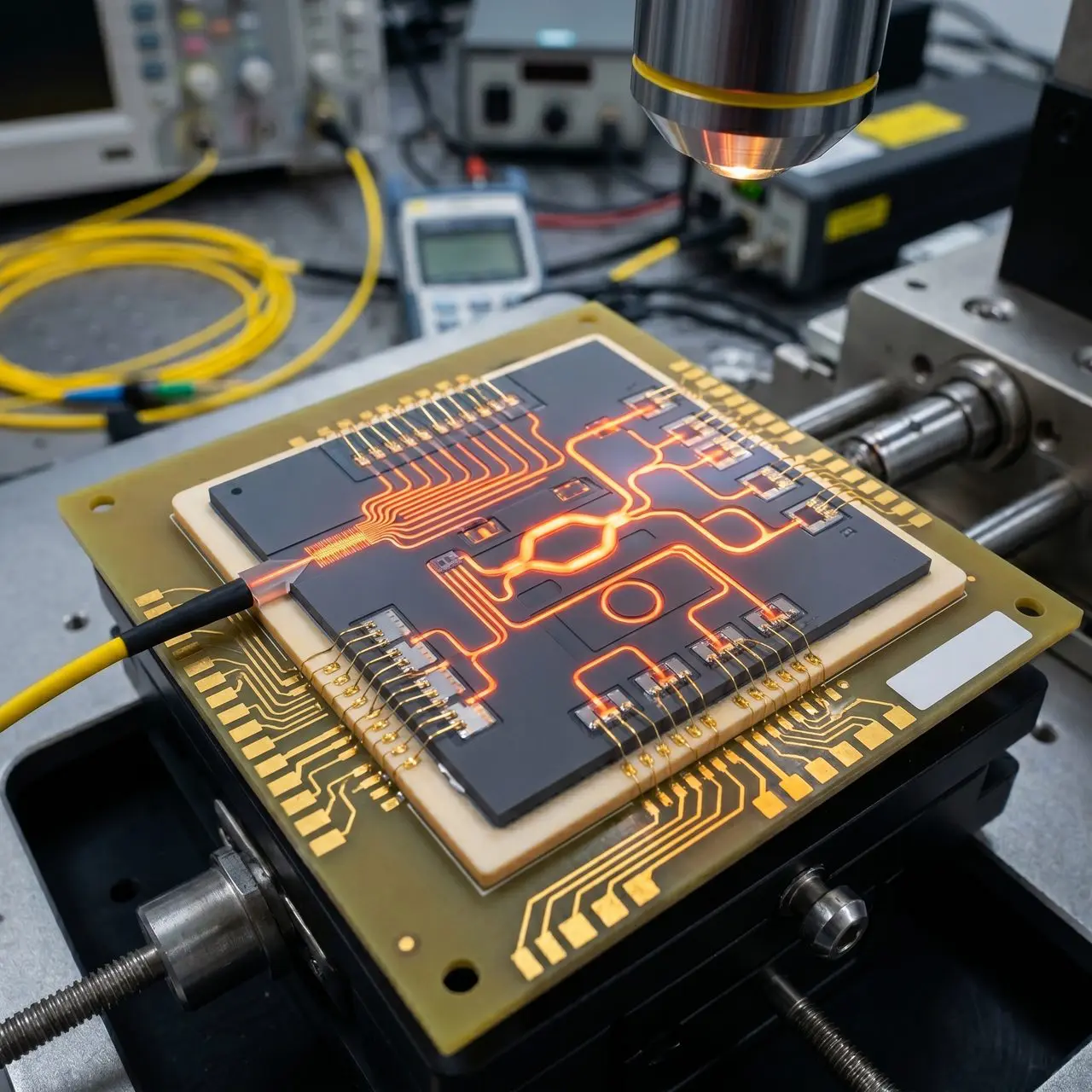
The University of Bristol team fabricated all components necessary for generating and detecting entangled photons directly onto a silicon microchip; this enabled distributed quantum sensing protocols not possible before due to practical limitations imposed by large optical instruments. An integrated photonic circuit generates four-mode entanglement and performs complete phase sensing utilising an array of on-chip homodyne detectors, devices that measure light properties, overcoming challenges associated with maintaining alignment and stability in complex free-space systems.
Silicon microchips now enable entanglement-enhanced precision reaching 0.199 ±0.016 dB, integrating all the components needed for both generation and detection of entangled photons. This represents an improvement over separable states which demonstrated only 0.041 ±0.018 dB in similar sensing applications.
The device manipulates light across four separate pathways by generating four modes of entanglement, while employing integrated homodyne detectors to accurately measure changes within these paths. Notably, the entire distributed quantum sensing (DQS) protocol implemented on a chip fabricated by IMEC Foundry Services using their iSiPP50G process; this marks the first demonstration of such a system compatible with standard manufacturing techniques.
Compact photonic circuits surpass classical limitations in precision phase shift measurement
Quantum sensing techniques are steadily being refined to detect ever more subtle environmental changes. This progress hinges upon creating entangled states of light, where particles become linked regardless of distance, within increasingly compact devices. While enhanced sensitivity for measuring combinations of phase shifts has been successfully demonstrated, current systems remain limited to linear functions only and extending capability to tackle complex parameter estimations or larger numbers of interconnected sensors remains an open challenge detailed by researchers.
Despite this limitation, the demonstration represents significant progress in distributed quantum sensing; it shows how compact integrated photonics can outperform traditional methods using bulky optics by achieving enhanced sensitivity below established noise limits when detecting phase shifts. By performing both verification of this entangled state and precise phase measurements with detectors also fabricated on the chip, limitations previously imposed by bulky optical setups hindering scalability in sensitive measurement applications were circumvented. Generating entangled states within an electronic chip paves the way towards creating scalable networks of sensors. This achievement promises future advances across diverse fields including medical imaging, materials science, and environmental monitoring due to its potential for highly accurate and compact sensor systems.
The researchers demonstrated enhanced precision in measuring linear functions of four phase shifts using an integrated photonic circuit. This result shows improved sensitivity, reaching 0.199 ±0.016 dB below the shot noise limit, compared with measurements made using separable states which achieved 0.041 ±0.018 dB. By generating and sensing entanglement on a single silicon microchip with integrated detectors, they overcame limitations associated with bulk optical setups traditionally used in quantum sensing applications. The team verified this approach allows for scalable networks of sensors to be created within compact devices.
👉 More information
🗞 Continuous variable distributed quantum sensing in integrated photonics
✍️ Bethany Puzio, Oliver M. Green, Joel F. Tasker, Jonathan Frazer, Tamzin Ellis, Benjamin D. J. Sayers, Rachel N. Clark, Alex S. Clark, Giacomo Ferranti and Jonathan C. F. Matthews
🧠 ArXiv: https://arxiv.org/abs/2609.19092



See today’s quantum computing news on Quantum Zeitgeist for the latest breakthroughs in qubits, hardware, algorithms, and industry deals.