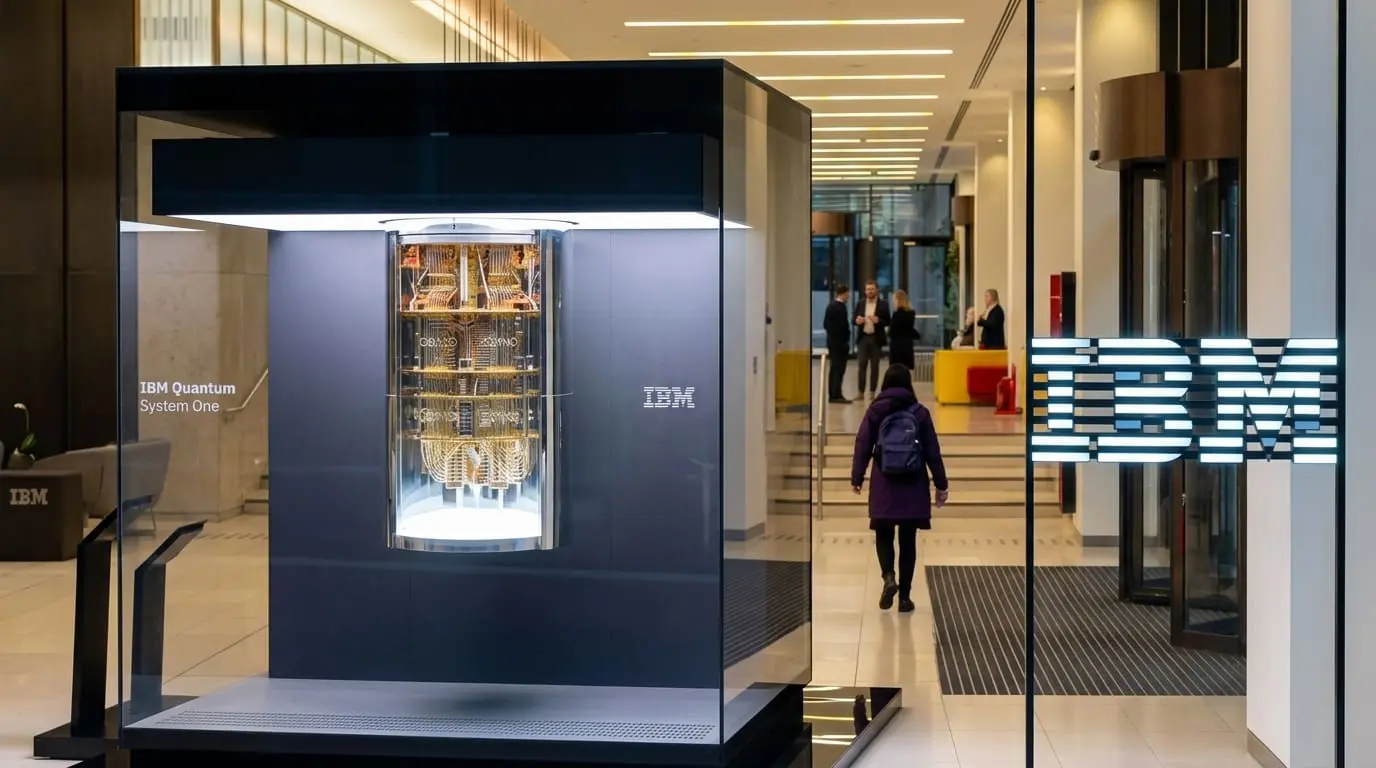
IBM’s historic crash forces the question it has been avoiding, what IBM Quantum is actually for.
On this page
- The frontier halo theory
- The Quantinuum precedent
- The case for spinning out
- The case for holding on
- The third option, buy instead of sell
- What IBM should do when it grows up
- The question the share price is asking
IBM shareholders have had a brutal few weeks, and if you have been following our coverage you saw most of it coming in stages. On 14 July the stock fell just over 25 percent in a single session, the worst day in at least 58 years of trading records and quite possibly the worst since the company’s predecessor listed in 1916, after CEO Arvind Krishna pre-announced second quarter numbers below consensus. Shares that closed at $290.23 the day before, near its recent high, now hover just above $200, with roughly $67 billion of market value gone in a day.
Wednesday’s full results confirmed the damage, revenue of $17.16 billion up just 1 percent, guidance cut to 4 to 5 percent constant currency growth, consulting flat, mainframe down 42 percent. The market has stopped believing IBM’s growth story at the multiple it was trading on, and that changes the calculus on everything, including IBM Quantum.

So here is the question I think is being argued over in Armonk right now. What does IBM actually want to do with quantum, and why has it done nothing structural with what is arguably its strongest frontier asset?
The frontier halo theory
The most plausible explanation for IBM’s inaction is that the company views quantum as a frontier technology whose primary job is to pull customers into the wider IBM business. Quantum is the shop window. Enterprises come for the roadmap briefings and the Qiskit workshops, then stay for consulting engagements and hybrid cloud contracts, and sooner or later the mainframe renewal comes up too. On that logic, spinning out quantum would be like a department store selling its window display.
There is something to this. IBM’s quantum credentials are genuinely first rate, and they lend a halo to a company whose overall shape increasingly resembles a legacy consulting business with some technology attached. IBM put the first quantum computer on the public cloud on 4 May 2016, years before anyone else, and open sourced Qiskit in 2017, still the most widely used quantum software development kit in the world. IBM Quantum says it has more than 90 systems deployed worldwide, almost certainly the largest installed base of physical machines anywhere.
It has executed consistently against a published roadmap that stretches to the fault tolerant Starling system in 2029 and the two thousand logical qubit Blue Jay in 2033, and it has stable, credible technical leadership under Jay Gambetta. Few companies anywhere can point to both the historical firsts and the current delivery.
The trouble is that the halo only pays if it converts, and the conversion path runs through IBM’s cloud. Here the picture is far less flattering. The hyperscale cloud market belongs to AWS, Azure and Google Cloud, while IBM sits somewhere else entirely, strong in regulated legacy accounts and nowhere in the growth conversation. If the strategic bet is that frontier quantum drags customers into a cloud they were not otherwise going to choose, the evidence for that pull is thin. A halo attached to a platform people are leaving is an expensive ornament.
The Quantinuum precedent
Honeywell has already run the experiment IBM is avoiding. It carved its quantum business out into Quantinuum, and on 4 June the company raised $1.68 billion in a Nasdaq IPO priced at $60 per share, with an order book more than 20 times oversubscribed, a deal we covered from the first S-1 filing through to the closing bell. Quantinuum now trades under the ticker QNT, valued at about $15.6 billion at the offer price and about $17.6 billion when it first traded, with Honeywell retaining roughly 48 percent of the voting power. Strictly this was an initial public offering rather than a spin-off, so Honeywell shareholders received no QNT stock in their accounts.
The structural point survives that distinction, because the quantum business now has its own listed currency, its own investors and its own board. Honeywell also kept a controlling stake, which is the arrangement any IBM separation would most likely copy.
Honeywell diversified its risk while retaining exposure to the upside. Quantinuum gained its own capital structure and its own investors, plus the freedom to move at the speed of the quantum industry rather than the speed of an industrial conglomerate.
That freedom matters most in dealmaking. The quantum sector is consolidating quickly, an M&A cycle that our commercial history of quantum computing argues has years left to run. IonQ has been voraciously acquisitive, completing its $1.075 billion purchase of Oxford Ionics in September 2025 after buying Lightsynq and Capella Space earlier that year, and then announcing a $1.8 billion deal for chipmaker SkyWater Technology in January. D-Wave acquired gate model developer Quantum Circuits for $550 million in January, buying its way into a second modality.
IQM listed on Nasdaq on 2 July via a SPAC combination, in what it describes as the first European quantum listing on a major US exchange, with a parallel Helsinki listing a day later. A standalone quantum company can use its own paper to buy smaller firms, close deals in weeks and integrate them without routing every decision through the machinery of a two hundred billion dollar parent. Inside IBM, every acquisition competes for capital against Red Hat, watsonx and the dividend, and every deal must survive the full weight of corporate process.
To be fair, IBM has hardly been idle. In May it announced Anderon, a standalone quantum wafer foundry established with support from the US Department of Commerce, and this week it agreed to acquire HRL Laboratories from Boeing and General Motors, adding silicon spin qubits, quantum sensing, networking and quantum materials to its superconducting programme. Jay Gambetta, IBM’s director of research, said the HRL team would help IBM push farther toward the frontiers of quantum innovation.
These are hardly the moves of a company that has lost interest. Interestingly, Anderon is itself being set up as a standalone company rather than an IBM division, and IBM intends it to serve other quantum hardware vendors as well as its own programme, which suggests the board already understands that some quantum assets work better outside the mothership. The question is whether that logic stops at the foundry.
The case for spinning out
A sum of the parts argument is easy to sketch. Consider what an independent IBM Quantum would look like on day one.
It would instantly be one of the largest quantum businesses in the world. It would bring the biggest installed hardware base, the dominant software ecosystem in Qiskit, a credible fault tolerance roadmap and a decade of operational experience running quantum systems for real customers.
The valuation gap is the sharpest part of the argument. Pure play quantum companies currently command multiples that a diversified conglomerate can never capture, with IonQ carrying a market capitalisation near $20 billion at the end of June against 2026 revenue guidance of $260 million to $270 million, a sales multiple of roughly seventy five times, and Quantinuum pricing its IPO above a twice-raised range. IBM Quantum, by contrast, is valued at roughly zero inside a stock priced as a slow growth software and services business.
Independence would also change what the business could do rather than merely what it is worth. An independent entity could acquire aggressively with its own equity, matching IonQ’s pace rather than watching from inside a corporate capital allocation process. The quantum consulting practice, the quantum classical integration work and the adjacent HPC business could all be folded in, giving the new company a services revenue base from day one rather than launching as a pure research bet.
There is a customer argument underneath the financial one. Government and defence buyers appear increasingly willing to contract with dedicated quantum counterparties, and Anderon’s Commerce Department backing shows Washington is willing to support exactly this kind of focused structure.
The case for holding on
The counterarguments are real, and they explain why the board has not moved. None of them is trivial, and several would give any chief financial officer pause.
Quantum is capital hungry and pre-revenue at scale. IBM’s balance sheet funds a roadmap that a standalone company would have to finance in public markets that can turn hostile quickly, and Quantinuum itself disclosed a large accumulated deficit on its way to listing.
Separation is also harder than it looks on an org chart. The IBM Quantum research pipeline is deeply entangled with IBM Research as a whole, and pulling it away from the surrounding materials science, semiconductors, cryogenics and packaging work would be genuinely difficult. The HRL deal, which folds sensing, networking and materials work into the quantum mission, deepens that entanglement further.
Then there is the matter of timing and of pride. The halo, however imperfectly it converts, is one of the few things that makes IBM feel like a frontier company rather than a services firm, and boards are reluctant to sell the family silver at the bottom of a drawdown. Spinning out at current sentiment risks pricing the asset badly, when a listing after Starling ships in 2029 would likely command a far richer valuation.
The third option, buy instead of sell
There is a third path the debate tends to skip. Instead of separating the division, IBM could use it as the platform for consolidation, buying its way to a position no rival could match. The company has already started down this road, with the HRL acquisition adding silicon spin qubits and the Anderon foundry securing manufacturing, so the question is one of degree rather than direction.
The logic is not fanciful. IBM Quantum is a superconducting house that has just bought its way into a second modality, and neutral atom, photonic and trapped ion players would extend that hedge further. The control electronics and cryogenics supply chain is another obvious target, since whoever owns the plumbing owns a toll booth on everyone else’s roadmap. The sector is consolidating around companies far smaller than IBM, and a balance sheet the size of Armonk’s could outbid any of them.
The problem is the currency. A crashed share price makes IBM’s equity a weaker acquisition currency at exactly the moment it would need to spend it, and every deal still competes for capital against Red Hat, watsonx and the dividend. Buying also does nothing about the underlying complaint, which is that the market will not pay a frontier multiple for anything held inside IBM. Consolidation would simply concentrate more value in a place investors refuse to price properly.
That is the uncomfortable symmetry. The same crash that makes the spin-out argument urgent also makes the acquisition argument harder to execute, which is why the structural question cannot be deferred for very much longer.
What IBM should do when it grows up
My suspicion is that these arguments are being had, loudly, in Armonk right now. We argued in the immediate aftermath of the crash that the plunge strengthens the hand of IBM Quantum inside the company, since the mainframe and software franchises drove the miss while the quantum roadmap kept shipping on schedule. The spin-out question is the natural extension of that logic. A one day loss of $67 billion concentrates minds.
Several United States shareholder law firms, among them Levi and Korsinsky and BFA Law, have announced investigations into whether IBM’s earlier guidance on its mainframe cycle was misleading. That is the routine reflex of the plaintiffs’ bar after a fall of this size rather than a regulatory inquiry, and no regulator has announced anything, but it is friction the board could do without.
Nor can a board watching AI models eat the consulting fee pool assume investors will wait patiently for the 2029 roadmap to vindicate the strategy. The February selloff, a 13 percent single day fall after Anthropic demonstrated a tool for modernising the COBOL systems IBM still services, was an early warning of exactly this dynamic. The fear inside Armonk is that clients will stop paying premium fees for work that software increasingly does, and that erosion strikes at the heart of what the rest of IBM sells.
The Anderon structure may turn out to be the tell. IBM has already accepted that a quantum foundry works best as a separate company with its own governance and its own government relationships. Extending that logic to the whole quantum division, with the consulting and HPC adjacencies folded in, is a smaller step than it looks. Nor would IBM be alone for long, since Google faces a similar mismatch between a world class quantum programme and a parent valued on advertising and cloud, and a successful IBM Quantum listing could put pressure on Mountain View to follow.
The question the share price is asking
None of this means IBM is making bad moves today. HRL is a sensible acquisition and the foundry play is genuinely creative, while roadmap execution remains the best in the industry. But the share price is now asking a question the quantum strategy has been allowed to defer, which is whether these assets are worth more inside a struggling conglomerate or outside it. On the historical precedent, and on the arithmetic of what pure plays command, the answer increasingly looks like outside.
None of that forces a decision this quarter, and boards rarely move at the bottom of a drawdown. But the longer the gap persists between what the market pays for a pure play and what it pays for the same assets inside IBM, the harder it becomes to argue that the current structure is the one serving shareholders best.
Disclaimer. This article is for informational purposes only and does not constitute investment, financial or professional advice. The quantum technology industry evolves rapidly and information may become outdated. Always conduct your own research and consult qualified advisers before making investment decisions. Investing in quantum computing companies involves significant risk, including the potential loss of your entire investment, and past performance is not indicative of future results.



See today’s quantum computing news on Quantum Zeitgeist for the latest breakthroughs in qubits, hardware, algorithms, and industry deals.