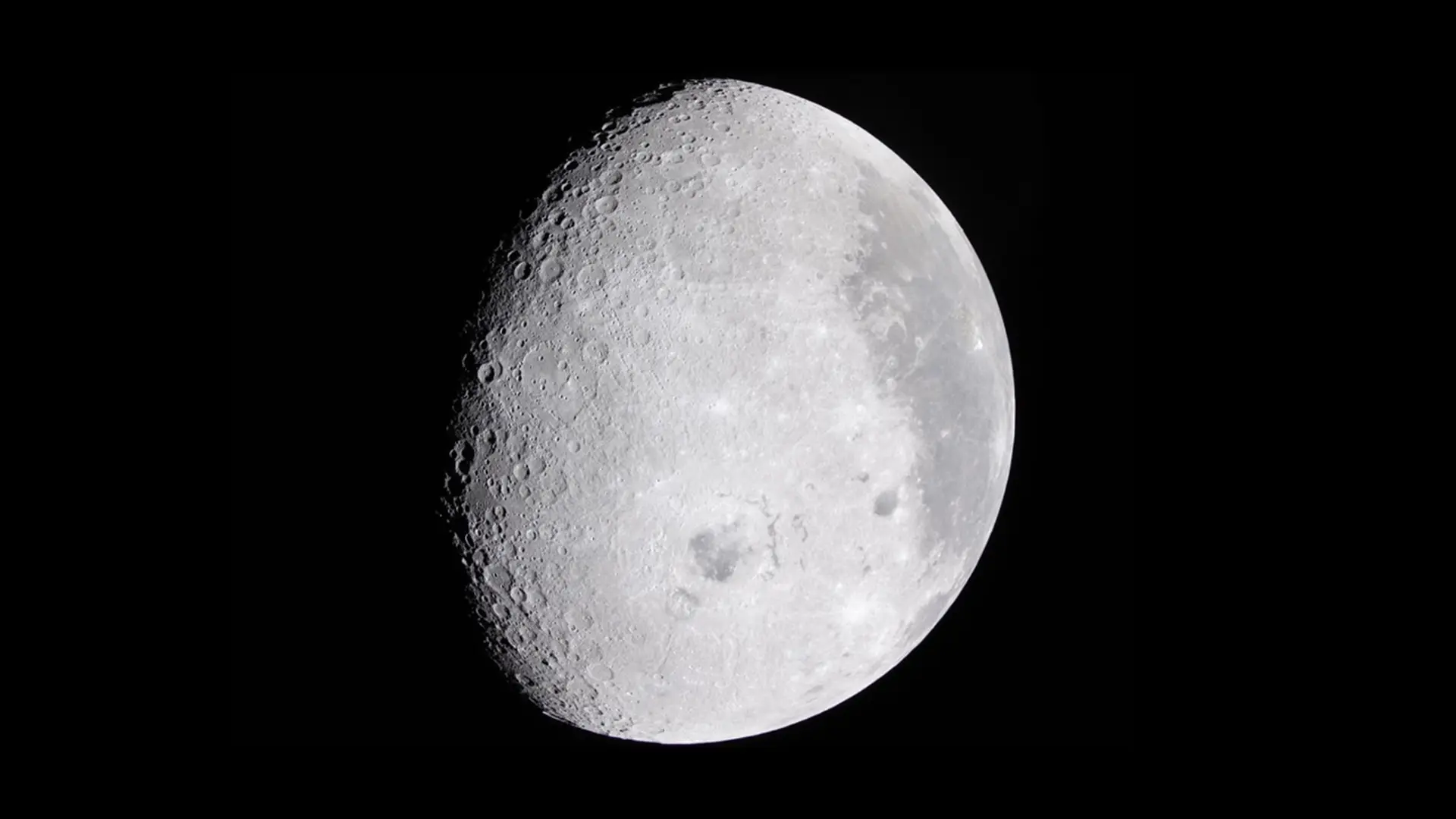
A new artificial intelligence model from NASA and IBM improves the accuracy of identifying key lunar features by up to 22 percent. The NASA-IBM Lunar Foundation Model analyzes petabytes of data collected over decades from lunar sensors and instruments, revealing patterns previously difficult to discern. Researchers can now more efficiently pinpoint potential ice deposits, map volcanic activity, and detect craters with greater precision, supporting plans for a sustained human presence on the Moon. This development helps scientists accelerate lunar exploration, according to the announcement.
Lunar Ice Prediction with 22% Improved Accuracy
The NASA-IBM Lunar Foundation Model achieves up to 22 percent greater accuracy in identifying areas with high potential for lunar ice compared to the SwinV2-B model, a benchmark in image analysis. This improvement stems from the model’s ability to integrate data from multiple sources and resolutions, a capability previously challenging to implement efficiently. The model’s performance was detailed in a NASA-IBM authored technical paper outlining the methodology and results of its testing against established methods.
Beyond ice detection, the model also demonstrates enhanced capabilities in mapping lunar volcanic features, known as Irregular Mare Patches. By utilizing imperfect labels, the model captured the extent of these features with 3 percent greater accuracy than SwinV2-B, while simultaneously reducing the computational cost of fine-tuning the system. Identifying these patches helps scientists understand the Moon’s thermal evolution and plan future surface operations, as they provide insights into the Moon’s volcanic history.
The model’s efficiency is particularly notable given the sheer volume of data it processes; NASA and IBM researchers curated petabytes of lunar observations for its training. The model’s impact extends to crater detection and classification, a vital task for selecting safe landing sites and planning long-term lunar infrastructure.
At a context scale resolution of approximately 100 meters, the NASA-IBM model outperforms SwinV2-B by nearly 19 percent, achieving this improvement with only half the training data, the company says. “NASA has spent decades building an extraordinary scientific record of the Moon, but collecting data is only part of the job,” said Kevin Murphy, chief science data officer and acting chief data and AI officer at NASA Headquarters in Washington.
“We also have to make data easier for scientists to explore and use.” The foundation model is one of the first publicly available tools of its kind, signaling a shift towards open-source artificial intelligence in lunar exploration.
This enhanced precision stems from the model’s ability to utilize imperfectly labeled data, a common challenge in lunar mapping where definitive boundaries are often obscured or difficult to ascertain, according to NASA. The model’s performance represents a step toward more efficient characterization of these formations, aiding future surface operations and resource assessment.
Unified Lunar Dataset Enables Multi-Instrument Analysis
Alongside the model’s release, scientists have also created the first open-source lunar dataset, aggregating over 30 spatially-aligned layers from nine instruments across four missions. This unified dataset was used to build the first open-source lunar dataset of its kind, a unified, machine learning ready lunar dataset combining tens of thousands of images and maps from NASA’s Lunar Reconnaissance Orbiter and GRAIL mission, as well as data from Japan’s SELENE/Kaguya mission.
The new dataset addresses a long-standing challenge in lunar science: the lack of a unified framework for integrating diverse data sources. Before this, researchers struggled to combine observations from different instruments, hindering their ability to identify subtle patterns and anomalies. These formations offer clues to the Moon’s volcanic history and thermal evolution, and the model’s multi-instrument analysis provides a richer understanding of their composition and distribution.
QuAIL’s work focuses on optimization, machine learning, and quantum simulation, using the power of quantum systems to tackle computationally intensive tasks, the company says. This accessibility is intended to democratize lunar data analysis, allowing a wider range of scientists to contribute to discoveries. This integration is critical for identifying subtle patterns and anomalies that might be missed by traditional analysis methods, ultimately accelerating the pace of lunar science.
“Uncovering the mysteries of the Moon requires an ability to learn from an extraordinary volume of scientific data,” a statement from IBM and NASA confirms, highlighting the scale of information now accessible through this new approach.




See today’s quantum computing news on Quantum Zeitgeist for the latest breakthroughs in qubits, hardware, algorithms, and industry deals.