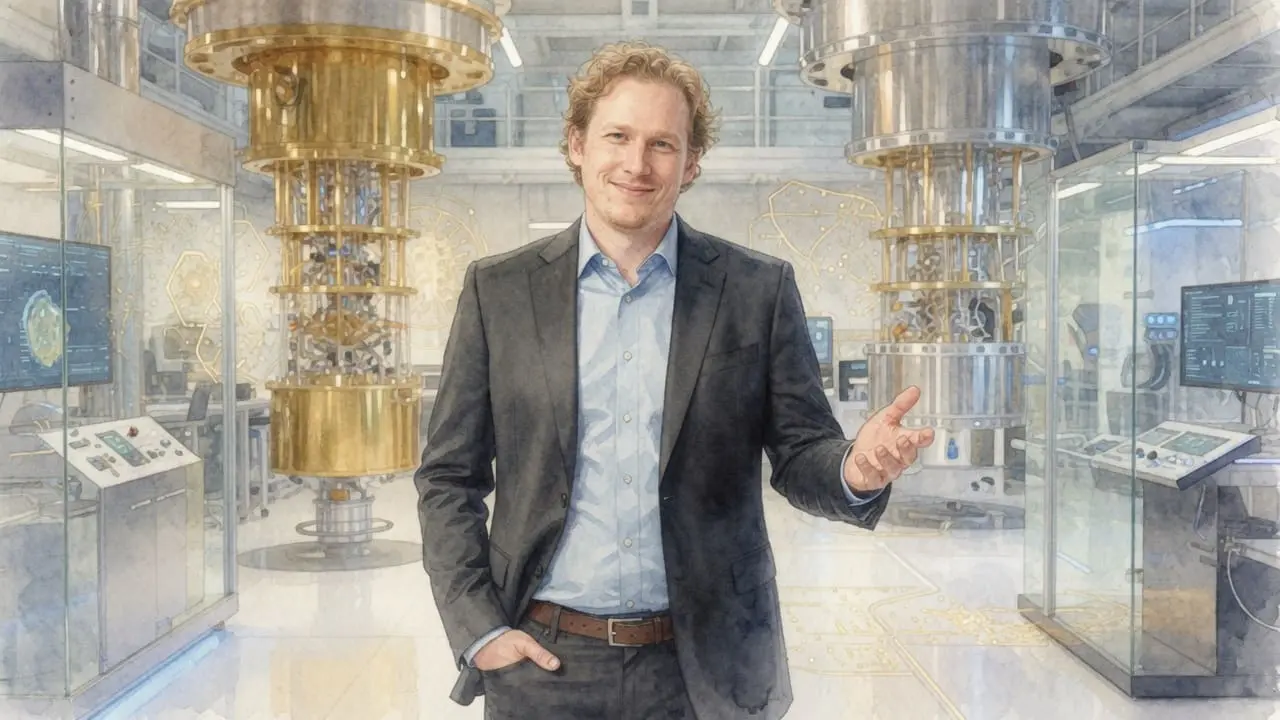
The physicist who turned a research curiosity into a global quantum program, plotting IBM’s course from cloud qubits to fault tolerance.
Jay Gambetta is the Australian-born physicist who sets the technical direction for one of the largest quantum computing efforts in the world. Where many quantum leaders are still chasing their first useful machines, he runs a program that has shipped hardware to a global community for years, and he has spent his career turning that head start into a structured roadmap toward fault tolerance.
He is also one of the field’s most credible voices on where quantum computing really stands, quick to separate genuine progress from hype. This profile traces how Jay Gambetta rose from the theory of open quantum systems to the top of IBM Research, and why the roadmaps he publishes shape expectations across the entire sector.
Understanding Gambetta means understanding a particular idea of how hard technology should be built. He favors public commitments over quiet promises, composite benchmarks over headline qubit counts, and open software over closed advantage. Those preferences run through every stage of his career, and they explain why IBM’s quantum program looks the way it does today.
From open quantum systems to a global program
Jay Gambetta earned his Bachelor of Science at Griffith University in Australia in 1999 and completed his PhD there in 2004 under Howard Wiseman, working on quantum foundations and non-Markovian open quantum systems. That early grounding in how quantum systems lose information would later prove central to everything he built. It gave him a physicist’s instinct for noise as the defining obstacle rather than a detail to be cleaned up later.
The questions he studied as a graduate student were abstract, yet they sat right at the heart of why quantum machines are so hard to build. Understanding decoherence and the flow of information out of a quantum system is the foundation for controlling qubits at all. His work gave him a rigorous physical intuition that he would carry from academia into industry, and it explains why his later engineering priorities always began with error.
This trajectory is unusual. Many of the people now leading large quantum programs began in experimental hardware, yet Gambetta arrived from the theory of open systems and information loss. That perspective gave him an early appreciation for the fact that raw qubit counts mean little without control, coherence, and correction. It would shape the engineering culture he set decades later.
A path through Yale and Waterloo
After his doctorate, Gambetta moved to Yale University as a postdoctoral researcher with Steven Girvin, where he shifted his attention toward superconducting quantum computing. Girvin’s group was central to the circuit quantum electrodynamics approach that treats a superconducting qubit as an artificial atom coupled to a microwave resonator. That method is the foundation of IBM’s hardware today, so the years at Yale connected Gambetta to the exact technology he would spend his career scaling.
In 2007 he joined the Institute for Quantum Computing in Waterloo, working alongside Raymond Laflamme, one of the pioneers of quantum error correction. There he was surrounded by researchers developing the theory of fault tolerance, the very topics that would later dominate his roadmaps. By the time he left academia, Jay Gambetta had touched nearly every layer of the problem, from open-system foundations to real devices and codes. That breadth would prove rare and valuable inside a large company.
Joining IBM and building the quantum stack
Jay Gambetta joined IBM in 2011 to help build a quantum computer based on superconducting qubits. At the time the prospect of a useful quantum machine felt distant, and the team was small relative to the ambition. He brought a clear conviction that progress required combining careful physics with disciplined engineering across the full stack, from the chip to the control electronics to the software a user actually touches.
Over the following decade he rose to become one of IBM’s most influential technical leaders. He was elected a Fellow of the American Physical Society in 2014, named an IBM Fellow in 2018, and appointed Vice President of quantum computing in 2019. In October 2025 he became Director of IBM Research, succeeding Darío Gil, who left to serve as Under Secretary for Science and Innovation at the United States Department of Energy. The promotion broadened Gambetta’s remit well beyond the quantum program he helped create.
The promotions tracked a steady accumulation of results rather than a single headline. Each new processor generation, software release, and benchmark added to a record that made his strategic judgment hard to dismiss. Inside IBM, Jay Gambetta became the person who could speak with equal fluency to physicists, software engineers, and executives. That rare combination is part of why his roadmaps carry so much weight both inside and outside the company.
Putting qubits in the cloud
One of Gambetta’s defining moves was opening quantum hardware to the public. Under his leadership IBM launched the IBM Quantum Experience, a cloud platform that let anyone run experiments on real quantum processors, an approach that drew hundreds of thousands of registered users. That decision turned quantum computing from a closed laboratory pursuit into something a global community could touch, test, and learn from directly.
The cloud strategy was also a hedge against uncertainty. By exposing real hardware to a wide audience, IBM gathered enormous feedback on how machines behaved under genuine workloads. Gambetta has consistently argued that this loop between users and devices speeds up progress more than any closed effort could. The choice helped IBM set the terms of the conversation long before fault tolerance was within reach.
The move also had a lasting cultural effect on the field. A generation of students and researchers first touched a real quantum computer through IBM’s cloud, and many of them now work across the industry. That reach gave Gambetta a kind of soft power that no single product could, because the tools and vocabulary people learned first tend to stick. It is one reason IBM’s framing of the field carries so far.
Qiskit and the software that made hardware usable
Hardware alone cannot make a technology accessible, and Jay Gambetta understood that software would decide who could actually use quantum machines. He helped lead the creation of Qiskit, IBM’s open-source quantum software development kit, which became one of the most widely adopted toolkits in the field. By giving researchers and developers a common language for building circuits, Qiskit lowered the barrier to entry across universities and companies alike.
The choice to make the stack open-source reflected a strategic bet on community. A shared toolkit meant that improvements, tutorials, and applications could accumulate far faster than any single team could manage. Gambetta consistently framed software and hardware as two halves of the same problem rather than separate concerns, and Qiskit became the connective tissue between them.
Software as a performance lever
Qiskit is not only a convenience layer; it is where much of IBM’s performance work lives. Techniques for circuit optimization, transpilation, and error suppression are delivered through the software, so that users gain better results without redesigning their experiments. Recent releases have folded error detection directly into the runtime, pushing more of the reliability burden onto the toolkit rather than the user.
There is a deeper logic to investing so heavily in software. Real quantum processors are noisy, and squeezing useful results out of them depends on smart compilation, calibration, and post-processing. By placing those capabilities in Qiskit, Gambetta ensured that every improvement reached the whole community at once. The toolkit became the channel through which research advances turned into practical gains for ordinary users.
An open ecosystem as strategy
Qiskit also anchors a wider ecosystem of education and partnership that Gambetta treats as part of the engineering effort. The long-running Qiskit summer schools have trained thousands of newcomers, and the toolkit is now benchmarked against rival frameworks by outside groups. That external scrutiny is exactly what Gambetta wants, because a toolkit others measure and stress-test improves faster than one used only in-house.
The ecosystem strategy has a competitive edge as well. Every student who learns quantum programming on Qiskit becomes a potential IBM user, and every research group that builds on the toolkit deepens its dependence on IBM hardware. Gambetta has been candid that community adoption is a moat as much as a public good. It is one of the clearest examples of how he blends open science with commercial strategy.
Measuring progress and the rise of Gambetta’s law
A recurring theme in Gambetta’s leadership is the insistence on measuring quantum computers honestly rather than by qubit count alone. He helped popularize Quantum Volume, a single number that captures how large and how deep a circuit a machine can run reliably, folding in gate errors, connectivity, and crosstalk. The observation that IBM’s Quantum Volume roughly doubled every year became known, half in jest, as Gambetta’s law.
The point of such metrics is to keep the field honest about what actually improves. A processor with more qubits but worse error rates can run fewer useful circuits than a smaller, cleaner one. By championing composite measures, Jay Gambetta pushed IBM and its competitors to compete on quality rather than headline numbers. That framing has aged well as the industry has shifted its attention from qubit counts to logical performance.
Why benchmarks matter more than raw qubit counts
Benchmarks are not an academic nicety for Gambetta; they are how he holds a roadmap accountable. IBM now reports gate speeds, error rates, and the size of circuits its machines can execute, alongside qubit counts. These figures let customers judge whether a processor can run their problem rather than simply admire its scale, and they make backsliding visible.
This discipline also shapes internal priorities. When progress is measured by the depth of circuit a machine can run, teams are rewarded for reducing errors and improving coherence rather than racing to the biggest chip. Gambetta has argued that this focus on usable performance is what separates a science instrument from a press release. It is a quiet but consequential part of how he has steered the field.
The era of quantum utility
By the early 2020s Jay Gambetta began arguing that quantum computers had reached a threshold he described as quantum utility. The idea was that machines could now run circuits large enough to produce results beyond the reach of brute-force classical simulation, even before full fault tolerance arrived. This reframing shifted the conversation from distant promises toward present-day scientific value.
The demonstration that anchored the claim came in 2023, when IBM and the University of California, Berkeley ran a 127-qubit experiment whose output pushed past exact classical methods. The result appeared on the cover of the journal Nature and leaned heavily on quantum error mitigation, a set of techniques that statistically correct for noise rather than eliminating it. When IBM announced the milestone, Gambetta framed it as a turning point rather than a final answer.
As we progress our mission to bring useful quantum computing to the world, we have solid evidence of the cornerstones needed to explore an entirely new class of computational problems. By equipping our IBM Quantum systems with processors capable of utility scale, we are inviting our clients, partners and collaborators to bring their hardest problems to explore the limits of today’s quantum systems and to begin extracting real value.

Heron and the workhorse processors
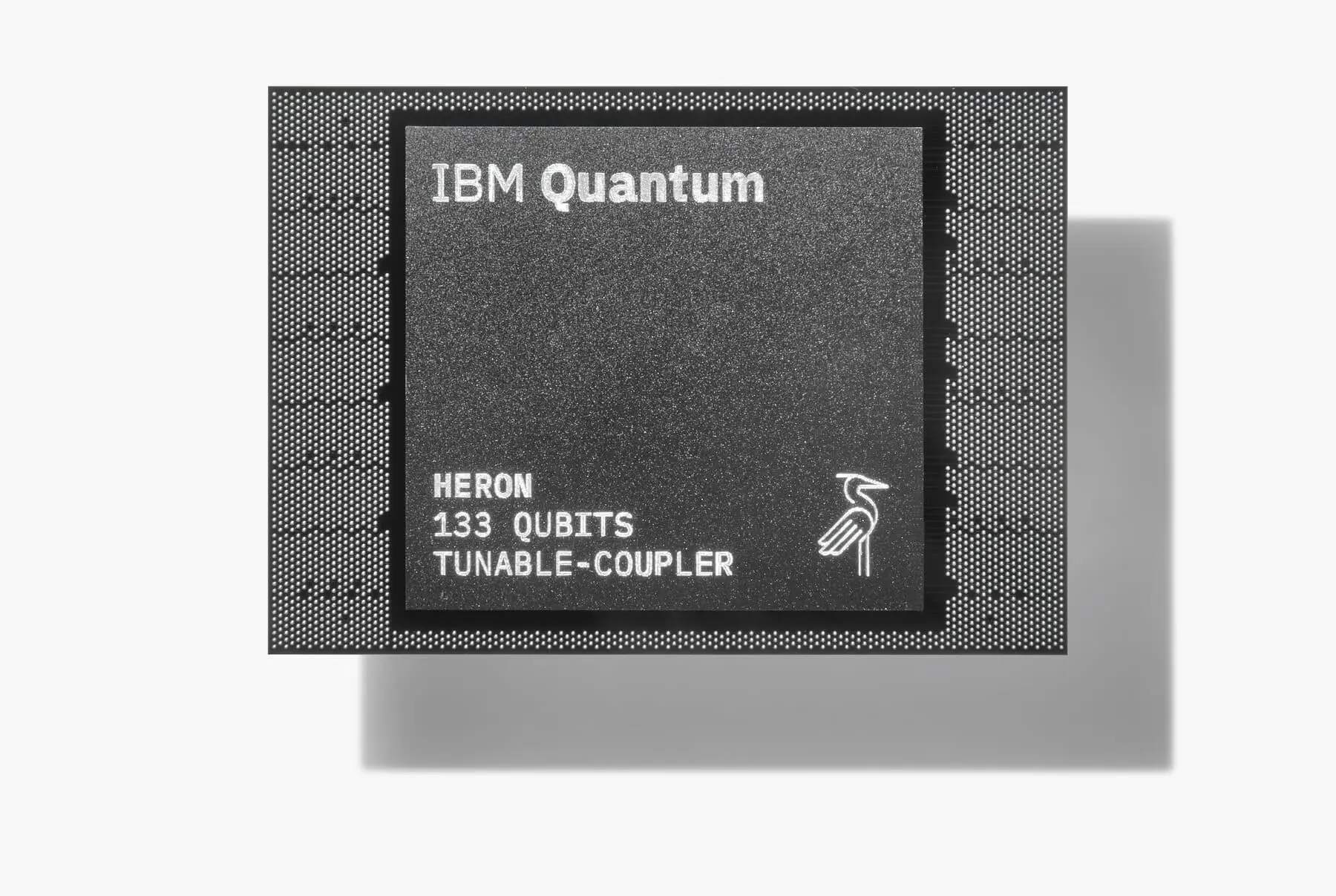
The hardware behind the utility era is IBM’s Heron family of processors, engineered for higher performance and lower error rates than the earlier Eagle generation. The first Heron carried 133 qubits, and a later revision reached 156 qubits in IBM’s heavy-hexagonal layout. These chips became the workhorses for utility-scale experiments across chemistry, materials, and optimization, and outside groups have used them to set records such as a 52-qubit quantum Fourier transform.
The Heron generation matters because it shows Gambetta’s preference for steady, measurable engineering over dramatic leaps. Rather than chasing the largest possible qubit count, the focus moved to gate quality, error rates, and reliability. That discipline made the processors genuinely usable for science instead of only impressive on paper, and it set the stage for the more ambitious error-corrected machines on the roadmap.
Error mitigation as a bridge
Gambetta has been consistent that error mitigation is a bridge rather than a destination. These techniques let noisy machines produce trustworthy averages today, buying time while the field builds toward true error correction. He has warned against treating mitigation as a permanent substitute, since its cost grows sharply as circuits get larger.
That candor about the limits of mitigation is part of why his utility argument landed with scientists rather than only marketers. He was not claiming that noisy machines had solved error; he was claiming they had become useful in spite of it. The distinction matters, and Jay Gambetta has been careful to keep it clear in a field prone to overclaiming.
The machines that house the qubits
Alongside the chips themselves, Gambetta oversaw the systems built to run them. He led the development of IBM Quantum System One, the company’s first integrated quantum computer designed for reliability and continuous operation, and then IBM Quantum System Two, a modular architecture meant to house multiple processors and scale beyond a single chip. The shift from System One to System Two mirrors the strategic move from single processors to modular machines.
System Two is the physical embodiment of the roadmap’s modular philosophy. It is designed to link several processors with the cryogenic infrastructure and control electronics needed to operate them as one machine. That modular approach is central to how IBM plans to grow toward the hundreds of thousands of physical qubits that error correction will eventually demand.

From System One to a modular System Two
The logic of modularity is that no single chip can be scaled indefinitely without the yield and control problems becoming unmanageable. By connecting many moderate processors, IBM hopes to sidestep the limits of any one device. Gambetta has framed this as the only realistic path to the qubit counts that fault tolerance requires, and it is why the roadmap is built around couplers and modules rather than ever-larger monolithic chips.
This engineering choice also changes how progress is delivered. Instead of waiting years for a single giant processor, IBM can ship incremental modules and prove the connections between them step by step. That cadence suits Gambetta’s preference for measurable milestones over dramatic reveals. It also gives customers something concrete to build on at each stage rather than a distant promise.
The couplers that join these modules are as important as the qubits themselves. Short-range couplers link neighbors on a chip, while longer-range connectors are what allow separate modules to share entanglement. Much of the near-term hardware work Gambetta oversees is really about proving these connections at high fidelity, since a modular machine is only as good as the links between its parts. That unglamorous engineering is where a great deal of the roadmap’s risk actually sits.
Designing the road to fault tolerance
Jay Gambetta is perhaps best known for the public roadmaps that have set expectations for the entire industry. Rather than promising a single breakthrough, IBM publishes year-by-year targets for processors, software, and the eventual transition to fault-tolerant machines. This transparency made the roadmap a reference point that competitors, customers, and researchers all watch closely.
The processor lineage behind that roadmap is now well known. Eagle reached 127 qubits in 2021, Osprey reached 433 in 2022, and Condor crossed 1,121 qubits in 2023, proving that IBM could fabricate large superconducting chips. After Condor, Gambetta deliberately turned the emphasis away from sheer size and toward the modular, high-fidelity Heron generation and the error-correction machines that follow it.
Nighthawk and the near-term push
The near-term workhorse on the roadmap is Nighthawk, a 120-qubit processor with 218 tunable couplers designed to run deeper, more connected circuits than Heron. IBM positions Nighthawk as the engine for demonstrating verifiable quantum advantage, with later revisions intended to run circuits of many thousands of gates across linked modules. It is the step that connects today’s utility-scale work to the error-corrected future.
Nighthawk reflects the same philosophy that runs through Gambetta’s tenure. The goal is not the biggest possible chip but the most capable one for real circuits, measured by the depth and connectivity a machine can actually deliver. By pairing more couplers with modest qubit counts, IBM aims to make each processor genuinely more useful rather than merely larger.
Toward Starling by 2029
Further out, the roadmap points toward a system called Starling, which IBM aims to deliver in 2029 as its first large-scale, fault-tolerant quantum computer. IBM says Starling will host roughly 200 logical qubits capable of running on the order of one hundred million quantum operations. Modular processors named Loon, demonstrated in 2025, Kookaburra in 2026, and Cockatoo in 2027 are positioned as the stepping stones that get there.
Publishing such specific targets is itself a strategic choice. By naming systems, dates, and qubit counts in advance, Gambetta invites scrutiny that a vaguer plan would avoid. The bet is that public accountability sharpens execution and gives partners the confidence to invest alongside IBM. Beyond Starling, IBM has sketched an even larger machine called Blue Jay, aimed at 2,000 logical qubits and a billion operations by 2033.
The bet on qLDPC and bicycle codes
A central technical bet in the strategy is a class of quantum low-density parity check codes, including a bivariate bicycle code, which IBM says can cut the number of physical qubits needed for error correction by roughly an order of magnitude compared with more conventional approaches. Choosing this route over the more familiar surface code reflects Gambetta’s willingness to back ambitious engineering when the physics supports it.
The stepping-stone processors are built to prove this bet in stages. Loon is designed to test the long-range couplers that qLDPC codes require, Kookaburra is meant to be the first module that stores information in a qLDPC memory, and Cockatoo is intended to entangle two such modules together. If the codes hold up at scale, the payoff is a far more practical path to large error-corrected systems than the surface code alone would allow.
There are many pillars to bringing truly useful quantum computing to the world. We believe that IBM is the only company that is positioned to rapidly invent and scale quantum software, hardware, fabrication, and error correction to unlock transformative applications.
The race to verifiable quantum advantage
The nearest milestone on Gambetta’s roadmap is what IBM calls verifiable quantum advantage, a clear and independently checkable case where a quantum computer outperforms the best classical methods on a useful problem. IBM has said it is on a path to demonstrate such an advantage by the end of 2026, a claim Gambetta has tied to concrete hardware and algorithm work rather than a single stunt.
This near-term target reflects how Gambetta has reframed the whole debate. His mission has three parts, running systems beyond classical brute force, delivering a verifiable advantage, and staying on the path to fault tolerance by 2029. By insisting that advantage be verifiable, he is trying to hold the industry to a higher standard of proof than earlier supremacy claims, which relied on contrived benchmarks that classical methods later challenged.
Gambetta has also been careful to distinguish advantage from utility. Utility means a machine is useful for science even without beating every classical method, while advantage means it clearly outperforms them on a real task. Keeping those terms separate is a small discipline that has helped IBM avoid the credibility problems that followed earlier, looser claims. It is another example of how Jay Gambetta tries to manage expectations as deliberately as he manages hardware.
Partnerships that anchor the roadmap
A roadmap this ambitious depends on money, manufacturing, and customers, and Gambetta has helped line up all three. IBM has committed more than ten billion dollars to its quantum program over five years, a scale of investment that few rivals can match. That commitment funds the fabrication, cryogenics, and control electronics that a fault-tolerant machine will require, and it signals that IBM intends to see the plan through.
Just as important are the users who put the machines to work. IBM has run joint projects with Allstate on portfolio-style optimization, with the Cleveland Clinic and RIKEN on modeling a large protein, and with national laboratories on particle-physics simulations. These collaborations are the proving ground for Gambetta’s utility argument, because they show real organizations extracting value rather than running abstract benchmarks.
The wider IBM Quantum Network ties hundreds of companies, universities, and laboratories into the same hardware and software stack. Gambetta treats this network as more than a customer list, because the feedback it generates shapes what IBM builds next. When a research group hits a wall on a real problem, that experience feeds back into the roadmap and the priorities for Qiskit and the next processor.
Supercomputers and the hybrid future
Gambetta has been consistent that quantum computers will work alongside classical supercomputers rather than replace them. IBM has linked its machines with high-performance computing centers, including a multi-year push with partners in Illinois, and it frames the goal as quantum-centric supercomputing that routes each part of a problem to the hardware best suited to it. That vision assumes quantum processors will be accelerators inside a larger computing fabric.
This hybrid framing matters for how the roadmap will actually be used. Few real workloads are purely quantum, so the value often comes from combining a quantum subroutine with heavy classical processing. By investing in the software that stitches the two together, Gambetta is trying to make sure IBM’s machines are usable the day they arrive rather than years later. It is a pragmatic stance that fits his broader emphasis on measurable, near-term value.
A leadership style rooted in physics
What distinguishes Jay Gambetta is the blend of deep technical credibility with the willingness to commit publicly to dates and numbers. He has authored well over one hundred scientific papers, and his work spans superconducting qubits, quantum codes, gate fidelity, coherence, and error mitigation. That research record gives weight to the strategic calls he makes, and it lets him defend a roadmap in technical detail rather than in slogans.
Gambetta also treats the broader ecosystem as part of the engineering problem. By opening hardware and software to outside users, he helped create a feedback loop in which real workloads shape what IBM builds next. The strategy assumes that a healthy community of users and developers accelerates progress more than secrecy ever could, and IBM’s deep partnerships with universities and national laboratories are the visible result.
Balancing ambition with honesty about noise
A recurring theme in how Gambetta communicates is his candor about the limits of current machines. He has been clear that today’s processors are noisy and that error mitigation is a stopgap rather than a final answer. That honesty has helped temper hype while still making a confident case for steady progress, and it has earned him credibility across both academia and industry.
This balance is not always comfortable. Committing to a fault-tolerant machine by 2029 invites criticism if any milestone slips, and Gambetta has accepted that exposure deliberately. He argues that a public, checkable plan is worth more than a cautious silence, because it lets the whole field measure IBM against its own words. That willingness to be judged is central to how he leads.
The honors and the record behind them
Jay Gambetta’s recognition tracks the arc of his contributions. His election as a Fellow of the American Physical Society in 2014 acknowledged his scientific standing, and his appointment as an IBM Fellow in 2018 marked him as one of the company’s most senior technical figures. These distinctions are reserved for sustained, field-shaping work rather than single results.
His move to Director of IBM Research in 2025 placed quantum leadership inside a much wider research mandate that spans artificial intelligence, semiconductors, and hybrid cloud. It signaled that the quantum program he nurtured had become central to IBM’s long-term identity. Few individuals have carried a single technology from laboratory experiment to corporate strategy so directly.
The breadth of his output reinforces the point. Gambetta’s papers are cited tens of thousands of times, and his name appears across many of the milestone results that define the superconducting approach. That citation record is not just an academic statistic; it reflects how often his methods became the tools others build on. It is the quiet evidence behind the public titles.
Why Jay Gambetta matters in quantum computing
Jay Gambetta matters because he turned a speculative research direction into a structured industrial program with measurable milestones. His insistence on publishing roadmaps forced the whole field to reason about timelines, hardware generations, and the real requirements of error correction. That discipline reshaped how seriously quantum computing is taken by industry and governments alike.
He also matters because his choices have downstream effects on thousands of practitioners. The decision to open hardware through the cloud and to build Qiskit as open-source software shaped how a generation learned to program quantum machines. Whether or not every target is met on schedule, Gambetta has defined much of the vocabulary and expectations the field now uses.
There is also a broader lesson in how he has worked. Gambetta showed that a research lab could set a public schedule for a technology as uncertain as quantum computing and then be held to it in the open. That model of accountable, milestone-driven science has been copied across the industry, for better and worse, and it raised the standard for what a credible roadmap looks like.
Ultimately his legacy will be judged on whether IBM reaches large-scale fault tolerance along the path he laid out. The bet on qLDPC codes and the Starling system is bold, and it places his technical judgment at the center of a high-stakes race. For now, Jay Gambetta remains one of the most consequential figures steering the future of quantum computing.
Frequently asked questions
Who is Jay Gambetta?
What is Jay Gambetta’s current role at IBM?
What did Jay Gambetta study?
When did Jay Gambetta join IBM?
What is Qiskit and what is Gambetta’s connection to it?
What is Gambetta’s law?
What is the era of quantum utility?
What is IBM’s Starling system?
What are qLDPC codes and why do they matter?
When does IBM expect quantum advantage?
What honors has Jay Gambetta received?



See today’s quantum computing news on Quantum Zeitgeist for the latest breakthroughs in qubits, hardware, algorithms, and industry deals.