Five years ago this month, a quantum company rang the opening bell on a US exchange for the first time. That company was Arqit, a British quantum encryption firm briefly valued at close to $3 billion, now valued considerably less. Seven pure-play quantum computing companies have followed it onto American markets since, and between them they have produced a five-year record that deserves closer inspection.
I have assembled the complete daily closing record for every quantum listing, from each company’s first session through the end of August 2026, and built it into a Pure Play Quantum Index, equal-weighted and rebalanced monthly, with the methodology published alongside. The data settles several questions that coverage of this sector usually leaves to impression. All figures are closing prices, which sit slightly below the intraday extremes commonly quoted, and nothing in this piece is investment advice.
The quantum sector trades on a cycle
IonQ listed first among the pure plays in October 2021 at a $9.20 first close and trades at $39.31 today. Rigetti and D-Wave followed in 2022 near ten dollars and are up 66 and 72 per cent, respectively. After a long gap, the class of 2026 arrived: Infleqtion in February, Quantinuum through a $60 IPO in June, Finland’s IQM in July, and France’s Pasqal at the end of August, and every newcomer with more than a week of trading currently sits below its first close.
The older three tell you most. All three broke their listing prices within a year of the bell, with Rigetti failing to close above ten dollars on any of its first 126 sessions and D-Wave managing only a handful of days better. Their lows were severe, $3.10 for IonQ and roughly forty cents for the other two, and the recoveries took a further two years to carry each back above its reference price.
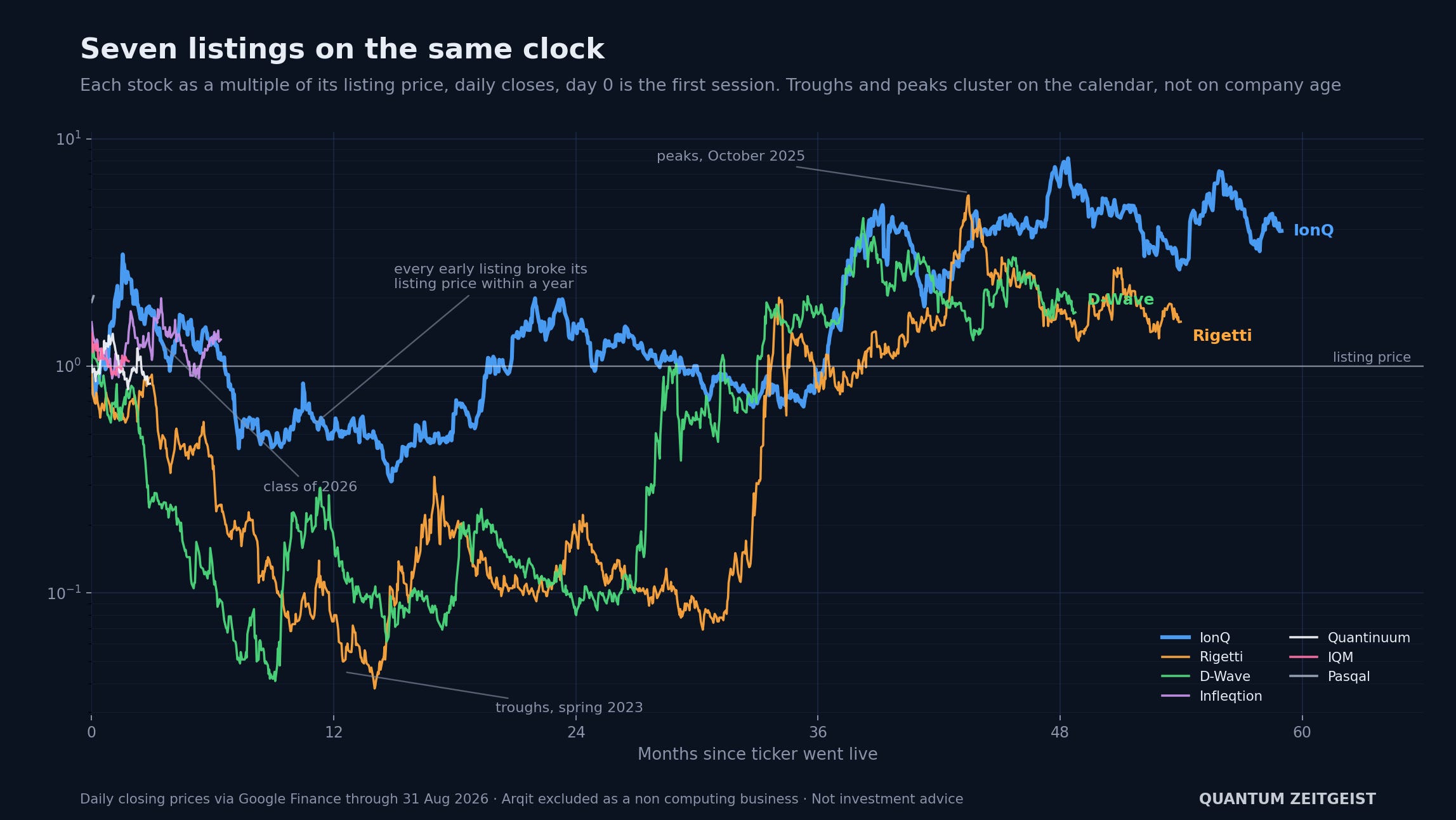
Now look at the dates rather than the ages. These three companies listed a year apart, yet all of them hit bottom in the same few weeks of spring 2023, and all of them peaked in the same week of October 2025, one at 38 months old, one at 43, one at 49. The market clearly wasn’t working through each company’s story on its own timetable. It moved the whole sector at once, and each stock simply joined the ride wherever it happened to be standing. Five years of evidence says the conditions a quantum company lists into matter more than anything it brings to the listing.
Three companies now move as one
You can put a number on this. In 2022, the daily returns of IonQ, Rigetti and D-Wave barely correlated at all, averaging 0.14 across the three pairs, about what you would expect from three small companies pursuing different technologies. The figure has risen every year since, through the recovery, the rally and this year’s decline, and stands at 0.89 for 2026, with Rigetti and D-Wave at 0.93. A single common factor now explains 93 per cent of the group’s daily variance, and at that level the market is treating the three as a single position.
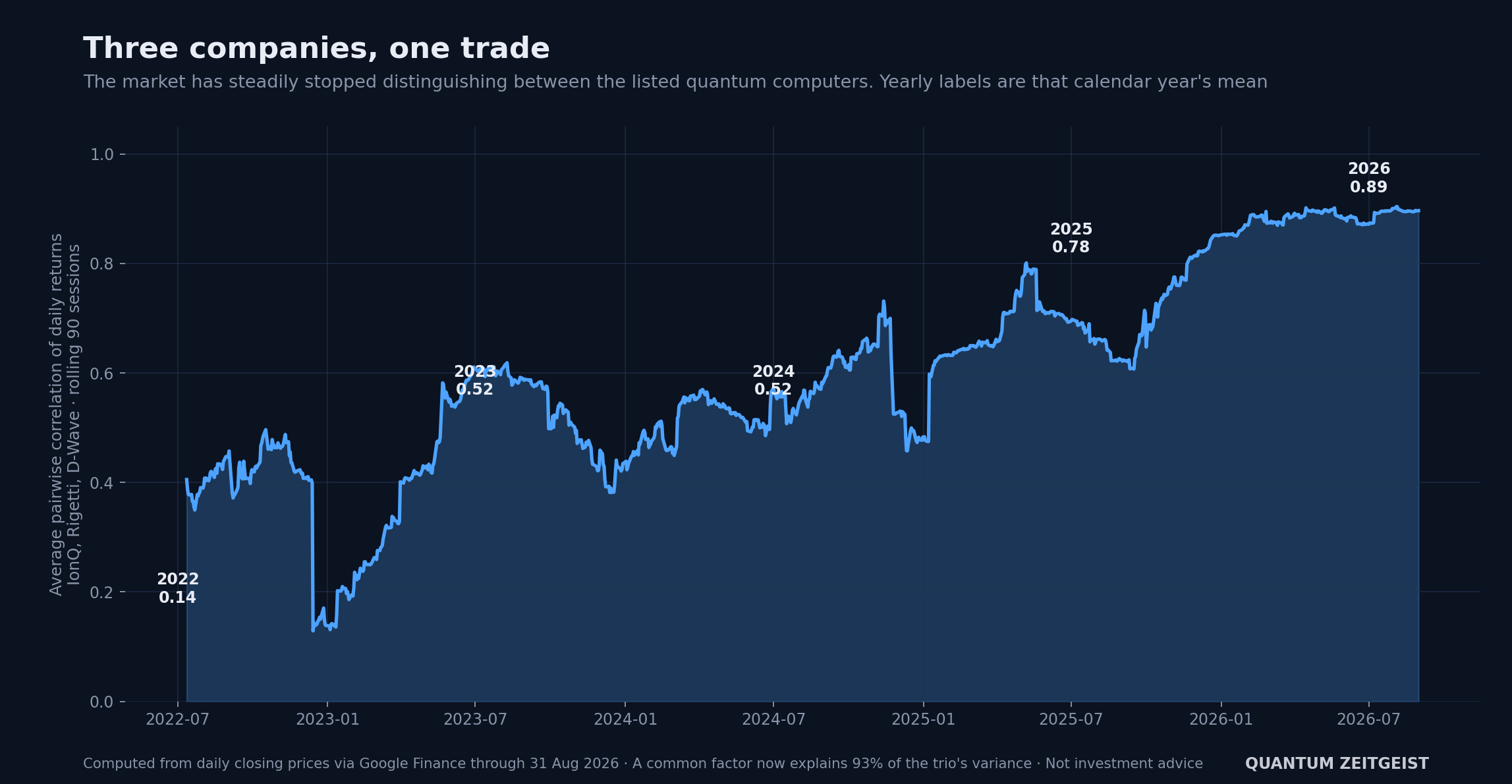
The group also amplifies the wider market, and the amplification has been growing. Betas to the Nasdaq sit near two over full lifetimes and near three over the past ninety sessions, so a one per cent move in the index has been worth roughly three per cent in these stocks through the summer, and the record shows the older names carrying higher betas on index down days than on up days. New listings are absorbed quickly. Infleqtion builds neutral atom systems with little engineering overlap with trapped ions or annealers, and within weeks of its February debut its shares were moving with the incumbents at correlations of 0.7 to 0.8. If you analyse these companies for a living, the uncomfortable conclusion is that sector exposure and timing have decided almost everything, and picking the right name has been a footnote.
Alpha has been a property of the period
Jensen’s alpha is the standard tool for separating what a company earned from what its market exposure handed it, the annualised return left over once a stock’s sensitivity to the index is stripped out. Run it on the quantum names, and you get the clearest finding in this whole exercise. From the May 2023 lows to the October 2025 peak, every listed quantum company generated strongly positive alpha, with Rigetti above 140 per cent a year and D-Wave not far behind. In the eleven months since, every one of them has generated strongly negative alpha, at annualised rates between minus 54 and minus 123 per cent, with no corresponding change in the underlying technology’s progress in either period. The residual that alpha is designed to isolate has itself been the sector cycle.
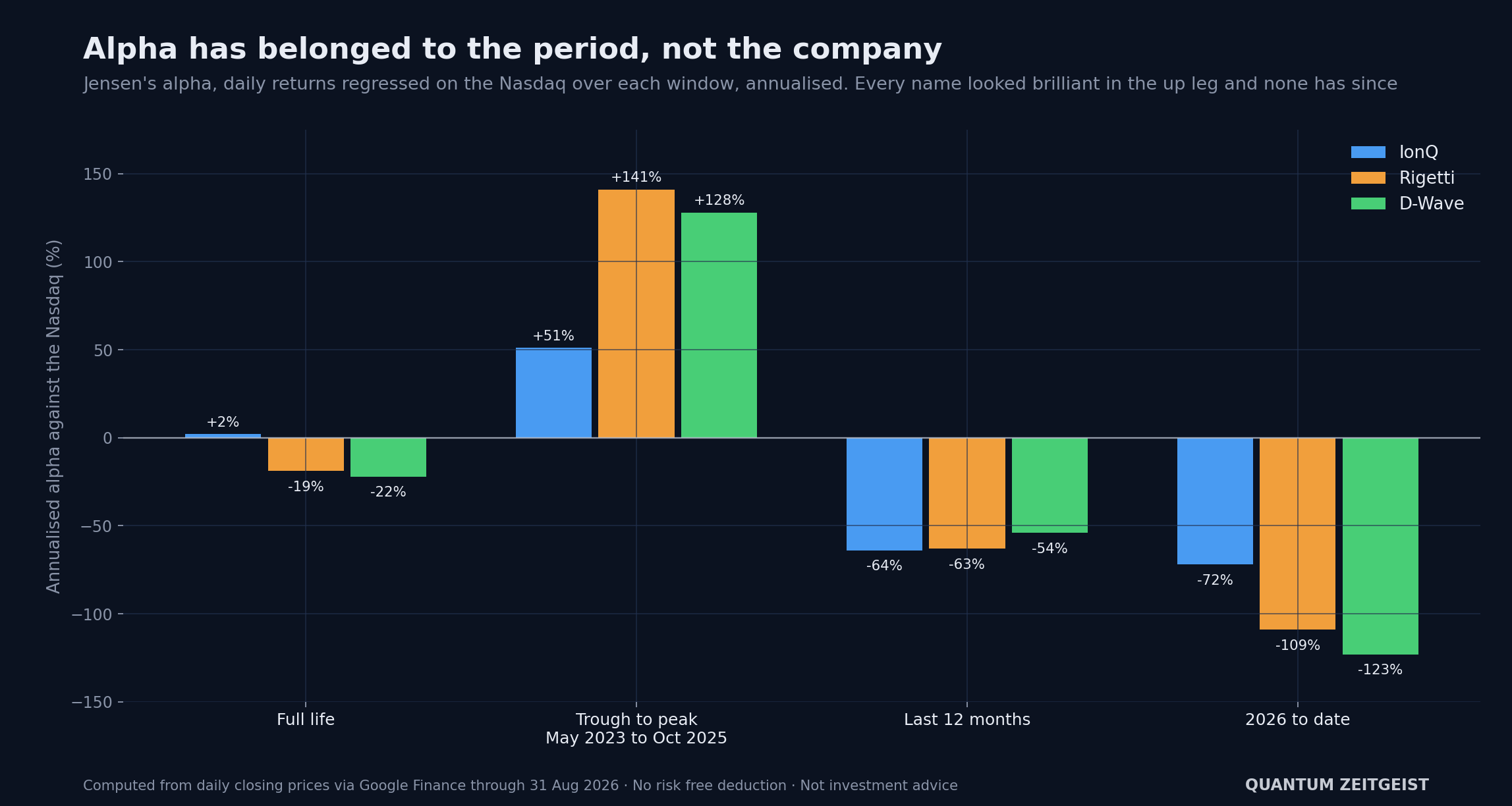
IonQ needs a careful caveat, because it is the closest thing this record has to a winner, and it’s easy to overclaim. It holds the only lifetime alpha that nets out positive, at around two per cent a year, alongside the lowest volatility in the group, the shallowest maximum drawdown, and considerably more revenue per dollar of market value than any peer. It has not, however, been the largest winner from any shared starting point, since Rigetti and D-Wave returned several times more from the common 2023 trough, a direct consequence of their higher volatility. The record supports describing IonQ as the best survivor of the cycle. It does not support describing any listed quantum company as a demonstrated source of persistent alpha.
Diamond Handing Quantum Stock
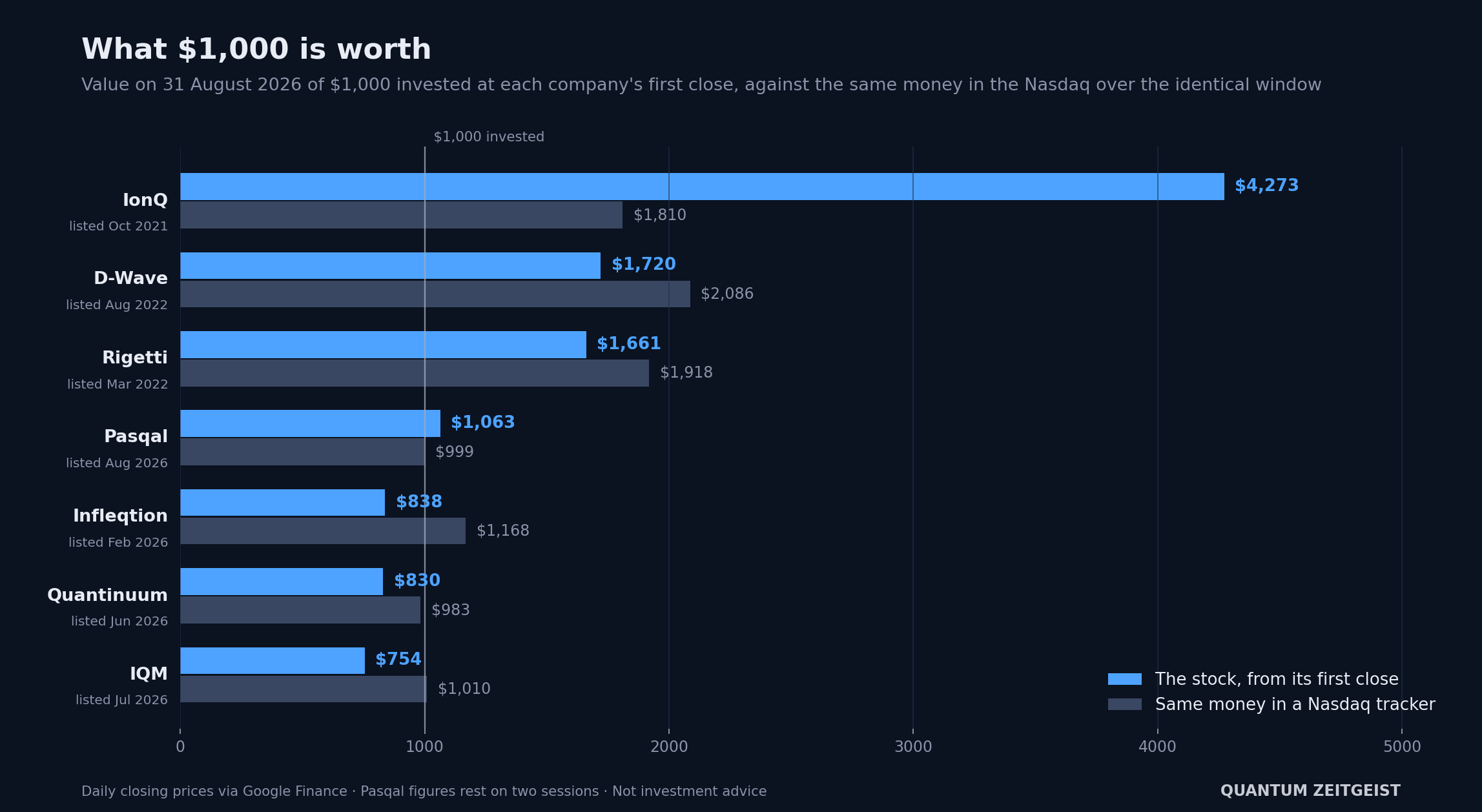
The plainest way to judge all this is to hand each first-day buyer a thousand dollars and count what is left. The IonQ holder has $4,273 today against $1,810 for the same money in a Nasdaq tracker, the only holder in the group to have beaten the index, and the path ran through a low of $337 before the recovery began. The Rigetti and D-Wave holders have around $1,700 each against tracker values near $2,000, positive in absolute terms and behind the market, with each stake worth roughly forty dollars at the 2023 lows. Every buyer of this year’s listings is below water while the broader index made a record in June.
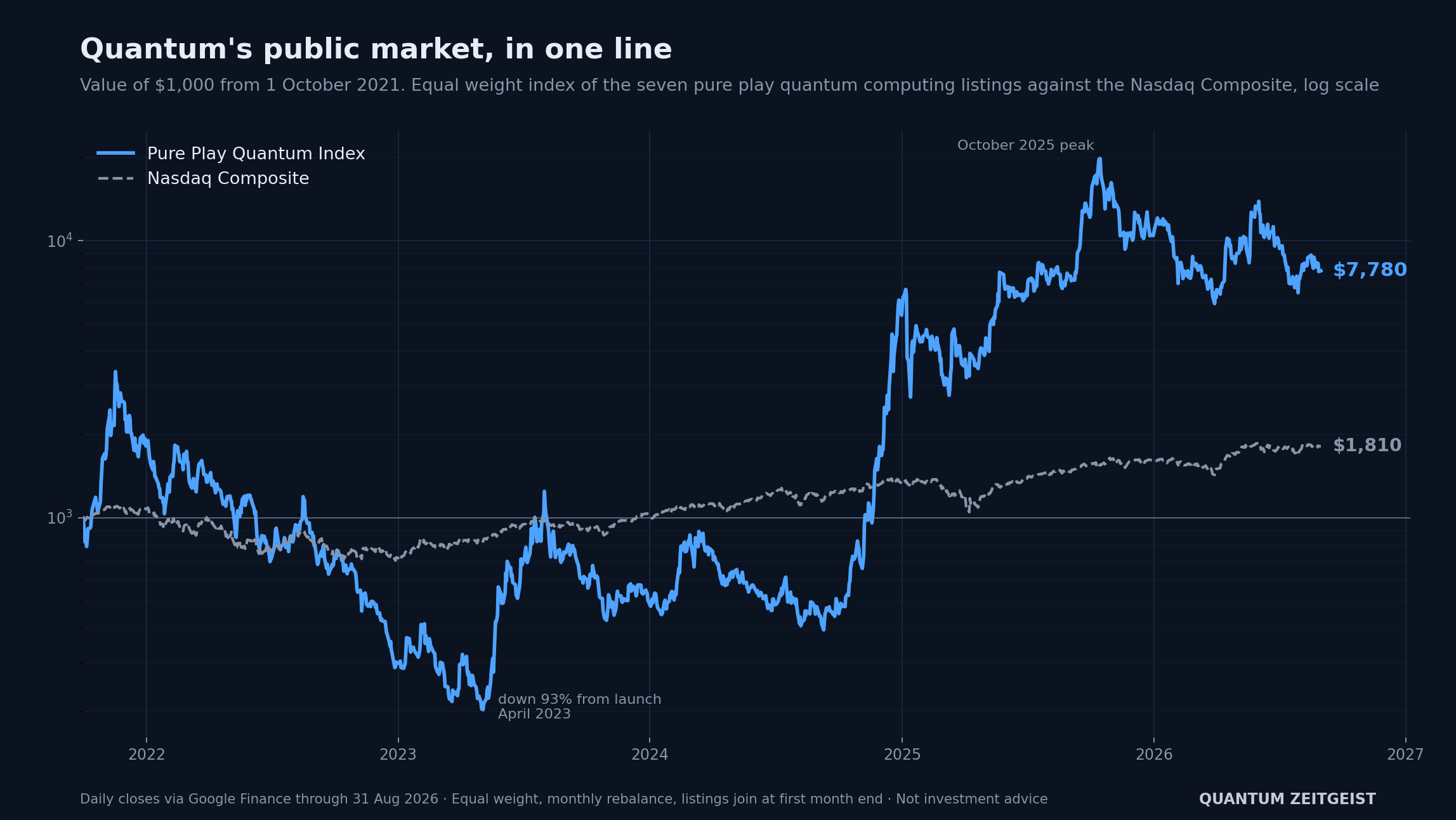
The aggregate looks much better, and every qualification belongs next to the number. The Pure Play Quantum Index turns $1,000 from October 2021 into roughly $7,780, a 52 per cent annual rate against 13 for the Nasdaq, achieved through a 94 per cent drawdown, volatility above 100 per cent annualised, and around seven in ten sessions spent more than half below the running high. A substantial part of the outperformance comes from the monthly rebalancing itself, which mechanically bought more of the collapsed names near the 2023 lows, a discipline it is fair to say no real portfolio manager likely maintained.
The last qualification is the one nobody prints. Restoring Arqit to the identical construction reduces the ending value from $7,780 to about $2,940, so the pure play framing alone nearly triples the sector’s apparent outcome, and the excluded company was the strongest opener of the entire 2021 wave before losing all of its value effectively.
What the Future May Bring
All this settles the past without telling us the future, so rather than a forecast, here are the three questions the next year will answer. The first is whether the class of 2026 quantum companies avoids the first-year pattern. Quantinuum listed with roughly $2 billion of cash and IQM with a substantial order book, resources the 2022 cohort could only dream about. Yet all three seasoned newcomers sit below their first closes in a rising market, and their lockup expiries begin arriving from late this year, the same supply mechanism that contributed to the original declines. Whether funded balance sheets hold a line that narrative could not is the sector’s live experiment. Pasqal is just days into its post-SPAC, so it’s really very early.
The second is whether the correlation ever breaks. At current levels, execution barely registers in the price, and the first company to decouple on its own results, in either direction, will be the most informative data point the sector has produced since the Willow announcement began the 2024 rally. The third is what ends the current decline, because the 2023 bottom arrived only after the wider market turned and lifted the sector with it, while the Nasdaq today is near a record rather than in a bear market, which removes that mechanism and leaves quantum to find a floor on its own for the first time in its public history.
After five years of this data, I would distrust anyone who claims to know the answers or has a crystal ball because the same stocks produced triple-digit positive alpha and then triple-digit negative alpha with no change in the science in between. But I think as time progresses, many may begin to look at Quantum as AI-adjacent or post-AI. As the AI boom sops up record investments, investors will no doubt be looking for the ‘next big thing,’ and now we have had 5 years of pure-play quantum companies; you could argue the quantum computing sector is heading toward some form of maturity.
Those existential days of penny stocks a few years back feel like a distant memory and will have spooked many an investor, but the sector has not only survived and thrived. We have seen massive M&A activity as companies jostle to build an R&D machine in the race to achieve milestone after milestone. I think we can safely say we survived a quantum winter. I’m being deliberate in how I chose the companies because QCI is not included, and neither is Zapata, which did lose its stock market listing only to rise from the dead.
Quantum equities trade as one leveraged expression of sentiment toward the field; the returns have gone only to holders who sat through drawdowns that very few investors sit through. Those investors must have had conviction when stocks like D-Wave were warned they breached the NASDAQ’s $1 minimum, especially since Zapata’s first incarnation was not so lucky. Those who took the plunge at the nadir have done very well and potentially made life-changing money, but choosing the winners is never easy.
Disclaimer
This article and the Pure Play Quantum Index are journalism and commentary, published for information only, and nothing here is investment advice, a recommendation, or an offer or solicitation to buy or sell any security. The author is not a regulated financial adviser, and readers considering any investment should consult a professional authorised in their jurisdiction. Figures are computed from daily closing prices obtained through Google Finance and cross-checked where possible, with the dataset and methodology published so any number can be rebuilt, but accuracy is not warranted, and corrections will be made when errors are found. The index is an analytical construction rather than an investable product; its rules are editorial judgments disclosed with their sensitivities, and past performance is no guide to future results, in a sector whose own record shows patterns reversing without warning. The securities discussed are exceptionally volatile; several lost more than ninety per cent of their value within the period covered, and investors in such securities can lose everything.

See today’s quantum computing news on Quantum Zeitgeist for the latest breakthroughs in qubits, hardware, algorithms, and industry deals.