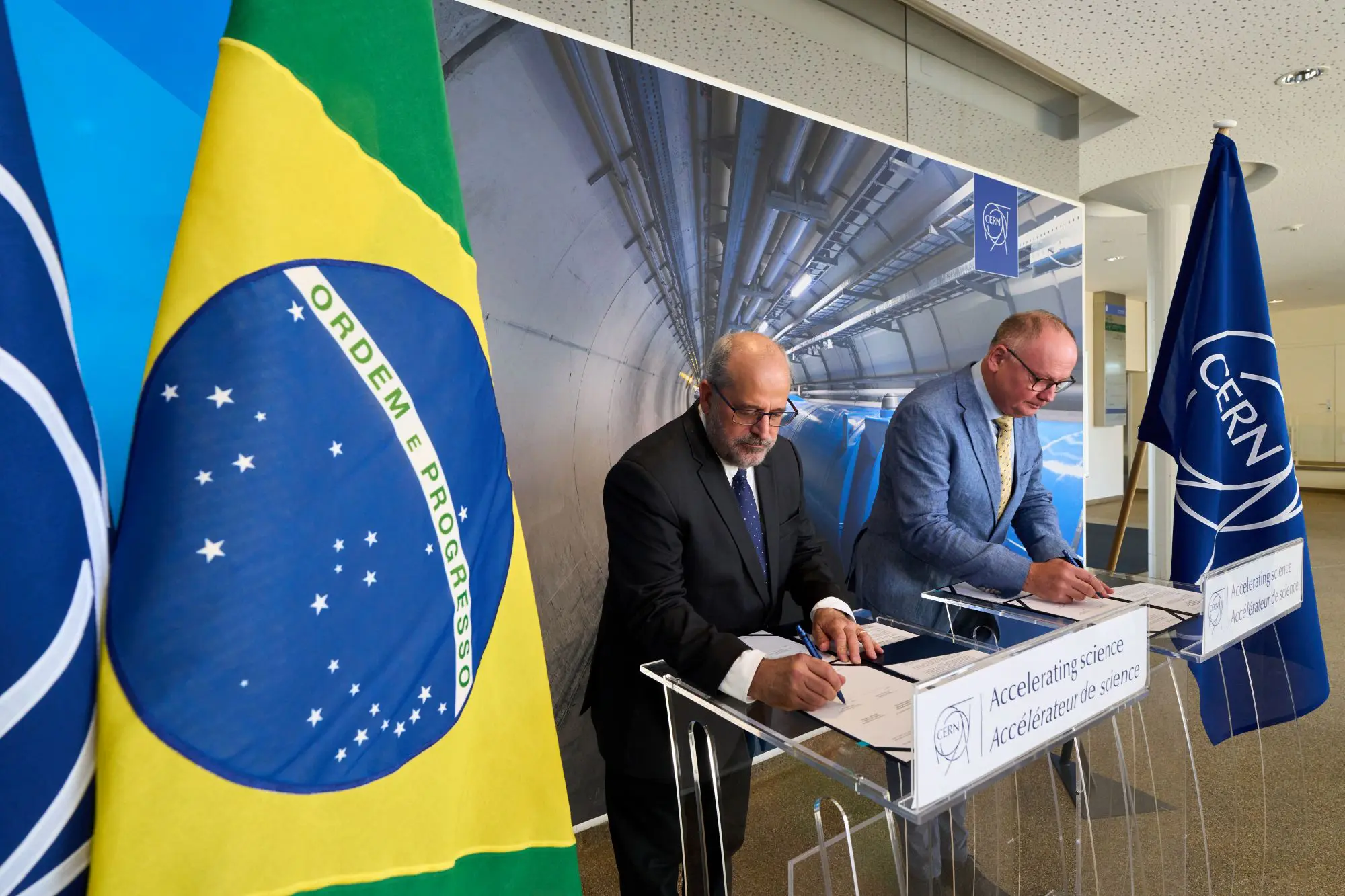
The Brazilian National Center for Energy and Materials Research (CNPEM) is expanding its collaboration with CERN on critical magnet technology for future particle physics projects. New agreements formalize CNPEM’s contribution to prototypes for the 91-kilometer Future Circular Collider (FCC) and the ALICE 3 detector, while doubling the number of Brazilian professionals training at CERN to ten, the company says. The partnership will focus on developing dipolar magnets for the FCC’s transport line and a superconducting solenoid for ALICE 3, with a prototyping phase estimated at 5.1 million Swiss francs.
CNPEM and CERN Expand Collaboration on Future Circular Collider Prototypes
The development of a superconducting magnet measuring approximately four meters in diameter and seven meters in length is now underway thanks to expanded collaboration between CNPEM and CERN. This large-scale magnet forms a key component of the proposed 91-kilometer Future Circular Collider (FCC), with CNPEM contributing to its design and prototyping as an “in-kind” contribution, according to the agreement. The partnership signifies a deepening commitment to particle physics technology and a recognition of Brazilian expertise in the field.
CNPEM will now send ten professionals to CERN for training, doubling the initial cohort of five technical collaborators who began their work in 2025 and are now entering their second year of the program. These individuals are actively involved in projects related to the FCC and the High-Luminosity LHC, the ongoing modernization of the existing Large Hadron Collider.
A second group is scheduled to arrive at CERN in January 2027 for an initial year-long placement. The expanded program aims to foster international collaboration and facilitate the transfer of technical knowledge, allowing Brazilian professionals to gain experience with technologies. Stated officials during the signing ceremony held at CERN headquarters in Switzerland. Salvatore Mele, head of relations with non-member states at CERN and special advisor for relations with Brazil and Chile, further emphasized the long-term benefits of the partnership.
Quando visitei o CNPEM pela primeira vez, em 2019, discutimos como uma parceria mais próxima com o CERN poderia trazer benefícios duradouros para as duas instituições. Acima de tudo, vimos uma oportunidade de ajudar a próxima geração de engenheiros e profissionais de tecnologia an adquirir experiência em tecnologias de ponta.
ALICE 3 Detector: CNPEM to Develop Superconducting Solenoid Prototypes
CNPEM will contribute to the construction and testing of prototypes for the superconducting solenoid planned for the ALICE 3 detector, a project funded with an estimated 5.1 million Swiss francs for qualification of superconducting conductors and insulation systems. This phase includes trials of manufacturing techniques and the building of a demonstrator coil, marking a significant expansion of Brazilian involvement in large-scale particle physics projects. The solenoid, a cylindrical electromagnet, will measure particle characteristics by analyzing the curvature of their trajectories within the ALICE 3 detector, designed to study particles produced by collisions at the Large Hadron Collider.
The collaboration aims for project construction and testing to occur in Brazil, coordinated by CNPEM and involving multiple national companies, with the complete magnet fabrication contingent on successful prototyping and a subsequent agreement addendum, according to the company. “É um ímã supercondutor de grande porte, com cerca de quatro metros de diâmetro e sete metros de comprimento.
Trabalhamos no projeto conceitual desde o ano passado como uma contribuição “in-kind” do CNPEM ao CERN/ALICE,” explains James Citadini, Deputy Director of Technology at CNPEM, detailing that an international review in early October will assess the conceptual design before prototyping begins. This builds on CNPEM’s experience with the Sirius light source and other projects, allowing them to contribute to challenges presented by both the FCC and ALICE 3.
CERN’s expertise in superconducting technology, honed over decades of building magnets for particle accelerators, is increasingly relevant to quantum computing development; the organization’s Quantum Technology Initiative applies this knowledge to qubit development and participates in the EU Quantum Flagship, the firm reports. The organization, founded in 1954 and headquartered in Geneva, Switzerland, also recently developed six Timepix chips deployed on NASA’s Artemis II mission to measure radiation exposure, demonstrating a broadening scope beyond pure particle physics. “Novos acordos abrangem protótipos para o futuro colisor FCC e para o detector ALICE 3, além da ampliação de programa de formação de profissionais brasileiros,” confirms the agreements formalizing CNPEM’s expanded role.
The scale of the Future Circular Collider is now drawing deeper contributions from Brazilian researchers; CNPEM will develop prototypes for dipolar magnets essential to the 91-kilometer accelerator’s transport line, the company states. These magnets will guide particle trajectories, a critical function for maintaining beam stability within the massive facility, and represent a significant expansion of CNPEM’s role beyond initial agreements. This expanded partnership also encompasses prototype development for a superconducting solenoid intended for the ALICE detector, a planned upgrade to the Large Hadron Collider.
The solenoid will be integral to ALICE 3’s ability to study the quark-gluon plasma, a state of matter thought to have existed shortly after the Big Bang, and builds on CNPEM’s growing involvement in both accelerator and detector technologies. CNPEM’s commitment extends beyond hardware; a doubling of the professional training program will send an additional five specialists to CERN for extended periods, increasing the total number of Brazilian professionals embedded within the European organization to ten. This sustained investment in personnel development reflects a strategic effort to foster long-term collaboration and build Brazilian capacity in particle physics.
CNPEM Contributions Leverage Sirius Expertise for Particle Physics Projects
The scale of the Future Circular Collider is now drawing deeper contributions from Brazilian researchers; CNPEM will develop prototypes for dipolar magnets essential to the 91-kilometer accelerator’s transport line. This sustained investment in personnel development reflects a strategic effort to foster long-term collaboration and build Brazilian capacity in particle physics.

See today’s quantum computing news on Quantum Zeitgeist for the latest breakthroughs in qubits, hardware, algorithms, and industry deals.