The emergence of the quantum game seems rather contrived, but quantum games have stopped being a curiosity confined to physics outreach stalls and have become a small but real category, with their own studios and their own arguments about what counts. The label now covers two very different things, and a third that sits awkwardly between them, and the difference matters far more than the marketing suggests.
For most of the last decade a quantum game meant a puzzle app built by a researcher in their spare time, released for free, and quietly abandoned once the grant ran out, and that era is over. In the past year a London company has put a free browser game in front of thousands of players with every level drawn on a real quantum processor, followed it with a hackathon and a Halloween demo in which the player is a zombie split into two exotic particles.
A Romanian studio has spent years turning quantum circuit design into a Steam puzzle game, and a Danish university has kept a citizen science game running long enough for its players to appear in research papers. These projects are routinely bundled together under one heading, and they should not be.
The cleanest way to sort them is to ask a single question of each game. Is there a quantum computer involved in playing it, and if so, where? The answer splits the field into quantum games that put real hardware in the loop, quantum games that teach quantum computing while running entirely on a laptop, and quantum games that use players as a research instrument, where the physics being studied is real even if the machine on the desk is not. The rest of this piece takes each in turn, then surveys the titles themselves and looks at the grey zone of quantum branding that sits around all three.
Underneath those three camps sits an older and simpler split, between quantum games built to teach quantum physics or quantum computing and quantum games that use a quantum effect as part of how they work, whether through a real chip, a borrowed rule or nothing more than the name. The teaching quantum games are judged on whether a player comes away understanding superposition or a logic gate, while the others are judged as games first, and the sections below keep the two sides apart because they succeed or fail on different terms.
Quantum games with a quantum computer in the loop
The first camp is the one that has generated the headlines, because it is the one where the words quantum computer can be used without any hedging. These are quantum games in which some part of what the player sees or does is produced by a real quantum processing unit, or QPU, the physical chip on which qubits are manipulated, sitting somewhere at the back end. The player does not write circuits and does not need to know a qubit from a bit. The hardware is a hidden engine, in the same way that a cloud graphics server is hidden behind a streamed game.
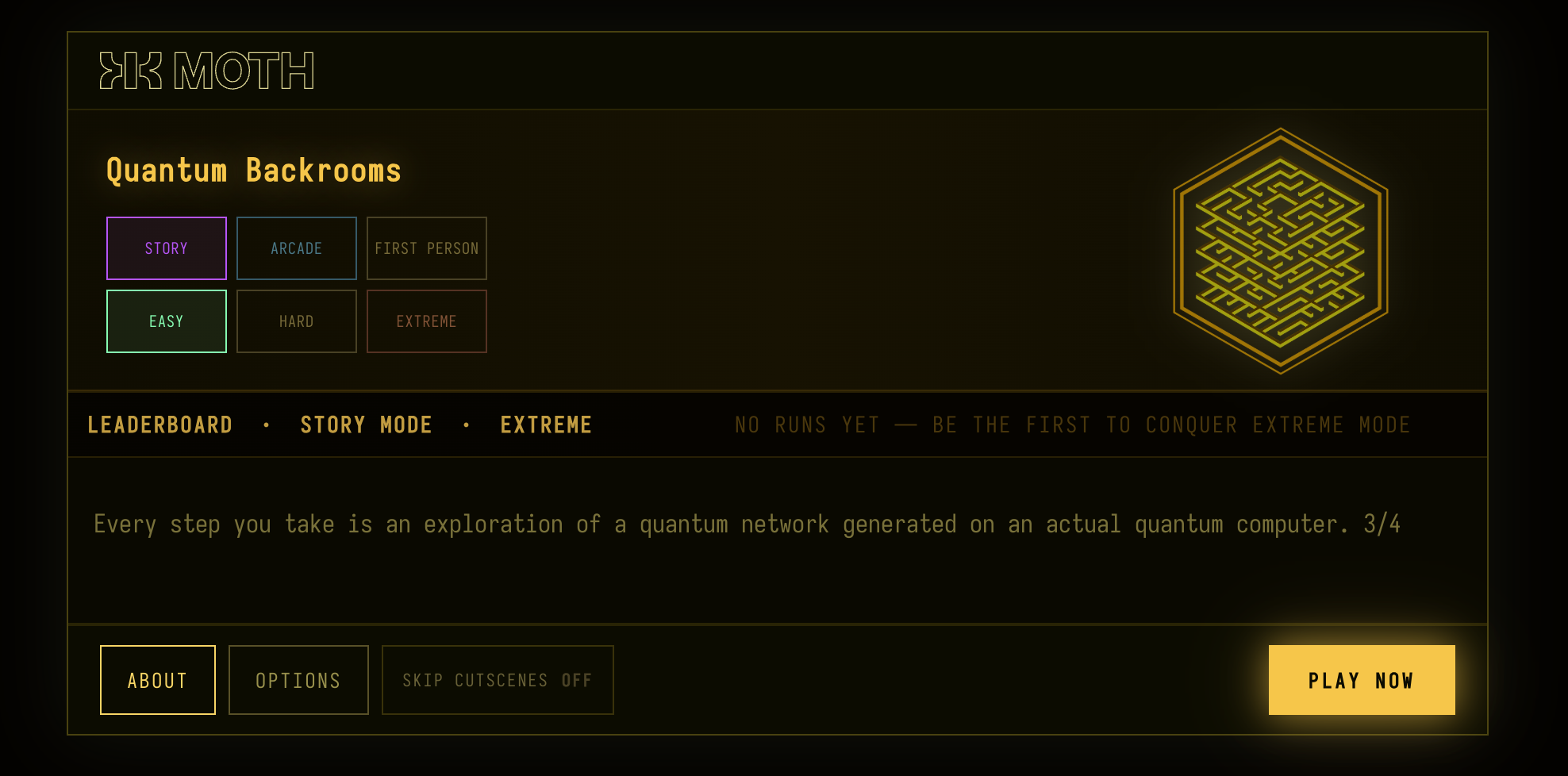
Moth Quantum, the London quantum software company co-founded and chaired by Ilyas Khan, who founded Cambridge Quantum and is a founder of Quantinuum, is the company whose quantum games make up most of this camp. Its earlier project Space Moths, a multiplayer Roblox game built with Onward Studios and shown at Gamescom 2025, generated its levels in real time on superconducting hardware from IBM, IQM and VTT‘s fifty-qubit machine, and was pitched at the games industry as a demonstration. Quantum Backrooms, released at the end of May, was pitched squarely at consumers.
It is a free browser game in which the player wanders through endless shifting corridors, every layout generated in advance on real IBM and IQM processors, so that the game players run is itself classical (as Wootton puts it, “we use the QPU to make the levels, and then players play on those levels”), and the mapping between chip and world is unusually literal. Each qubit stands for a section of the map, and the physical links between qubits on the processor, the paths along which two qubits can be made to interact, decide which routes through the maze exist.
A player sees rooms and doorways and never learns that the layout is a portrait of a specific chip. The mechanic rests on QuantumGraph, whose programming model Moth set out in a May 2026 paper that formalises an approach running from quantum imaginary time evolution, a way of steering a quantum system towards a target state, to procedural generation in games, and Moth is careful to say that none of this gives the game any speed or capability a classical engine lacks. The game arrived the day before A24’s Backrooms film reached cinemas, which put a quantum product in front of an audience that would never have gone looking for one, and thousands played it on launch day.
Moth has been open that the game is the demonstration and that the product underneath is Atlas, a low-code platform intended to let creators and studios build quantum applications on real hardware without a physics doctorate. This autumn the company ran a hackathon in a Soho basement, where anyone could walk in and try Atlas while a smaller group built projects on it, and QZ covered the event at length in The Launch of Quantum Computers for Creatives.
The scientific credibility comes from James Wootton, Moth’s chief scientific officer, who spent years at IBM Quantum building tools such as Quantum Blur, which encodes an image as a quantum state so that gates can be applied to it, and QuantumGraph, the process that drives Backrooms. Wootton is the thread that ties this camp to its own prehistory, because in 2017 he made what he calls the first game to run on a quantum computer, a rock-paper-scissors variant, followed by a version of Battleships, using IBM’s five-qubit cloud device, at a time when doing so was a stunt rather than a product.
The most recent Moth release shows the model bending. Braided, a Halloween demo built on Atlas and released a month after a Global Quantum Game Jam whose theme was braiding, casts the player as a zombie split into two halves which are Majorana particles, exotic objects first described by the physicist Ettore Majorana in 1937 that can either cancel each other out or combine into an ordinary particle when brought together. Whether the two halves of the zombie reunite or vanish depends on the paths they have walked, a property called braiding that is the basis of one proposed route to error-tolerant quantum computers.
The physics is implemented through Matching Codes, a family of quantum error correcting codes that naturally describe Majoranas, and Moth found that this particular quantum behaviour can be emulated on a conventional computer fast enough to play in real time, so Braided runs without a quantum processor at all. A company that built its name on putting real hardware in the loop has shown that, for some mechanics, faithful emulation of the physics is enough, and that quietly blurs the line between this camp and the next.
The honest question to ask of the hardware-in-the-loop model is what the quantum computer contributes that a classical procedural generator could not. Moth’s answer is that quantum hardware produces textures, layouts and noise with a character of their own, and that the point of putting it in front of consumers is to build the familiarity that will eventually let people ask for more.
Harry Kumar, Moth’s co-founder, has said plainly that “Moth is not a company that is focused on building games or developing games” and compares quantum today with AI development in 2016. At the Backrooms launch he put the bet more broadly, saying “The next leap in quantum computing will not come from hardware alone.” Whether that becomes a lasting creative advantage or remains an elegant piece of positioning depends on what Atlas users build once it moves beyond its closed alpha, and that is still an open question.
Quantum games that teach quantum computing without one
The second camp is older, larger and far more useful to anyone who wants to work in the field. These are quantum games whose subject is quantum computing but whose engine is entirely classical. They simulate a handful of qubits on an ordinary processor, which is easy for small systems, and they use that simulation to make the rules of quantum information into something a player can push against. Nobody needs a cloud account, nothing goes to a data centre, and the quantum computer, if it appears at all, is the thing the player is learning to program rather than the thing running the game.
The game that proved this camp could reach a mass audience was Quantum Chess. Chris Cantwell built it as a graduate student at the University of Southern California, and it lets a piece occupy two squares at once through superposition, the state in which a quantum object holds more than one value until it is measured, and lets two pieces become entangled, so that resolving the position of one fixes the position of the other.
It reached millions of people through a filmed match between Stephen Hawking and the actor Paul Rudd, narrated by Keanu Reeves, directed by Alex Winter and produced by Caltech‘s Institute for Quantum Information and Matter for a Feynman celebration in January 2016, which passed a million and a half views in its first week. The game went into Steam early access in December 2016 and left it in February 2017.
Cantwell went on to publish a mathematical framework for designing quantum games and to found a studio, Quantum Realm Games, which now sells a Unity toolkit called Quantum Forge for putting real quantum behaviour into other developers’ games. Many quantum versions of familiar games since, from Quantum TiqTaqToe to Cheqqers, have followed the pattern of taking a game everyone already knows and letting its pieces behave like qubits.

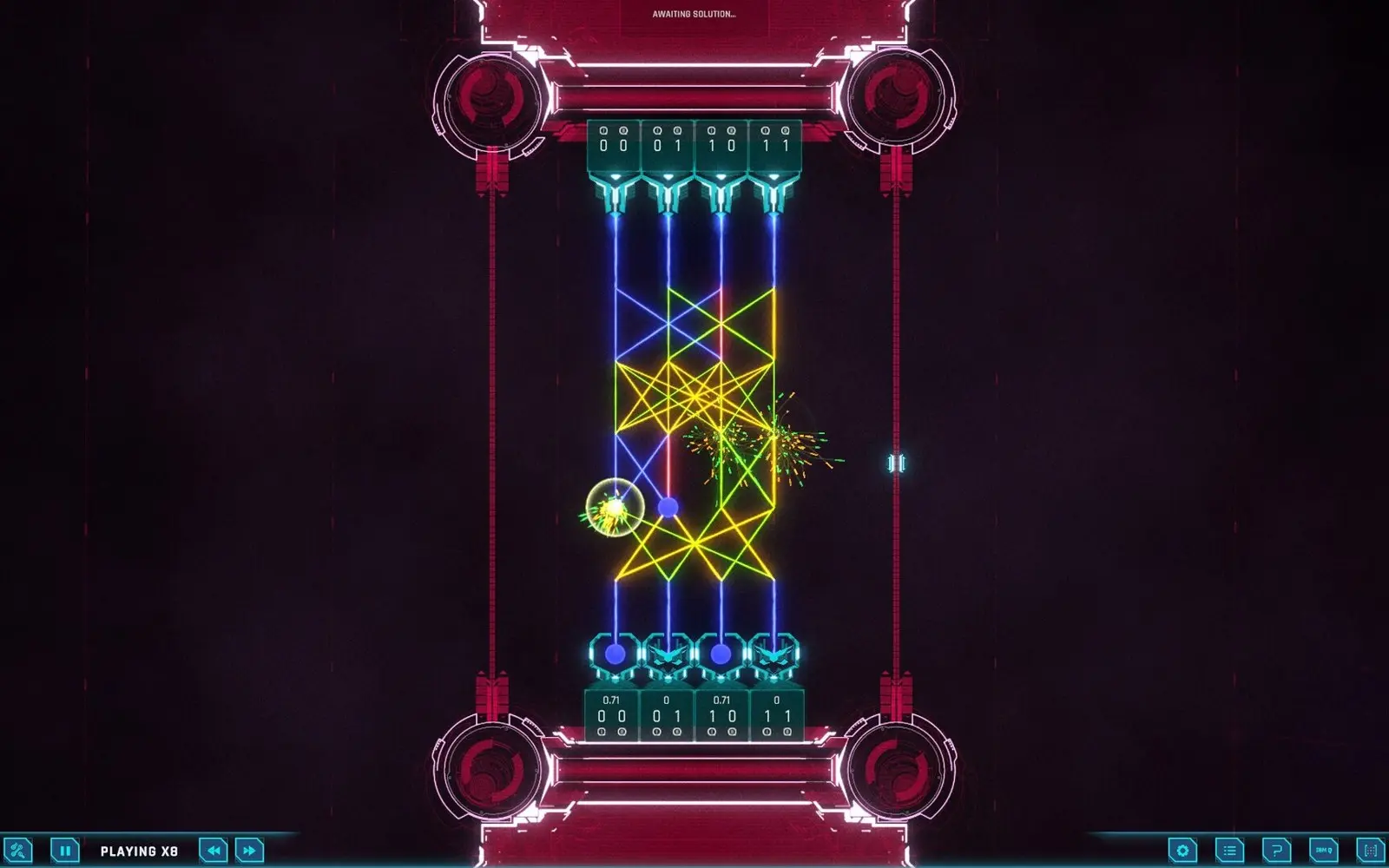
Quantum Odyssey from Quarks Interactive is, alongside Quantum Chess, one of the few teaching quantum games sold commercially on Steam. Built in Romania by Laurențiu Niță, whose doctoral research produced the visual system the game runs on, it reached Steam Early Access in January 2025 after years of development and has been patched steadily since, and the studio says a player needs no coding or physics background.
The player builds quantum circuits, sequences of operations applied to qubits, as visual puzzles in the open-ended style of Zachtronics titles such as Opus Magnum, and the studio’s claim is that a player with no science background can move from nothing to designing working algorithms in weeks. It offers hundreds of puzzles across branching story paths, a sandbox called The Forge for building original algorithms, and the notable feature that anything designed inside the game can be exported and run on IBM hardware. That last point is the bridge between the two camps, since the game itself never touches a quantum computer but its output can.
The lineage behind these runs through a decade of smaller titles. Hello Quantum, made by James Wootton with IBM in 2018, while he was at the University of Basel, taught two-qubit logic through a grid puzzle somewhere between Sudoku and pinball, and its explanatory text formed the first posts on the Qiskit blog. Cheqqers, a quantum version of draughts from Evert van Nieuwenburg’s group at Leiden published last year, added its quantum rules in four graded levels so that a player meets superposition, entanglement and interference one at a time.
Google Quantum AI‘s Qubit Game is an idle builder in which the player grows a quantum computer while heat and cosmic rays chip away at it, which turns decoherence, the loss of quantum information to the environment, into something a player feels rather than reads about. QZ’s guide to ten quantum games covers the current crop in more detail.
Circuit and gate puzzles
Quantum Odyssey is not the only circuit puzzle, and a free way into the genre is QuantumVR, a free Steam game from SZENARIS and the Technische Universität Braunschweig, released in April 2023 for VR headsets with a 2D version, in which the player places simple quantum gates to solve small algorithms and free animals. A more hacker-friendly cousin is QiskitBlocks, which James Weaver of IBM presented at IEEE Quantum Week in 2022 and which is built on the Minecraft-like engine MineTest, so that building the circuit each puzzle asks for opens the next, as QZ reported in its piece on gamified learning in the quantum space.
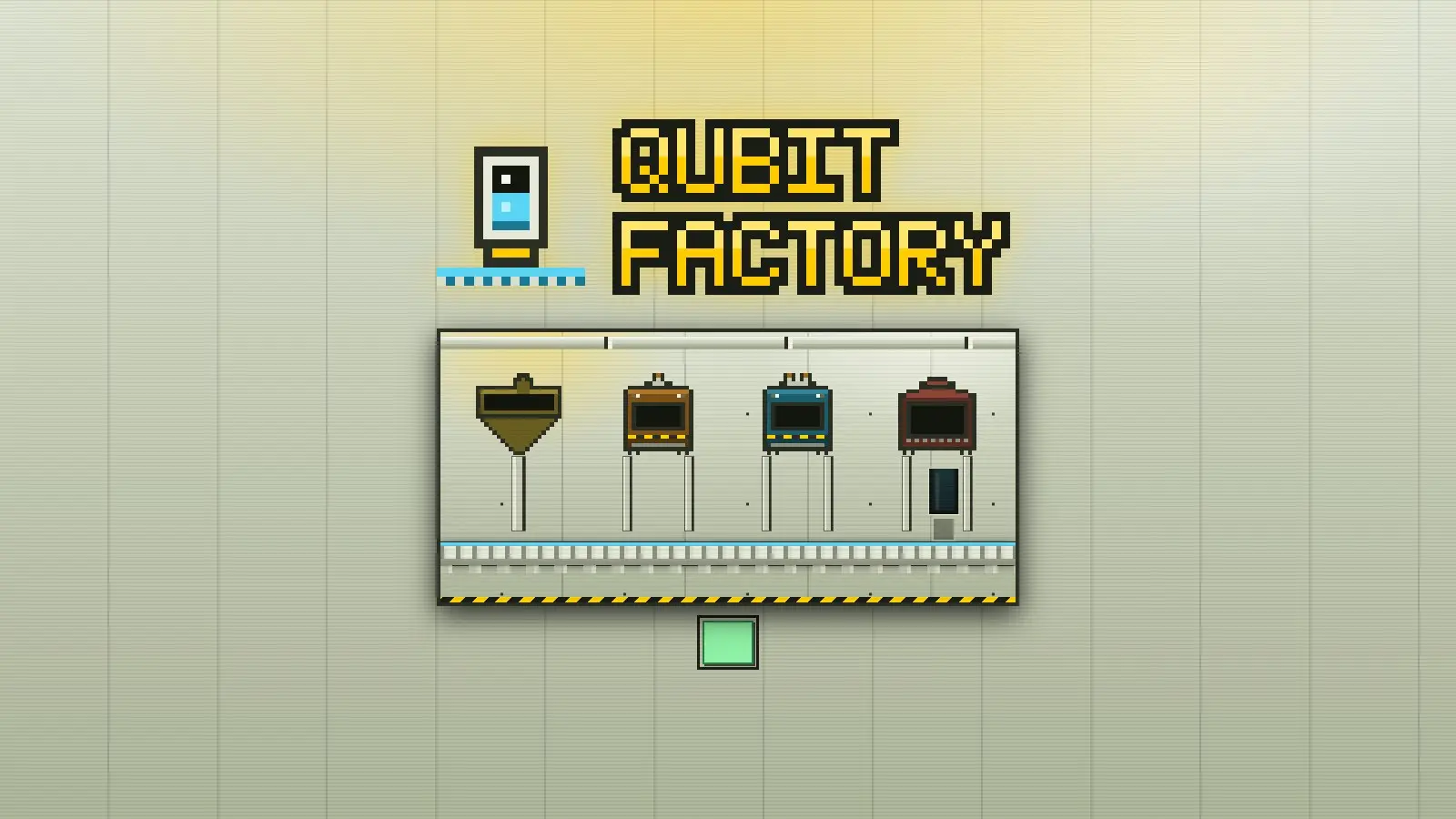
Circuit puzzles are also turning up on smaller sites built for people who want a quick route in. Quantum Nerds, a free learning site from the publisher of this article, packages browser games and quizzes as eight cassette tapes in an Arcade, and its lead title is Qubit Factory, which should not be confused with The Qubit Factory, a separate free Steam game by the quantum researcher Glen Evenbly.
The player runs circuits of one or two qubits and then watches the game count the results of a hundred fresh runs, which shows in a few seconds how individual random readings build into the statistics a quantum program produces, an idea beginners often find hard to believe. It is typical of a wider pattern in this camp, in which small, free, single-concept quantum games sit beside the larger titles rather than competing with them.
Quantum versions of games everyone knows
Quantum Chess and Cheqqers belong to a family that goes back further than either, and its oldest member is probably Quantum Tic-Tac-Toe, which Allan Goff of Novatia Labs first described with Dale Lehmann and Joel Siegel in a 2002 conference paper before setting it out in the American Journal of Physics in 2006. Each move marks two squares with a pair of linked marks, and when the marks form a cycle the position is forced to collapse into one of its possibilities, which teaches entanglement and measurement with nothing more than a grid.
The idea came back as Quantum TiqTaqToe, an iOS and Android app announced in July 2019 on the blog of Caltech’s Institute for Quantum Information and Matter by Evert van Nieuwenburg, then a Caltech postdoc who made it with Spiros Michalakis. A player drags a piece across two squares to put it in superposition, and once the board is full it collapses at random, each outcome weighted by the square of its amplitude, all of it simulated in software.
Sandboxes and simulators
Some teaching quantum games set no goal beyond curiosity, and Quantum Game with Photons, which Piotr Migdał, Patryk Hes and Michał Krupiński released in beta in June 2016, lets the player route single photons through mirrors and beam splitters in a browser and is open source. Its second version, built in 2019 and 2020 with funding from the Centre for Quantum Technologies in Singapore, is now developed by Quantum Flytrap.
Georgia Tech’s LearnQM project offers two more, Particle in a Box, a single-player platformer that sets a classical world against a quantum one, and Psi and Delta, a collaborative classroom game whose current beta covers probability and energy levels. Both can be played online or downloaded for Windows and Mac, and the project offers homework assignments to educators who ask.
Games that ran on real hardware
A handful of teaching quantum games broke this camp’s rule and ran on a real chip. Wootton’s Battleships used partial NOT gates as attacks, so that a ship could be partly destroyed, and it ran on IBM’s five-qubit prototype, the only device available at the time, while his Quantum Awesomeness had the opponent entangle random pairs of qubits and left the player to work out which pairs and undo them, with results shown from IBM’s sixteen-qubit machine.
What unites this camp is that the game is a teaching device first and a product second. The audience is students, hobbyists, hackathon entrants and the growing number of universities that license these quantum games for courses, and the business model, where one exists, is an educational licence rather than a consumer purchase. Quantum Odyssey’s tie to the DigiQ consortium, which lets players earn a Quantum Literate certificate endorsed by European universities, says a great deal about who this camp is really for.
Quantum games where the player is the instrument
There is a third camp that a simple split between hardware games and teaching games misses, and it is arguably the one with the longest track record of doing something a quantum physicist would call useful. Citizen science quantum games invert the relationship in the other two. The player is not being entertained by a quantum computer and is not being taught about one. The player is being used, with consent and usually with enthusiasm, as a source of intuition that an algorithm lacks, and the results feed back into laboratory work.
The flagship is Quantum Moves from ScienceAtHome at Aarhus University, first released in 2012. Players drag a representation of an atom’s wavefunction, the mathematical description of where the atom is likely to be found, across a screen using what amounts to a simulated optical tweezer, a focused laser beam that can hold and move individual atoms. The challenge is to move the atom quickly without exciting it, which is exactly the control problem the Aarhus group faces in building a quantum computer from arrays of trapped atoms.
Player solutions were used to seed optimisation algorithms, and a 2016 paper in Nature reported that human intuition had found routes the algorithms had missed, a claim that drew worldwide coverage. The story did not end there, because other researchers showed that standard optimisation methods beat the players once run correctly, an error was found in the code behind the paper’s benchmark, and Nature retracted it in 2020.
The game itself survived the episode, and Quantum Moves 2 launched in 2018 with a built-in optimiser so that players could see how their own attempts compared with the algorithm’s. The lesson is that a result from a game needs the same scrutiny as any other, and the Aarhus group’s later work has been more careful to describe what it is for.
Decodoku, another Wootton project, turned quantum error correction into a puzzle. Error correction is the set of techniques for spotting and undoing the errors that creep into fragile qubits, and it is one of the hardest problems standing between today’s machines and useful ones. Decodoku asked players to find the errors in a grid of symbols, which is the same task a decoding algorithm performs, and the strategies players came up with were studied for ideas that might improve real decoding algorithms.
The Quantum Game Jams that have run since 2014 sit in this camp as well, since their purpose is less to ship polished titles than to draw game developers into working alongside physicists. This year’s Global Quantum Game Jam took braiding as its theme, and at least one entry, COHERENCE: Braid, draws its randomness from Moth’s service, which shows how the camps have begun to feed one another.
This camp has never had a business model and probably never will, because the value it creates lands in a research group rather than in a company. Its importance is that it demonstrated, years before anyone talked about a consumer product, that play could be connected to real quantum problems, and at least one of the people who built these quantum games, James Wootton, now builds the commercial ones.
Quantum games that use quantum effects without teaching them
The other side of the split is harder to pin down, because it takes in real hardware, borrowed ideas and plain branding, and the only sensible way to sort it is by how much of the physics a game carries into play. Moth’s quantum games sit at the top of that scale, since Quantum Backrooms and Space Moths use a quantum processor to produce their content and are built to be played rather than to teach, which is why they were covered in the first camp above. They are the clearest case of a quantum effect doing real work inside a game that a player can enjoy without knowing it is there.
Outer Wilds, made by Mobius Digital and published by Annapurna Interactive in 2019, has a Quantum Moon that moves to orbit a different planet whenever the player is not looking at it, which echoes the idea that a state is settled only when it is observed. Quantum Minesweeper, a free browser game by Adonis made for the 1-Bit Jam, goes further in the same direction by turning the mouse into a flashlight, so that unobserved dark tiles keep changing until the player shines the light on them.
Quantum Break, Remedy’s 2016 time-powers shooter, drew its fiction from a made-up substance called chronon radiation, although the team did consult the physicist Syksy Räsänen so that the plot would stay within current theory, and Quantum Conundrum, from Airtight Games in 2012, switches between four fictional dimensions that change weight, time and gravity without touching quantum mechanics at all. Schrödinger’s Cat and the Raiders of the Lost Quark, a 2014 comic platformer made by Italic Pig and published by Team17, sends the cat after escaped quarks, gluons and bosons, which makes the three of them a reminder that a game can wear the word without carrying any of the idea.
A timeline of quantum games
The category is older than its recent attention suggests, since Quantum Tic-Tac-Toe was first described in 2002, but most of its milestones fall in the past fifteen years, with citizen science and teaching games leading, early experiments on real hardware from 2017, and consumer quantum games built on quantum processors arriving only from 2025. The dates below are the ones that can be checked against a developer page, a paper or a news report.
- 2012. Aarhus University’s ScienceAtHome releases Quantum Moves, a citizen science game whose player solutions were used to seed the group’s optimisation algorithms.
- October 2013. Google and Caltech’s Institute for Quantum Information and Matter release qCraft, a Minecraft mod that adds quantum blocks.
- January 2016. A filmed Quantum Chess match between Stephen Hawking and Paul Rudd, made by Caltech’s institute, passes a million and a half views in its first week.
- December 2016. Quantum Chess enters Steam early access, and it leaves early access in February 2017.
- 2017. James Wootton runs what he calls the first game on a quantum computer, a rock-paper-scissors variant, and then a version of Battleships, both on IBM’s five-qubit cloud device.
- 2018. James Wootton and IBM release Hello Quantum, and Aarhus launches Quantum Moves 2.
- May 2019. Outer Wilds is released with a Quantum Moon that moves when the player looks away, borrowing the idea of an observed state rather than teaching it.
- July 2019. Evert van Nieuwenburg announces Quantum TiqTaqToe, a phone app he had been testing in schools with Spiros Michalakis.
- July 2020. Nature retracts the 2016 Quantum Moves paper after an error is found in the code behind its benchmark.
- April 2022. Google Quantum AI releases the Qubit Game, an idle builder about growing a quantum computer.
- April 2023. QuantumVR reaches Steam as a free game that has the player place quantum gates.
- January 2025. Quantum Odyssey opens on Steam in early access.
- June 2025. Cheqqers, a quantum version of draughts, is published by Evert van Nieuwenburg’s group at Leiden.
- August 2025. Moth shows Space Moths, a Roblox game with levels generated on quantum hardware, at Gamescom.
- May 2026. Moth launches Quantum Backrooms, a free browser game whose layouts were generated in advance on IBM and IQM processors.
- September 2026. The Global Quantum Game Jam takes braiding as its theme, and Moth opens its Atlas platform to visitors at a London hackathon.
- October 2026. Moth releases Braided, a Halloween demo whose quantum behaviour is emulated on a conventional computer.
The field at a glance
The titles below are the ones worth knowing, grouped by camp, with links to QZ coverage where it exists. Several are free and run in a browser, so most can be tried in minutes.
Hardware in the loop. Quantum Backrooms by Moth is a free browser maze whose levels were generated on IBM and IQM processors, the clearest consumer example of hardware in the loop. Space Moths was its industry-facing predecessor, built with IBM, IQM and VTT. Braided, also by Moth, is a Halloween puzzle about Majorana particles built on the Atlas platform and runs on emulation, which places it on the border of this camp. Wootton’s 2017 games for IBM’s five-qubit device are the ancestors of all of these and are now of historical interest.
Learning quantum games. Quantum Chess by Chris Cantwell is on Steam and makes a natural first game for anyone who already plays chess. Quantum Odyssey by Quarks Interactive is on Steam in early access, with hundreds of puzzles and circuits that can be exported to IBM hardware. Hello Quantum, IBM’s 2018 mobile puzzle, is one of the genre’s early titles. Cheqqers is a free web version of draughts with four levels of quantum rules. The Qubit Game from Google Quantum AI is a free browser idle game about building a quantum computer.
Entanglion from IBM Research is a free print-and-play board game. qCraft was a Minecraft mod from Google and Caltech that added quantum blocks, now unmaintained but historically important. Quantum Flytrap’s Virtual Lab is a browser optics bench in which photons, lasers and beam splitters can be arranged to build real quantum experiments, and sits somewhere between a game and a simulator. Qubit Factory on Quantum Nerds is a free browser game that shows how repeated runs of a small circuit build into statistics, and leads an arcade of similar quick games.
QuantumVR is a free Steam title in which the player places gates to free animals. Quantum Tic-Tac-Toe and Quantum TiqTaqToe are quantum versions of noughts and crosses, the second as a phone app from Caltech’s IQIM.
Citizen science. Quantum Moves 2 from ScienceAtHome at Aarhus University is free, and is the successor to the game behind the retracted 2016 Nature paper. Decodoku, Wootton’s error-correction puzzle, still has a web version online. The Global Quantum Game Jam, held each autumn, is a regular source of new prototypes.
Borrowing the effects. Outer Wilds and the browser game Quantum Minesweeper borrow the idea that a state settles when it is looked at, while Quantum Break, Quantum Conundrum and Schrödinger’s Cat and the Raiders of the Lost Quark borrow the name and little else. Both groups are covered in the section above on games that use quantum effects without teaching them.
The grey zone around all three
Around all of these sits a wide penumbra of games that borrow the word quantum without borrowing any of the physics, of which the three named above are only the best known, and a game that has a character called Dr Qubit is not a quantum game in any sense that matters here. One of the oldest examples was given a second life in 2023. Atari’s Quantum, a 1982 arcade cabinet designed by Betty Ryan at General Computer Corporation in which the player steers a probe to encircle drifting particles, was reissued as Quantum Recharged in 2023 with neon visuals and co-op play, and its enemies are called Quarks and Neutrons.
It is a fine game and we are fond of it, and there is not a trace of quantum mechanics in it, which reminds us that the word has been decorating arcade cabinets for longer than most quantum computing companies have existed. That kind of borrowing is harmless, though it muddies the water for anyone assessing the category from the outside.
There is a thinner line between the first camp and a game that merely uses quantum randomness. A quantum random number generator is a device that draws its randomness from a physical quantum process, such as the arrival of single photons at a detector, rather than from an algorithm, and several vendors now sell that randomness as a service.
A game that uses it for dice rolls or loot drops can truthfully say a quantum device is involved. It cannot claim that the quantum device shapes the game in any way a player could notice, since good classical randomness is indistinguishable at the table. Moth’s approach is on the far side of that line because the structure of the processor is visible in the structure of the world, and that distinction, between quantum as a random number tap and quantum as a generative engine, is the one worth holding onto as more studios adopt the label.
A test that works across all of these cases is to ask what would change if the quantum component were quietly swapped for a classical one. In a citizen science game the research would stop being about quantum physics. In a learning game the puzzles would stop being true. In a Moth game the levels would still exist but would no longer be a portrait of a chip. In a game that only uses quantum dice, nothing would change at all.
Future directions for quantum games
The shift of the past year is that the first camp has drawn in people from the hardware side of the industry, although none of these quantum games has itself become large. Moth’s board, its alpha community of creators, its hackathon, and its choice to run on both IBM and IQM machines rather than tie itself to one vendor all look like the early moves of a platform business rather than a games studio.
The involvement of a Quantinuum founder makes it, in effect, a bet from inside the hardware industry that the consumer side will arrive sooner than the enterprise use cases. The learning camp has meanwhile matured into something universities will pay for, and the fact that Quantum Odyssey spent years reaching Steam and is still being updated is itself evidence that there is enough of an audience to justify the effort.
The three camps are already borrowing from each other. Quantum Odyssey exports its circuits to real hardware, Moth has released a game that runs on emulation, Moth’s chief scientific officer came from the citizen science tradition, and the game jams keep moving developers between all three.
The next phase is easy to predict in shape if not in detail. Simulating a few qubits costs almost nothing, the tooling for browser and mobile quantum games has never been cheaper, and every quantum company now has a reason to want the public to understand what it sells, so the count of small, free, playful quantum games on phones, in browsers and on Steam will keep climbing, most of them forgettable and a few of them very good.
Taken together with the courses, simulators and explainers now appearing alongside them, that makes this a good time to be learning quantum computing, and games are the part of it most likely to reach people who would never open a textbook. Anyone assessing this space should resist the temptation to rank the camps, since a free browser maze drawn by IBM and IQM processors and a Steam puzzle game whose graduates earn a Quantum Literate certificate are not competing for the same players or the same money.




See today’s quantum computing news on Quantum Zeitgeist for the latest breakthroughs in qubits, hardware, algorithms, and industry deals.