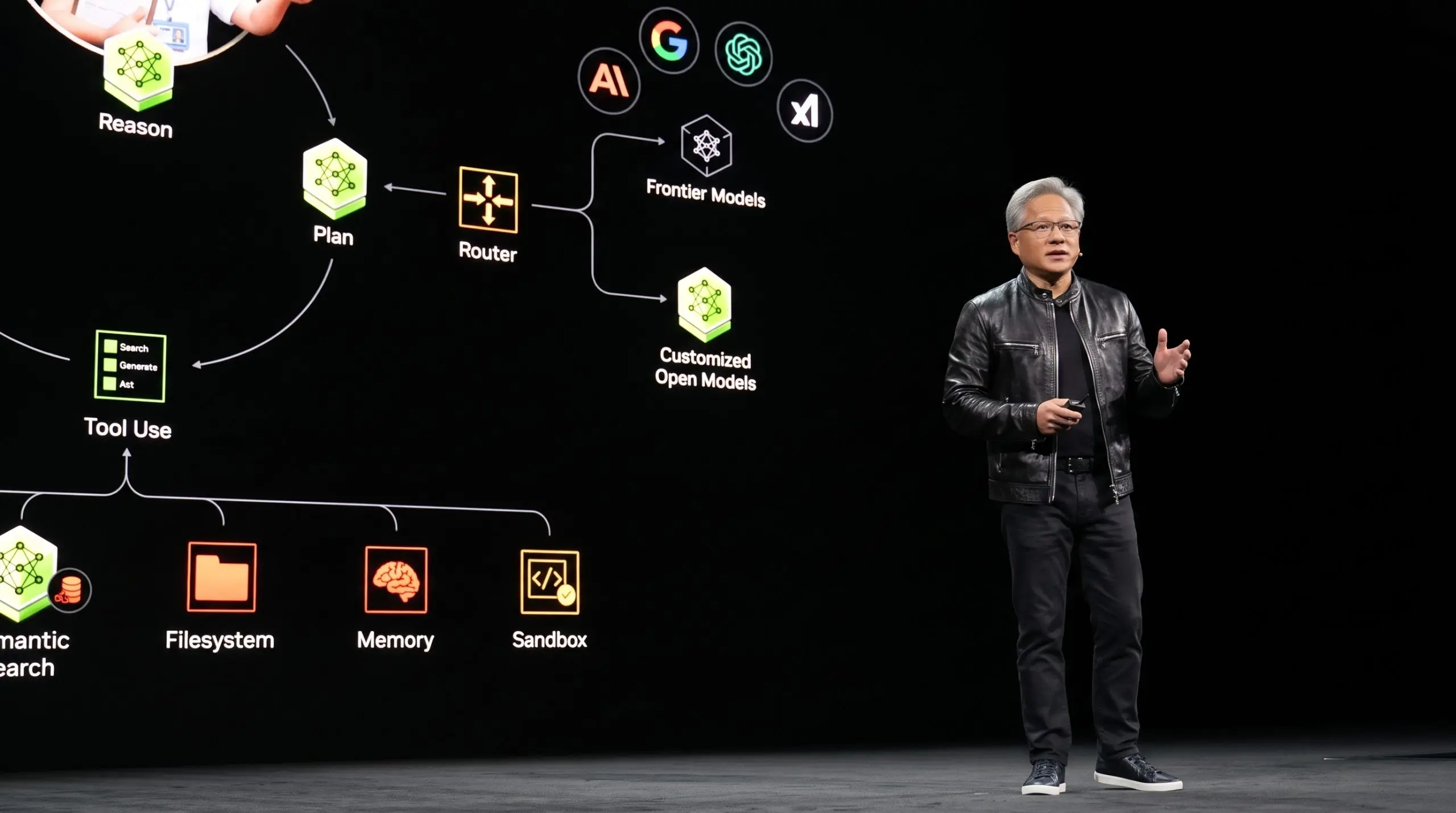
Jensen Huang said useful quantum computers were 15 years away, then bought into four of the companies building them. His exit leaves those bets without their champion.
Most coverage of Jensen Huang‘s departure from Nvidia, one of the world’s most valuable companies and the dominant maker of the chips behind AI, has dwelt on the scandal around it. The Nvidia quantum strategy he built says more about what the company has lost. In a few months he changed his mind in public when the facts changed, which bosses of his standing rarely do.
In this article
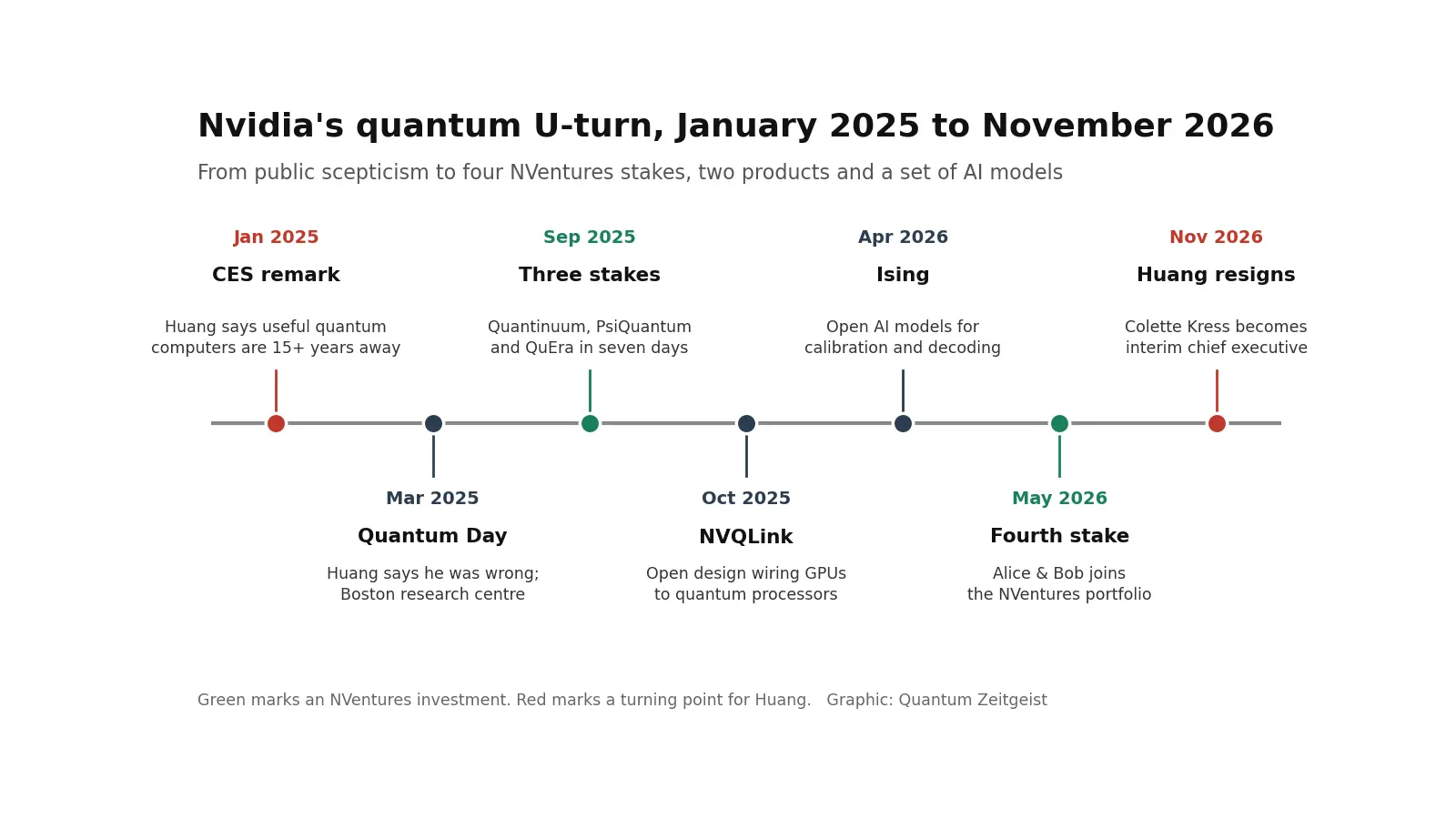
In January 2025, Huang told Wall Street analysts at the CES trade show in Las Vegas that 15 years would be an early estimate for very useful quantum computers, and shares in listed quantum companies fell sharply. Twenty-two months later, the company he ran until his resignation on 12 November holds equity in four quantum hardware builders. It also supplies the software and networking that connect their machines to its graphics processing units (GPUs), the chips that run most of today’s AI systems.
The equity sits in NVentures, the venture capital arm Nvidia set up in 2022, whose portfolio page listed 125 companies on 21 November 2026 and files four of them under the heading Quantum. Each of the four uses a different physical system for its qubits, the quantum counterparts of the bits in an ordinary computer. Nvidia has never disclosed the size of any of the four stakes, and it has said it does not intend to build a quantum computer of its own.
Nvidia quantum bets in the NVentures portfolio
| Company | Base | Qubit technology | NVentures joined | Round |
|---|---|---|---|---|
| Quantinuum | Majority owned by Honeywell | Trapped ions | September 2025 | $600m at a $10bn pre-money valuation |
| PsiQuantum | Palo Alto | Photons in silicon chips | September 2025 | $1bn Series E at a $7bn valuation |
| QuEra | Boston | Neutral atoms | September 2025 | Extension of a $230m round |
| Alice & Bob | Paris and Boston | Superconducting cat qubits | May 2026 | Extension of a €100m Series B |
The Nvidia quantum category is among the smallest of the portfolio’s 20, against 23 companies in healthcare and digital biology and 15 in robotics. Quantinuum remains on the list although it now trades on Nasdaq, while SandboxAQ, the quantum and AI software company that took investment from Nvidia in 2025, does not appear on it.
Huang admits he was wrong
Huang began to walk the CES comment back within ten weeks. On 20 March 2025 Nvidia held its first Quantum Day at the GTC developer conference in San Jose, where he sat on stage with executives from a dozen quantum companies, among them PsiQuantum and Quantinuum. He told the audience he had invited them to explain why he had been wrong, and added that he hadn’t known any quantum computing companies were publicly traded when he made the remark.
The same day Nvidia announced the Nvidia Accelerated Quantum Research Center in Boston, with Harvard, MIT, QuEra and Quantinuum as partners. By June, according to Time magazine, Huang was saying that quantum computing had reached an “inflexion point”.
Chief executives of Huang’s standing rarely concede a public error so plainly, and fewer still follow the concession with money. Within six months of that panel NVentures had bought into three quantum companies, two of which had sent executives to sit beside him on the Quantum Day stage.
Nvidia quantum work had some history before 2025. The company announced cuQuantum, a software kit for simulating quantum circuits on GPUs, at its 2021 conference, and that work grew into CUDA-Q, the programming layer of the Nvidia quantum computing platform. It lets one program send some of its work to a quantum processor and the rest to GPUs. Quantum companies were already building on CUDA-Q before Nvidia invested in any of them.
Three Nvidia quantum deals in seven days
Between 4 and 10 September 2025, NVentures joined funding rounds at Quantinuum, PsiQuantum and QuEra, which Fast Company noted at the time were the first quantum investments it had ever made. Quantum Zeitgeist has followed the portfolio since in its NVentures coverage.
Quantinuum, majority owned by Honeywell, builds trapped-ion computers, in which individual charged atoms are held in electric fields and manipulated with lasers. It raised $600 million at a $10 billion pre-money valuation, and NVentures joined as a new shareholder alongside Quanta Computer and QED Investors.
PsiQuantum, based in Palo Alto, encodes its qubits in single particles of light travelling through silicon chips made in conventional semiconductor factories, an approach known as photonics. Its $1 billion Series E, the fifth main round of venture funding in the company’s life, valued it at $7 billion. BlackRock affiliates, Temasek and Baillie Gifford led the round, and the money is meant for sites in Brisbane and Chicago.
A Forbes column in April 2026 called the deal a $1 billion bet by Nvidia, which overstates it, since NVentures was one of many investors and its share was not disclosed. The two companies also agreed to work together on quantum algorithms and on connecting GPUs to quantum processing units (QPUs).
QuEra, a Boston company, uses neutral atoms, which are uncharged atoms held in a grid by focused laser beams. NVentures joined an extension of the $230 million round QuEra announced in February 2025, which already included Google. The two companies were working together before the investment, and a QuEra machine in Japan sits next to ABCI-Q, a supercomputer fitted with more than 2,000 Nvidia H100 GPUs.
Not everyone in the field saw a neat fit. Pete Shadbolt, PsiQuantum’s chief science officer, told Time that month that “quantum computing and AI are sort of diametrically opposed”, and Time’s own reading was that quantum machines were unlikely to help Nvidia’s AI customers much.
Alice & Bob makes four
Alice & Bob, founded in Paris in 2020 and with a second office in Boston, announced on 22 May 2026 that NVentures had joined its Series B. NVentures came in through an extension of the €100 million round, which first closed in January 2025.
The company builds superconducting circuits, which are loops of metal cooled to near absolute zero, and arranges them as cat qubits. The design, named after Schrödinger’s cat, resists one of the two kinds of error that afflict quantum hardware, so only the other needs correcting and far fewer qubits are needed to do it.
Alice & Bob is aiming for a useful machine by 2030, and its Quantum Zeitgeist profile puts its total funding near €130 million. It has worked with Nvidia on CUDA-Q since 2024 and later on NVQLink, and chief executive Théau Peronnin described the investment as a new stage in that collaboration.
NVQLink wires GPUs to qubits
Qubits lose their information within fractions of a second, so a working quantum computer must measure groups of them continuously and pass the results to a conventional computer. That computer works out corrections before errors pile up, a process called quantum error correction. It has to be fast and has to sit very close to the quantum hardware, and that is the job Nvidia wants its GPUs to do.
On 28 October 2025, at a GTC event in Washington, Nvidia announced NVQLink, an open design for wiring GPUs directly to quantum processors and their control electronics. It launched with 17 quantum hardware builders, five control-systems makers and nine US national laboratories signed up, and Huang called it “the Rosetta Stone connecting quantum and classical supercomputers”.
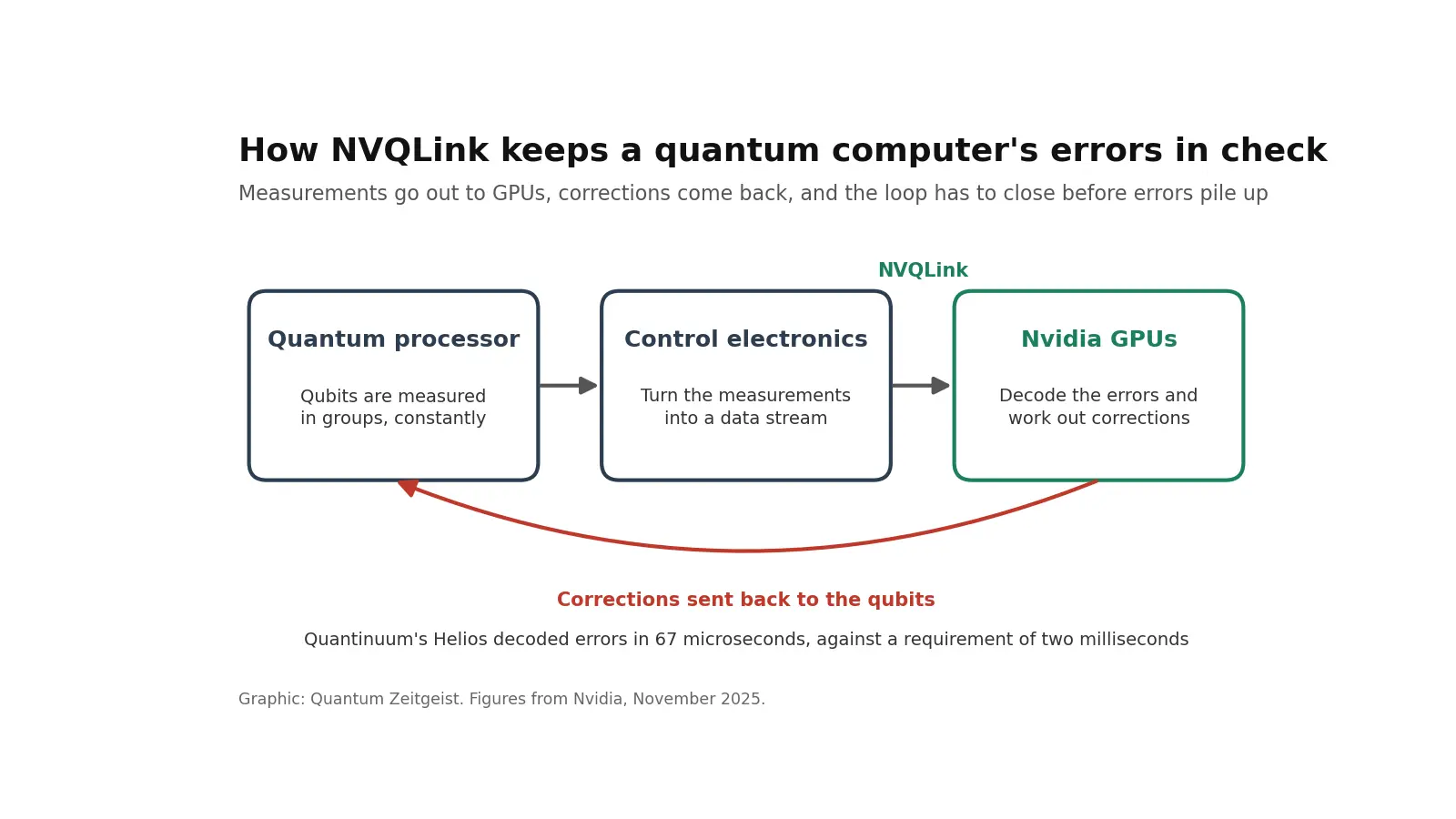
The first public result came from Quantinuum, whose Helios machine used NVQLink and Nvidia GPUs to decode errors with a reaction time of 67 microseconds, against a requirement of two milliseconds. Nvidia reported the figure in November 2025, when it said more than a dozen supercomputing centres would adopt the system, and in March 2026 it opened NVQLink to any developer through a programming interface called cudaq-realtime.
All four companies in the Nvidia quantum portfolio work with it on CUDA-Q or on GPU integration, and at Quantinuum, QuEra and Alice & Bob that work was under way before the equity arrived. In each case the money followed the engineering.
Ising puts AI in control
On 14 April 2026, World Quantum Day, Nvidia released Ising, a family of AI models published under open licences for anyone building a quantum processor. Ising Calibration is a vision-language model, a type of AI that reads images as well as text, with 35 billion parameters. It is trained to look at measurement plots from a quantum processor and decide how to adjust the control settings, and Nvidia says an AI agent using it can cut calibration, the routine retuning every quantum processor needs, from days to hours.
Ising Decoding is a pair of convolutional neural networks, the kind of network long used in image recognition, which take the stream of error measurements and do a first pass of the decoding before a conventional algorithm finishes the job. Against PyMatching, the open-source decoder Nvidia treats as the current standard, the company claims up to 2.5 times the speed and three times the accuracy.
Huang said in the launch statement that with Ising, “AI becomes the control plane” of quantum machines. Tom’s Hardware set out the commercial logic in its coverage, noting that the models are free while the decoder depends on NVQLink to deliver data in time, and the deployment tools target Nvidia hardware only.
Huang is gone, the Nvidia quantum bets remain
Nvidia announced on 12 November 2026 that Huang had resigned as president, chief executive and board member with immediate effect. Chief financial officer Colette Kress became interim chief executive, and Harvey C. Jones became the company’s first board chair.
The resignation came four days after the board opened an independent investigation into reports that Huang had been targeted by a foreign intelligence effort. Fortune reported that it followed his admission of an extramarital affair with a woman whom US intelligence officials deemed to be a Chinese spy. CNN later reported that US intelligence is not sure she spied for China, and nothing published so far proves that she did. On the earnings call of 17 November, Jones said the board “does not intend to reinstate Jensen as CEO”, according to Forbes, and Huang said the same day that he would be honoured to return if asked.
No change to the Nvidia quantum programme had been announced by 21 November. NVentures still lists all four companies, and NVQLink, CUDA-Q and Ising are products with partner lists that do not depend on one executive.
The appetite for new deals is less certain. The newsletter Newcomer reported after the earnings call that Kress intends to slow the pace of dealmaking Huang had set, and every quantum investment NVentures has made was made while he was in charge.
Nvidia loses its chief bet maker
There is a risk that, without Huang in charge, Nvidia will not repeat the investments it made in joining classical and quantum computing, or the capital that came with them. He turned what was once a niche gaming product into the chip behind today’s AI boom, and he did it over 33 years by paying for software and partnerships long before the revenue arrived. The Nvidia quantum effort follows the same pattern, with CUDA-Q, NVQLink and the four NVentures stakes each a commitment to joining classical and quantum machines long before anyone can sell the result in volume.
We think of Huang as Nvidia’s “chief bet maker”, the person who decided where the company’s money and engineering time should go years before the market agreed with him. He bet on programmable GPUs when they were sold for games, on CUDA when few outside research labs used it, and on AI when it was still an academic pursuit. The quantum stakes followed the same instinct within months of his admission that he had been wrong.
Every quantum deal NVentures has signed, from Quantinuum, PsiQuantum and QuEra in September 2025 to Alice & Bob in May 2026, was made on his watch. None of them would have been an obvious call for a chip company answering to quarterly earnings.
An interim chief executive with a finance background, working through a board investigation and a search for a successor, has less room for long-dated bets on a technology whose payoff is far less certain than that of AI chips. The money and engineering time that flowed into quantum companies between September 2025 and May 2026 depended on a chief executive who believed in joining the two kinds of computing, and the next one may not.
Frequently asked questions
What did Jensen Huang say about quantum computing at CES 2025?
He told analysts in January 2025 that 15 years would be an early estimate for very useful quantum computers. Shares in listed quantum companies fell sharply on the remark, and he said at Nvidia’s Quantum Day in March 2025 that he had been wrong.
Which companies are in the Nvidia quantum portfolio?
Through its venture arm NVentures, Nvidia holds stakes in Quantinuum, PsiQuantum and QuEra, all bought in September 2025, and Alice & Bob, bought in May 2026. It has not disclosed the size of any stake.
Is Nvidia building its own quantum computer?
Nvidia has said it does not intend to build one. It supplies the software (CUDA-Q), the GPU-to-quantum link (NVQLink) and AI models (Ising) that connect other companies’ quantum processors to its GPUs.
What is NVQLink?
NVQLink is an open design, announced in October 2025, for wiring Nvidia GPUs directly to quantum processors so the GPUs can correct errors fast enough. Quantinuum’s Helios machine used it to decode errors in 67 microseconds.
What happens to Nvidia quantum investments after Huang’s resignation?
By 21 November 2026 Nvidia had announced no change, and NVentures still listed all four quantum companies. Newcomer has reported that interim chief executive Colette Kress plans to slow the pace of new deals.
What is NVentures?
NVentures is the venture capital arm Nvidia set up in 2022 to invest in start-ups. On 21 November 2026 its portfolio page listed 125 companies in 20 categories, four of them under the heading Quantum, and Nvidia does not disclose the size of its individual stakes.
Which quantum company did Nvidia invest in first?
NVentures made its first quantum investments in a single week, joining funding rounds at Quantinuum, PsiQuantum and QuEra between 4 and 10 September 2025. Fast Company reported at the time that these were its first quantum deals, and Alice & Bob followed in May 2026 as the fourth.
How much did Nvidia invest in PsiQuantum?
Nvidia has not said. NVentures was one of many investors in PsiQuantum's $1 billion Series E in September 2025, a round led by BlackRock affiliates, Temasek and Baillie Gifford that valued the company at $7 billion, so reports of a $1 billion bet by Nvidia overstate its part.
What is CUDA-Q?
CUDA-Q is Nvidia's programming platform for hybrid quantum and classical computing. It grew out of cuQuantum, a kit for simulating quantum circuits on GPUs announced in 2021, and lets one program send part of its work to a quantum processor and the rest to GPUs.
What is Nvidia Ising?
Ising is a family of open AI models that Nvidia released on World Quantum Day, 14 April 2026, for teams building quantum processors. Ising Calibration reads measurement plots and suggests control settings, which Nvidia says cuts calibration from days to hours, while Ising Decoding uses two neural networks to speed up error correction.
Why does quantum error correction need GPUs?
Qubits lose their information within fractions of a second, so a quantum computer has to measure them constantly and work out corrections before errors pile up. That sum must finish inside a strict time limit, and Quantinuum's Helios used Nvidia GPUs over NVQLink to decode errors in 67 microseconds against a two-millisecond requirement.
Who runs Nvidia now?
Chief financial officer Colette Kress became interim chief executive on 12 November 2026 and keeps her finance role while the board looks for a permanent successor. Harvey C. Jones became the company's first-ever board chair, and he has said the board does not intend to reinstate Huang.
This article is for information only and is not financial advice. Readers should do their own research before making any investment decision.



See today’s quantum computing news on Quantum Zeitgeist for the latest breakthroughs in qubits, hardware, algorithms, and industry deals.