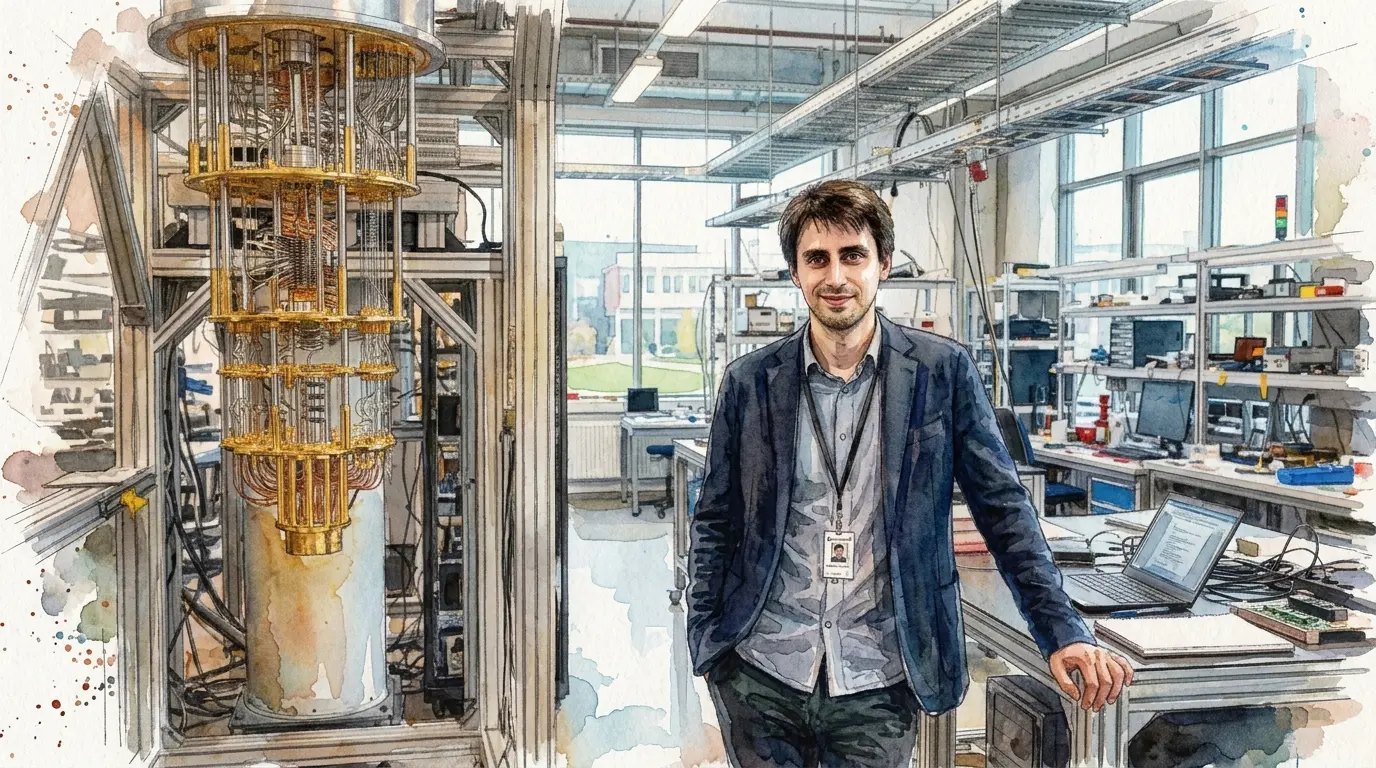
A physicist who turned a noisy laboratory cavity into a company, Théau Peronnin is wagering that one clever qubit can shorten the road to useful quantum machines.
He turned a laboratory result into a company. Théau Peronnin co-founded Alice and Bob out of work on superconducting cavities. The company exists to build one specific kind of qubit.
The cat qubit is a bet on asymmetry. A cat qubit suppresses one type of error by design so that correction only has to handle the other. If it holds, the correction overhead falls sharply.
The saving claimed is in physical qubits, not speed. The argument is that fewer physical qubits are needed per logical one. That is the number that decides whether a useful machine fits in a building.
It belongs to a wider family of bosonic codes. Cat qubits are one approach among several that store information in the states of a resonator rather than a two-level system. The family is worth knowing as a whole.
The company has stated a 2030 target. Alice and Bob has set out milestones towards fault tolerance by the end of the decade. Targets in this field have slipped before and should be read as intent.
It is a European position as much as a technical one. France and the EU have funded sovereign quantum capacity deliberately. The company sits inside that policy as well as inside the physics.
- The physicist who co-founded Alice and Bob and runs it
- His doctoral years at ENS Lyon included the result the company was built on
- Two founders bet the whole company on one kind of qubit
- The cat qubit trades a hard error for an easier one
- The roadmap runs from the Boson chips to a 2030 machine
- A 100 million euro Series B, then an NVIDIA extension
- Protection in the hardware where rivals correct in software
- Betting a whole company on one error-correction idea
- Frequently asked questions
The physicist who co-founded Alice and Bob and runs it
Théau Peronnin is the French quantum physicist who co-founded Alice and Bob in January 2020 and runs it as chief executive from offices in Paris and Boston. He built the company with Raphaël Lescanne, its chief technology officer. The two had worked alongside each other during Peronnin’s doctoral years.
Alice and Bob builds one kind of qubit and nothing else. The whole company rests on that decision. It is a superconducting device called a cat qubit, engineered so that the most common hardware error, the bit flip, becomes extremely rare. The claim that follows is that far fewer physical qubits are then needed for each error-corrected logical qubit.
Alice and Bob closed a Series B of 100 million euros in January 2025 and added an extension in May 2026 with an investment from NVentures, the venture arm of NVIDIA. The company has said it intends to deliver a useful fault-tolerant machine by 2030. Read that as intent, not as a schedule.
Peronnin trained as an experimentalist before he became a chief executive. He spent years measuring superconducting circuits in the laboratory. His doctoral years at ENS Lyon included co-authoring the result the company was later built on, and the technology Alice and Bob sells is the one he helped demonstrate.
His doctoral years at ENS Lyon included the result the company was built on
Peronnin graduated from École Polytechnique, entering with the class of 2012. A PhD in quantum physics followed at ENS Lyon. His doctoral work sat inside the quantum circuits community that links the ENS schools in Lyon and Paris, where superconducting devices are cooled to near absolute zero and probed with microwave signals. That environment is where the central idea of his future company first took experimental shape.
His doctoral thesis, defended at ENS Lyon on 16 June 2020 under the supervision of Benjamin Huard, was titled Building and operating a quantum node of a microwave network. Work led from ENS Paris, with Raphaël Lescanne as first author and Peronnin and Huard among the co-authors, appeared in Nature Physics in 2020 and demonstrated the exponential suppression of bit-flips in a qubit encoded in an oscillator. That paper appeared in 2020, the same year the company was incorporated. It is the result the company was built on.
The ENS Lyon quantum circuits group sits within a wider French tradition of cavity and circuit experiments that stretches back decades. Peronnin learned there to fabricate, cool and measure the delicate devices on which his later company would depend. By the time he finished his doctorate, Théau Peronnin had both a published proof of concept and the practical skills to turn it into a product.
Serge Haroche shared the 2012 Nobel Prize in Physics for methods that allow individual quantum systems to be measured and manipulated. That work on cavity quantum electrodynamics is a direct ancestor of the photon-trapping circuits Alice and Bob now engineers. Peronnin entered the field in the years immediately after the prize, and the physics his company sells was established science before the company existed.
Two founders bet the whole company on one kind of qubit
Théau Peronnin and Lescanne founded Alice and Bob in 2020, taking the name from the two characters that appear in almost every explanation of cryptography and quantum communication. From the start the two founders split responsibilities. Peronnin served as chief executive and Lescanne as chief technology officer. Peronnin defended his own doctorate at ENS Lyon in June 2020, a few months after the company was incorporated.
The company set itself one objective. It is to build a fault-tolerant quantum computer using cat qubits instead of the more common transmon approach. That focus distinguished Alice and Bob from rivals who hedge across several qubit types.
Alice and Bob had raised about 130 million euros in total by January 2025, on the company’s own account, roughly 135 million dollars at that month’s rate. The company publishes technical results on error rates and timelines rather than headline claims alone, and those published numbers are what its roadmap is measured against.
The cat qubit trades a hard error for an easier one
The technology Peronnin’s company builds, the cat qubit, is a bosonic code. It sits inside a superconducting microwave cavity. Instead of encoding information in a single two-level circuit, the cat qubit stores it in superpositions of many photons, the quantum analogue of Schrödinger’s cat being alive and dead at once. This encoding is engineered so that the most common hardware error, the bit flip, becomes extremely rare. Cat qubits are one member of a family of bosonic codes that store a logical qubit inside a single oscillator, and the GKP code is the other well-known member.
The protection comes from a process called two-photon dissipation, in which photons are added and removed from the cavity in pairs through a coupled buffer mode. That carefully shaped energy exchange stabilises the cat states and suppresses bit-flip errors exponentially as the number of photons grows. The trade-off is that phase-flip errors increase. Those remaining errors are easier for an error-correcting code to clean up.
Why fewer errors mean fewer qubits
A surface code protecting one logical qubit well enough for a serious calculation needs somewhere in the region of a thousand physical qubits. Estimates for breaking modern encryption or simulating an interesting molecule run into millions of physical qubits as a result. Scaling to those numbers is the central obstacle in the field. The overhead per logical qubit decides what is buildable.
Because the hardware handles one whole error channel on its own, the software layer has far less work to do. Alice and Bob argues this can cut the number of physical qubits needed per logical qubit dramatically compared with unprotected designs. Published estimates from this line of work have claimed reductions of an order of magnitude or more.
The code that sits on top only has to catch phase flips. The simplest code that does that is a repetition code arranged in one dimension rather than a lattice in two. A one-dimensional chain is cheaper than a two-dimensional patch for the same protection. It is easier to lay out on a chip. Published roadmaps from this direction describe logical qubits built from tens of cat qubits rather than the hundreds or thousands a surface code would require.
The cat qubit does not remove the need for quantum error correction. It makes that correction cheaper. Phase-flip errors still have to be corrected with a code such as a repetition code or a tailored surface-code variant. The wager is that trading a harder error for an easier one nets out in the company’s favour as systems grow.
It is straightforward to protect a qubit that is sitting still. Operating on it without opening a path for the very error you suppressed is the hard part, and it is where this approach has to prove itself. No independent laboratory has published a comparison of the cat-qubit route against the surface-code route on the same task. The trade-off therefore rests on the company’s own figures. This profile says so rather than pretend otherwise. That trade-off is the single technical idea on which the whole enterprise stands.
The roadmap runs from the Boson chips to a 2030 machine
Under Peronnin, Alice and Bob has published a staged roadmap. Named chip generations lead to a useful machine. The early milestone was mastering the cat qubit itself through the Boson chip series, which demonstrated the long bit-flip lifetimes the approach promised. Later stages move from a single logical qubit toward fault tolerance, universal operation, and finally a target system carrying one hundred high-fidelity logical qubits.
Alice and Bob has reported steadily longer bit-flip stability times as the chips have progressed. The company reported 430 seconds on its Boson 4 chip in 2024, then preliminary results of between 33 and 60 minutes on its Galvanic Cat qubit design, the one used on the Helium 2 chip, in September 2025. These are the company’s own published measurements rather than independently replicated results, and Quantum Zeitgeist has not verified them against a peer-reviewed source. On the company’s account the bit-flip requirement for its 2030 device is 13 minutes. Clearing that bar early would give the roadmap headroom.
From published papers to an on-premise machine
Alice and Bob says it has moved beyond laboratory demonstrations towards delivering systems. It unveiled the Helium Quantum System in June 2026, an on-premise machine that the company says is engineered to encode its first logical qubit in eighteen physical cat qubits. Alice and Bob describes Helium as a laboratory open to outside groups rather than a product launch, so the move from published results to delivered systems is still to be tested. The stated destination remains a useful fault-tolerant computer by 2030, with the company naming simulation, materials science, machine learning, finance, healthcare, and cybersecurity among the early industrial targets.
Each named generation in the roadmap is meant to retire a specific risk before the next one begins. The Boson series came first and was there to prove the qubit, and only the later stages move towards fault tolerance, universal operation and a hundred logical qubits.
A 100 million euro Series B, then an NVIDIA extension
Alice and Bob closed a Series B of 100 million euros in January 2025, a round reported as roughly 104 million dollars at the time. Future French Champions, AXA Venture Partners and Bpifrance led the round. It was one of the larger European quantum financings. The capital went into building out laboratory and fabrication capacity.
On 22 May 2026 the company announced an extension of that Series B with an investment from NVentures, the venture arm of NVIDIA, though the size of the investment was not disclosed. The two had been working together since 2024 before any money changed hands. In the company’s announcement Peronnin said: “We’ve been working alongside NVIDIA to connect our cat-qubit architecture with its full accelerated computing ecosystem, from hardware to software, in support of the first fault-tolerant quantum computers.” Alongside the money came a technical relationship, with Alice and Bob connecting its hardware to NVIDIA’s accelerated computing tools so that quantum processors and GPUs can work together.
The NVIDIA tie also reflects a broader French and European push to fund sovereign quantum capacity, and Alice and Bob sits squarely inside that effort alongside publicly backed research institutions. France has backed quantum technology heavily through its national plan, and the companies that emerged have tended to pursue technically distinctive approaches rather than competing on qubit count. European growth capital is thinner than in the United States, so an architecture that needs less scale is a rational answer to a smaller funding base.
Capital alone does not build a fault-tolerant computer. The money buys fabrication capacity, cryogenic infrastructure and the engineers needed to run it. All of that feeds back into the experimental roadmap rather than standing in for it.
Protection in the hardware where rivals correct in software
Théau Peronnin occupies a specific niche. He is a founder-physicist who bet an entire company on one error-correction idea rather than spreading risk. That makes Alice and Bob a useful case study in how hardware strategy diverges across the industry. Where some firms pursue many qubits and fix errors mostly in software, Peronnin’s company pushes protection down into the physics of each qubit.
If cat qubits deliver at scale, hardware-level error suppression will have been shown to beat brute-force scaling. If they fall short, the attempt will still have sharpened the field’s understanding of where to spend its qubits. Either way, Alice and Bob is one of the clearest live tests of trading hardware complexity for software overhead.
Betting a whole company on one error-correction idea
Théau Peronnin matters because he turned a doctoral result into an industrial bet on fault tolerance. He committed a whole company to it. By committing Alice and Bob entirely to cat qubits, he set up a test of whether hardware-level error suppression can outpace brute-force scaling. For an investor weighing hardware bets, the question this company answers by 2030 is whether suppressing one error in the qubit itself lowers the qubit count enough to matter. For a rival laboratory it is whether to hedge across qubit types before that answer arrives.
The position is also strategic. A French company working on an unusual architecture now carries investment from NVIDIA’s venture arm. Whether or not the 2030 target lands, the cat qubit has been funded well enough to be tested properly.
His route shows a path. For students and engineers entering the field, it runs from the laboratory bench to the chief executive’s chair. The person who co-authored the demonstration is the one now deciding how the technology gets built and how fast.
Frequently asked questions
Who is Théau Peronnin?
What company did Théau Peronnin found?
What is a cat qubit?
How do cat qubits suppress errors?
What is Alice and Bob’s roadmap?
How much funding has Alice and Bob raised?
Is NVIDIA an investor in Alice and Bob?
Where did Théau Peronnin study?
Why is the cat-qubit approach significant?


See today’s quantum computing news on Quantum Zeitgeist for the latest breakthroughs in qubits, hardware, algorithms, and industry deals.