On superconducting quantum hardware, a single round of quantum error correction currently takes approximately one microsecond, creating a critical bottleneck for decoders. NVIDIA addresses this latency challenge with Ising Decoding, an AI-based pre-decoder designed to rapidly clear easily identified errors before passing the remaining, more complex issues to a full decoder.
This approach eases a bottleneck stemming from the iterative quantum error correction cycle, which involves storing a logical qubit, measuring stabilizers, decoding the syndrome and issuing recovery commands, repeating continuously. Researchers trained NVIDIA Ising Decoding on Amazon Web Services, evaluating performance across a range of accelerated compute instances.
NVIDIA Ising Decoding Accelerates Quantum Error Correction Cycles
The team validated this speedup on Amazon Web Services, using a containerized workflow on AWS Parallel Computing Service to ensure consistent testing conditions across different hardware configurations. Each newer generation of GPU demonstrably accelerates the training of the Ising Decoding model. The researchers ran benchmarks across five accelerated compute instance types, spanning four GPU generations, to quantify this improvement. The training stack relies on CUDA and PyTorch for neural network processing, while the Stim simulator generates the syndromes used as training data, all integrated within the Ising Decoding repository.
This combination allows for data-parallel training across up to eight accelerators, maximizing efficiency and reducing the time required to prepare the pre-decoder for validation. The researchers found that cost also varies significantly across instances, suggesting that the optimal hardware choice depends on the specific stage of development and budgetary constraints.
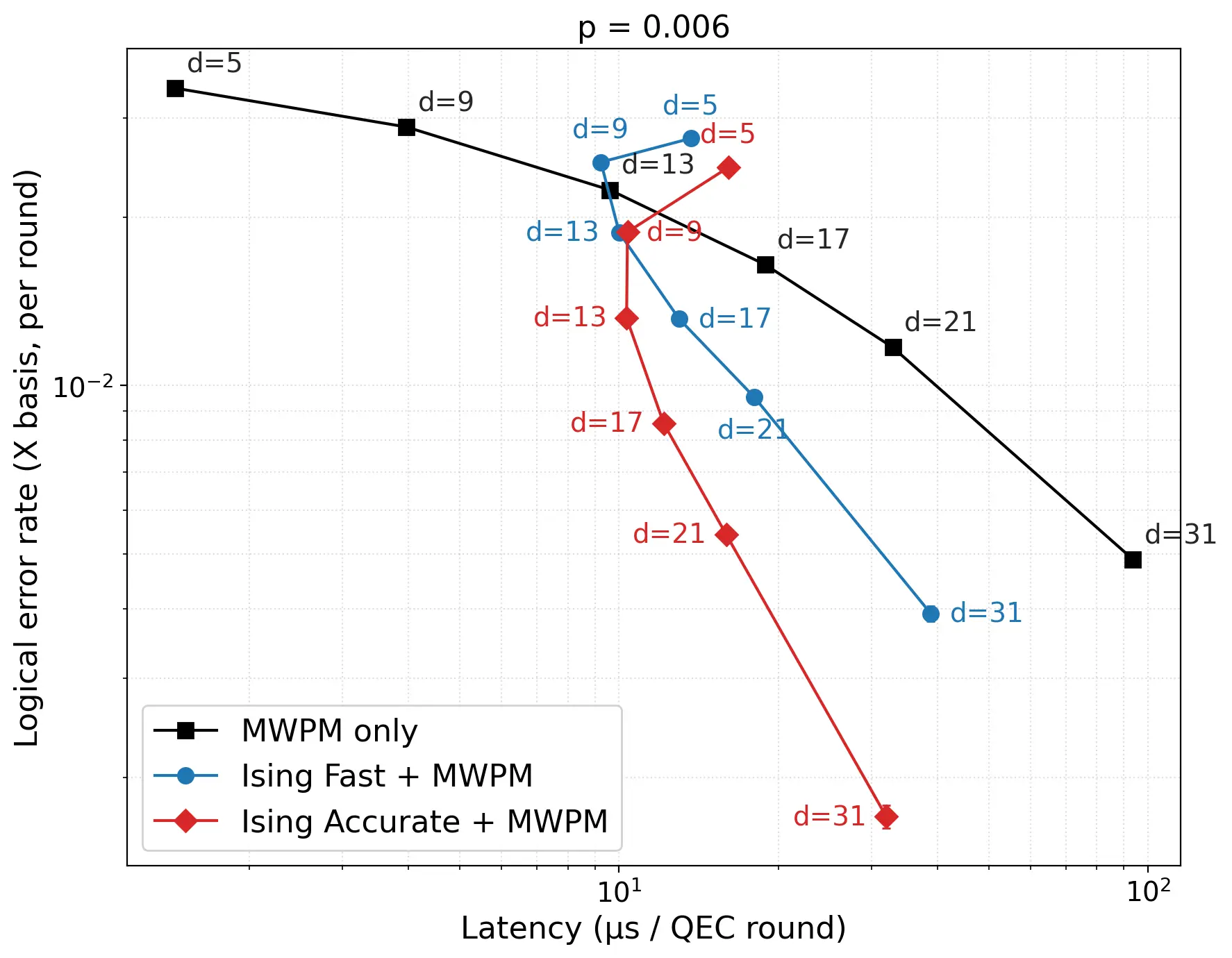
While minimum-weight perfect matching remains faster at smaller code distances due to the fixed runtime overhead of the neural network, the pre-decoder’s advantage becomes increasingly pronounced as the complexity of the quantum error-correcting code grows. The team reports that at distance 31, Ising Decoding reduces latency per round by roughly 2.4 times to 2.9 times relative to minimum-weight perfect matching alone, while improving the logical error rate.
This is particularly relevant given that the computational expense of minimum-weight perfect matching increases with code size, potentially limiting its applicability to larger, more complex quantum systems, AWS says. The code and an AWS sample for AWS Parallel Computing Service setup are available in the Ising Decoding GitHub repository, allowing others to reproduce the benchmarks and adapt the workflow to their own quantum error correction models. “Fast and accurate AI-based pre-decoders for surface codes,” by Chamberland, Christopher, et al., provides further detail on the underlying methodology.
Performance of Ising Decoding Across NVIDIA GPU Generations
AWS offers a diverse range of accelerated compute instances, allowing for comparative analysis of GPU generations in the context of quantum error correction. The researchers used Amazon EC2 P4d, P5, P5en and P6 instances, each equipped with eight GPUs: A100, H100, H200, and Blackwell B200 respectively, alongside G6e instances with L40S GPUs.
The container image included the complete training stack, with CUDA and PyTorch handling neural-network training on the GPUs, while Stim simulated noisy data to generate training syndromes. The Ising Decoding repository implemented the pre-decoder model and its associated training workflow, providing a fully integrated system for evaluation.
Validation runs on a single B200 GPU on a P6 instance demonstrated the pre-decoder’s impact on logical error rate versus decoding latency at a physical error rate of 0.006, comparing the minimum-weight perfect matching decoder alone against both “Fast” and “Accurate” variants of Ising Decoding, each followed by minimum-weight perfect matching. The team varied the code distance from 5 to 31, effectively enlarging the surface-code patch to assess performance across different code sizes.
This process revealed that each successive GPU generation delivered faster training times, highlighting the benefits of newer hardware for machine learning workloads in quantum error correction. “Stim: a fast stabilizer circuit simulator,” played an important role in generating the training data needed for the pre-decoder.
The team validated the trained pre-decoder on AWS, observing a reduction in decoding latency at larger code distances alongside an improvement in the logical error rate. The ability to run validation sweeps across accelerator generations and iterate on the pre-decoder’s neural network on AWS provides a powerful platform for ongoing research and optimization.
Ising Decoding Reduces Decoding Latency and Improves Accuracy
The computational cost of decoding quantum error correction grows rapidly with code size, a limitation now being addressed by advancements in pre-decoding techniques. Minimum-weight perfect matching, a widely used decoding method, faces increasing demands as quantum error-correcting codes scale, prompting exploration of alternative approaches to manage the decoding workload. NVIDIA’s Ising Decoding, an AI-based pre-decoder, demonstrably reduces the burden on full decoders by efficiently identifying and clearing easily resolved errors in a first-pass analysis.
This initial processing step significantly shrinks the problem size for subsequent decoding stages, improving overall performance. Validation runs on Amazon Web Services demonstrate the speed gains achieved with Ising Decoding at larger code distances. At a code distance of 31, the “Fast” variant of the pre-decoder reduces decoding latency per round by approximately 2.4 times, while the “Accurate” variant achieves a 2.9 times speedup, both relative to using minimum-weight perfect matching alone.
These improvements are coupled with a reduction in logical error rate, indicating that the pre-decoder not only accelerates the process but also enhances the reliability of the error correction. The benefits of this approach extend beyond raw speed; the ability to rapidly characterize and iterate on pre-decoder models is itself a significant advantage.
This iterative process, facilitated by tools like AWS Parallel Computing Service, enables optimization of the pre-decoder’s performance and adaptation to different quantum error correction models, according to the company. The choice of compute instance for training and validation, however, is not solely dictated by speed, as the most suitable instance depends on balancing training time against budgetary constraints, a practical consideration for any large-scale machine learning project.
While the latency requirements of a fault-tolerant quantum machine necessitate co-location of decoding hardware with the quantum processing unit, much of the decoder development and characterization can be efficiently performed in the cloud. This separation of concerns allows for scalable and cost-effective optimization of the decoding pipeline.
The work builds on the understanding of hybrid quantum-classical workflows, and the team has made the tools for reproducing their benchmarks publicly available. The NVIDIA Ising Decoding code is accessible through a GitHub repository, and an accompanying AWS sample provides a pre-configured setup for AWS Parallel Computing Service, facilitating broader adoption and further innovation in the field of quantum error correction.