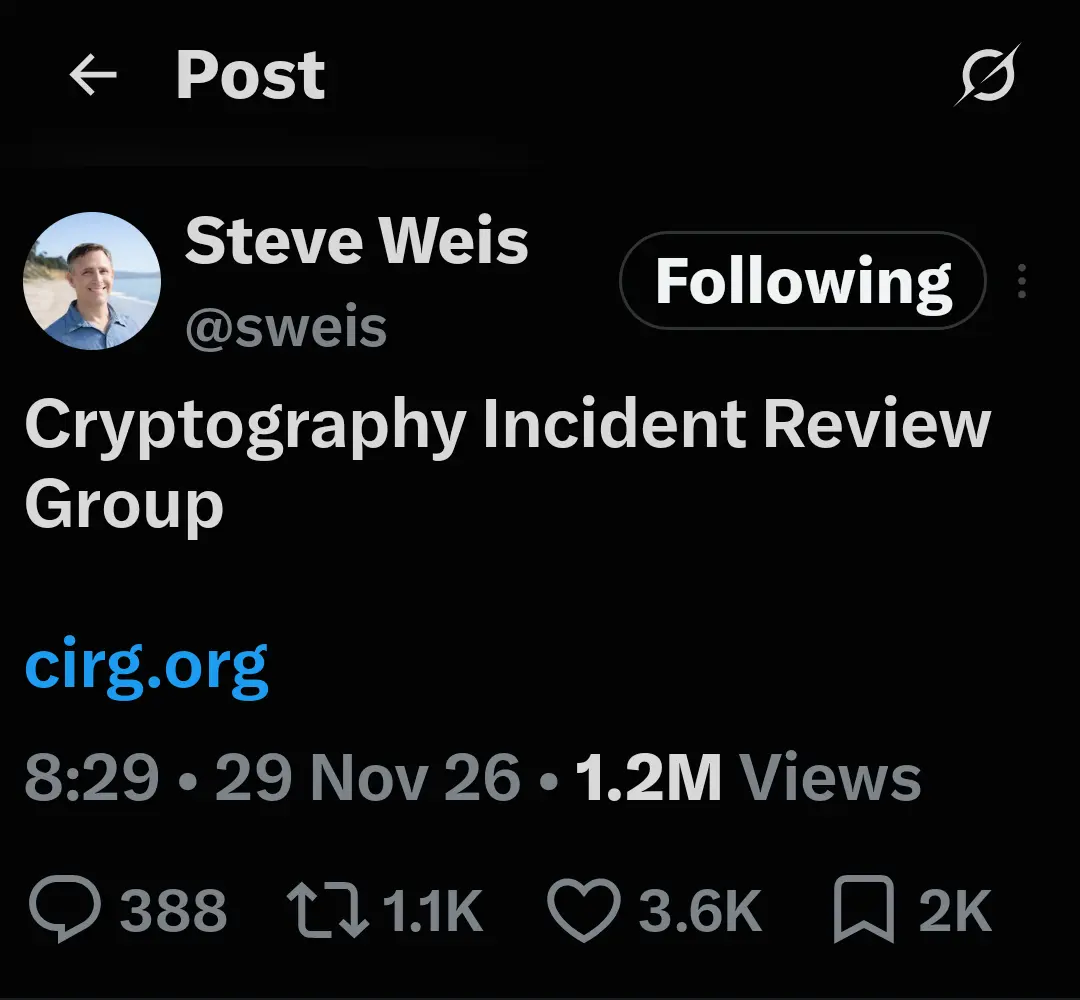
I woke up on Sunday to a feed full of panic about public key cryptography, and I’ll be honest, it got to me a little. Steve Weis had posted three words and a link on X at 8.29 that morning, and that was all it took. The words were “Cryptography Incident Review Group”, and the link went to cirg.org, a brand-new site carrying some of the biggest names in cryptography. By the afternoon, the post had passed 1.2 million views, 1,100 reposts and 2,000 bookmarks, and nobody involved has said anything has been broken, which has somehow rattled people far more than any announcement could.
In this article
Why Weis matters
The messenger is a big part of why this blew up. Weis works on security at Anthropic, the lab whose Claude model sits behind the Riemann claim I come to below, and he did his PhD at MIT under Ron Rivest, the R in RSA. He isn’t on the CIRG member list himself, so when a Rivest student working at a frontier AI lab quietly shares a group set up to handle code breaks, people were always going to read something into it.
And read into it they did. The reply that sums up the mood came from the account chiefofautism, which posted a fake Warren Buffett quote card telling everyone to panic sell because it’s all over, and separately wrote that an Anthropic employee posting a cryptography incident group with an unreleased statement meant “yep its over”.
Prakash, who posts as @8teAPi, said “Oh boy… they set up a website pending announcement”, while Roelof van Dijk said it felt like the “math” GitHub repo discovery all over again. Others were more sceptical, with one reply asking whether the members even knew they had been named, before conceding that Weis seemed legit. Joi Ito, president of the Chiba Institute of Technology, had already told his followers to keep an eye on the space earlier that morning.
Look at who signed up
I went through the member list twice because I could hardly believe it. Dan Boneh from Stanford is on it, along with Matthew Green from Johns Hopkins, Nadia Heninger from UC San Diego, Yael Tauman Kalai, Vinod Vaikuntanathan and Ryan Williams from MIT, Chris Peikert from Michigan, Vadim Lyubashevsky from IBM Research and Justin Thaler from Georgetown and a16z, with twelve more from places like EPFL, Cornell and Carnegie Mellon. All 21 are serving in a personal capacity, which is exactly how you would set things up if you expected to say something awkward.
Several of these people designed the lattice schemes we are all supposed to be moving to. Lattice cryptography takes its security from how hard it is to find short vectors in huge, high-dimensional grids of points, and nobody has a classical or quantum algorithm that does that quickly, which is why it underpins the new NIST post-quantum standards ML-KEM and ML-DSA. When the people who built the new locks start organising a fire drill, I think we should sit up and listen.
One statement, still blank
The site describes CIRG as a group of cryptographers aiming to review and help navigate cryptanalytic advances. Cryptanalysis is the craft of attacking codes and signatures, so in plain English this is a team set up for the day somebody breaks the maths that keeps our data and money safe, ready to advise on how to disclose it, who to warn and how to rebuild afterwards.
The bit that sent X into a frenzy is the statements page, which reads “Forthcoming statement” and nothing else. If you launch a body to handle breaks with a statement already queued up, people are going to assume you know what it says, and I can’t really blame them for that.
Rumours have abounded
What surprised me is that most of the noise isn’t about quantum computers at all. For weeks there have been unconfirmed reports that an AI lab has found a polynomial-time algorithm for factoring large numbers, which I went through claim by claim on the Substack earlier this week. Polynomial time means the effort grows only gently as the numbers get bigger, so an ordinary computer could break RSA keys that would currently take longer than the age of the universe. RSA, the public key cryptography system behind a big chunk of secure web traffic and digital signatures, lives or dies on factoring staying hard.
The rumours point to papers from a Google AI agent claiming a better factoring bound, and to Scott Aaronson suggesting AI labs may be sitting on relevant results. Matthew Green, now on CIRG, told Scientific American in October that he put the odds of losing confidence in public key encryption at about 15%. That’s a big number from a man who has spent his whole career defending this stuff.
Maths prizes are getting walloped
I’d normally give rumours like these very little airtime, except that we have watched some of the hardest problems in mathematics get absolutely walloped in recent months. Back in August, Anthropic showed an unreleased Claude pushing up a decades-old bound on the zeros of the zeta function, and on 20 November Levent Alpöge, one of the company’s mathematicians, posted that he believed he had, working with Claude, found a full proof of the Riemann hypothesis.
That’s the 167-year-old conjecture about where the zeros of the zeta function lie, which governs how the prime numbers are spread out, and it is one of the seven Clay Millennium Prize Problems worth a million dollars each. The proof is written in Lean, a proof assistant that checks every logical step by machine, and it runs to around 17 million lines, which independent experts have already put through the checker.
It isn’t a one-off either. The Clay list now shows Navier–Stokes as a solution claimed with the prize pending, and OpenAI has been putting out its own stream of results, including October work on the Hodge conjecture for a special class of objects called CM abelian varieties. Every one of these claims needs to be fully tested and verified, and a 17-million-line proof that no human can yet read is going to take mathematicians a long time to digest.
Still, the point stands that it is no longer surprising to see maths prizes being claimed by frontier labs, and primes sit at the very heart of RSA. When a lab can take on the most famous open problem about primes, I don’t think it’s mad to wonder whether factoring is next. Could we be about to see one of the most significant results ever to come out of a frontier lab, and one that knocks the legs out from under internet security?
Coinbase says calm down
Coinbase moved fast to settle its customers. On 28 November, it called the rumours unsubstantiated and said it had seen nothing specific or actionable behind them, while admitting that AI-assisted researchers had published a mild improvement to factoring that affects RSA. It also pointed out that blockchains don’t use RSA and that nobody has shown a practical break of a major blockchain signature scheme, and its cryptography lead Yehuda Lindell said there was no evidence whatsoever of a breakthrough against the underlying maths.
There is one real AI result that keeps getting muddled into the threads. Anthropic told Scientific American that Claude found a much better attack on HAWK, a proposed quantum-resistant signature scheme still under evaluation. That matters for a candidate standard and shows AI can now do genuine cryptanalysis, though it tells us nothing about RSA or elliptic curves.
Quantum hasn’t gone away
All of this lands on top of the quantum threat, which keeps creeping closer towards what security teams call Q-Day. A big enough fault-tolerant quantum computer, meaning one that fixes its own errors faster than they pile up, could break RSA and elliptic curve cryptography with Shor’s algorithm. In October Alice & Bob put breaking RSA-2048 at about 23,000 cat qubits and three days, using superconducting qubits engineered so that one of the two main kinds of error almost never happens.
That’s roughly 40 times fewer physical qubits than the figure Craig Gidney at Google Quantum AI published in 2025, which we covered at the time, and back in 2019 everyone was talking about 20 million. Nobody has a machine that can run the attack today, but the target keeps moving towards the hardware faster than the hardware moves towards the target. If you want to see who is building these machines, every one of them is tracked in our Quantum Navigator company directory on Entangled Future.
Where that leaves public key cryptography
I honestly don’t know what the CIRG statement will say. What I do know is that cryptographers have never needed a standing body for disclosing breaks, because serious breaks of widely used public key systems almost never happen. Some of the best-informed people on the planet have now built one anyway, and that tells me they see a sudden break as something you plan for, with AI chipping away from one side and ever cheaper quantum attacks from the other.
If the statement turns out to be a framework and nothing more, the panic will be gone by Wednesday, and the lasting legacy will be a hard shove towards post-quantum migration. If it describes a real result, the first casualties will be anything still running RSA or elliptic curves with no upgrade path, from creaky banking systems to crypto wallets whose public keys are already sitting on chain.
The US and UK have given everyone until 2035 to finish the switch, and that deadline felt comfortable right up until this morning. We’ll cover the CIRG statement the moment it lands, so subscribe on Substack if you want it in your inbox first, though I keep coming back to the question in the headline, and I’m far less sure of my answer than I was a week ago.



See today’s quantum computing news on Quantum Zeitgeist for the latest breakthroughs in qubits, hardware, algorithms, and industry deals.