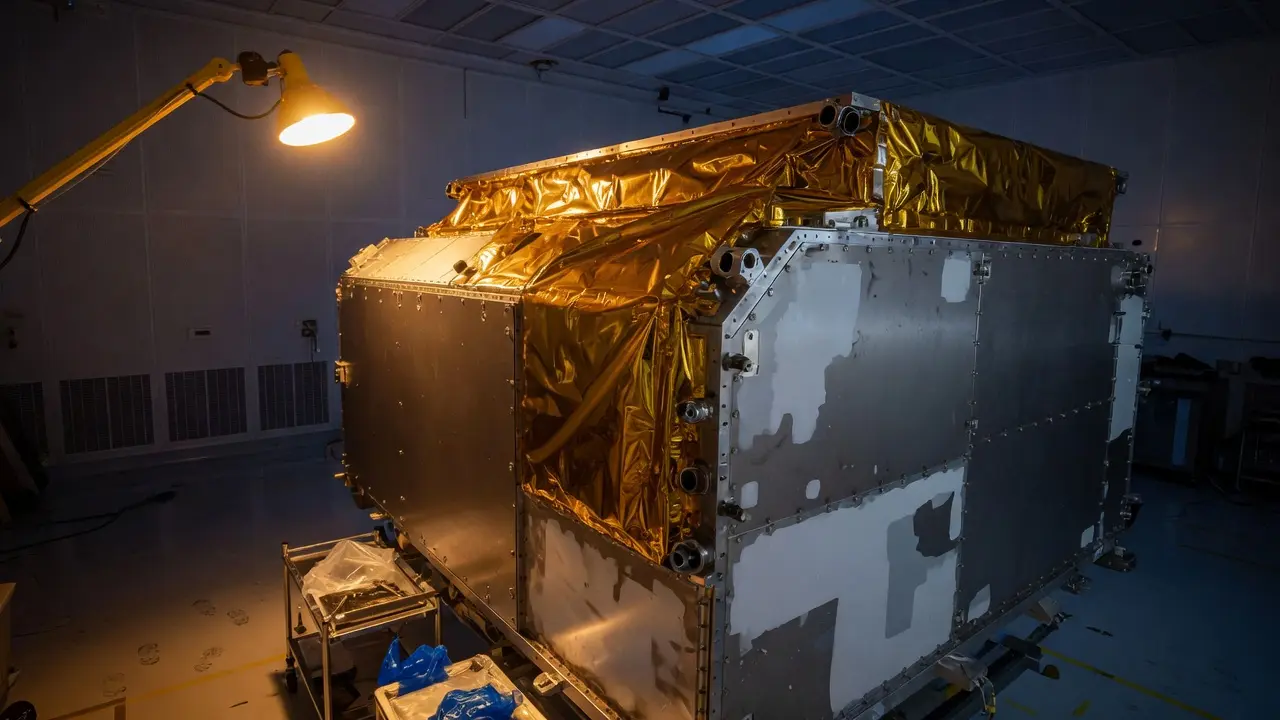
The Institute for Quantum Computing recently delivered two quantum sources to the Canadian Space Agency, a key step for Canada’s first quantum satellite mission, QEYSSat. These sources will transmit encrypted signals from Earth to the satellite, enabling study of quantum key distribution and secure communication.
Justin Schrier (BSc ’22), an IQC PhD candidate, notes, “There is no textbook on how to build quantum sources for a mission like this,” reflecting the uncharted technical territory of the project. Over fifteen years, fifty undergraduate and graduate students, and postdoctoral fellows have contributed to the development of this technology.
Quantum Sources for QEYSSat Mission Delivery
The weak coherent pulse source (WCPS) delivered to the Canadian Space Agency (CSA) employs single photons for encrypted signal transmission, representing a pragmatic approach to quantum key distribution (QKD) network implementation. The WCPS stands in contrast to the entangled photon source (EPS) also delivered, which prioritizes enhanced security through entangled photons but demands more sophisticated electronics and equipment.
Eva Pearson (BSc ’25), a Research Associate at IQC, transitioned from a support role to a primary builder of the delivered quantum sources, a progression facilitated by the collaborative environment within the Quantum Photonics Lab (QPL). Pearson says, “This guidance helped me advance from a support role, building things here and there, to a more primary role helping build the source that was delivered to the CSA,” highlighting the mentorship structure that encouraged skill development.
The QPL, led by Dr. Thomas Jennewein, provided a supportive framework for students to assume increasing responsibility throughout the fifteen-year project, demonstrating a commitment to cultivating expertise in advanced quantum technologies. The development of these quantum sources presented unique challenges, as established textbooks offered little guidance for building hardware destined for space-based deployment. The team relied on iterative design and meticulous attention to detail, building upon prior experience with similar sources while adapting to the specific demands of a space environment.
Schrier also noted, “There is a lot of trust from Thomas and the group to figure things out and we had to be especially precise with details even though we had built similar sources in the past.” This reliance on in-house expertise and problem-solving highlights the innovative spirit driving the mission. The QEYSSat mission’s focus on practical applications distinguishes it from purely theoretical explorations in quantum science.
Schrier explains that the experiments conducted by the satellite are designed to demonstrate real-world relevance, showing how quantum technologies are already being implemented. “Breakthroughs in quantum-related technologies can seem like they are years away,” Schrier says.
“But QEYSSat will perform experiments that are relevant now and show the real-world applications that are already being implemented.” Dr. Jennewein, the initiator and science lead of QEYSSat, attributes the project’s success to the exceptional talent and dedication of the IQC’s graduate students. “IQC graduate students continue to rise to the occasion, demonstrating their deep understanding of the science and technology, resourcefulness and leadership abilities,” he says.
Pearson anticipates a significant moment when the satellite launches and begins transmitting data, marking a transition from development to operational use. Schrier notes, “It’s cool to know that what you are working on will one day be communicating with a satellite in space.” He adds, “We’ll have a chance to celebrate when it launches, but it will also be when a lot of new work will start.” The satellite is currently scheduled for launch no earlier than 2027, promising a wealth of data for researchers to analyze and build upon.
There is no textbook on how to build quantum sources for a mission like this.
Justin Schrier, IQC PhD candidate


See today’s quantum computing news on Quantum Zeitgeist for the latest breakthroughs in qubits, hardware, algorithms, and industry deals.