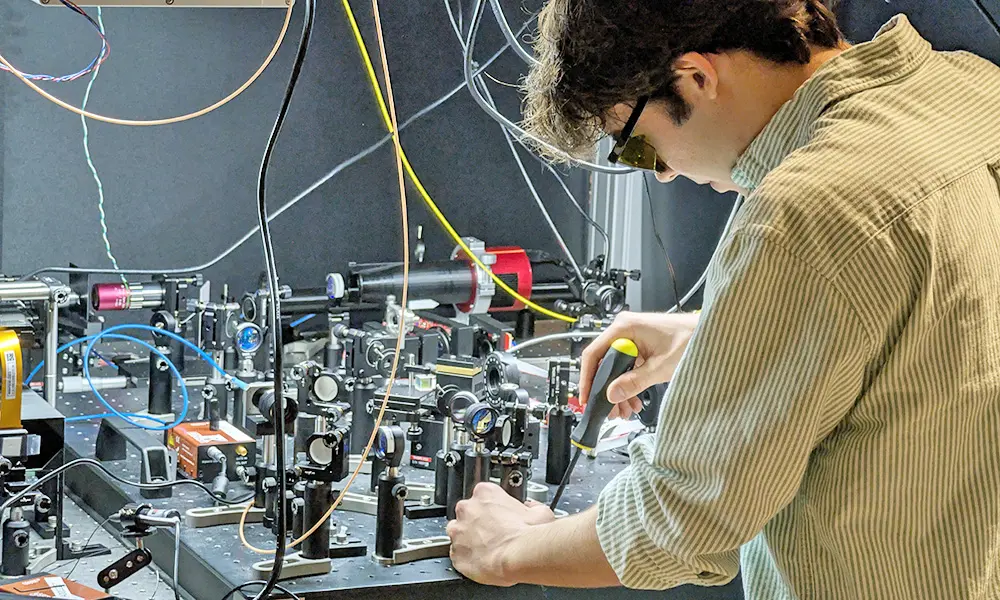
A $5,000 scholarship from SPIE is enabling Christopher Negraes to continue research in quantum photonics despite a lack of funding for an undergraduate position at the University of Ottawa. Negraes is exploring a novel method to write a superposition of Bragg gratings within volume holograms, a technique that could lead to advancements in optical technologies. He says, “Never be afraid to ask questions because it’s better to look ignorant for a second than to remain ignorant forever,” and began working directly after completing high school. He is also developing leadership skills through SPIE student programs.
SPIE Scholarship Enables Holography Research for Undergraduate Student
Christopher Negraes began working in a quantum photonics laboratory immediately after graduating high school, an unusual path facilitated by a University of Ottawa scholarship and now sustained by a $5,000 grant from SPIE. This early access to advanced research wasn’t initially supported by a formal employment opportunity within the lab; the SPIE Optics and Photonics Scholarship is allowing him to continue investigations despite budgetary limitations.
The undergraduate student, currently pursuing an honors BSc in physics-mathematics at the University of Ottawa, describes a fascination with the fundamental properties of light. “We’re used to seeing light almost everywhere, every day of our lives, so we rarely notice its presence, but there is so much fascinating behavior that makes this seemingly mundane thing anything but mundane,” he explains.
This initial exposure to photonics research quickly evolved from observation to active participation. “I quickly went from shadowing the graduate students to becoming an active participant in the delightful puzzle solving process that is the physical creation of experimental setups,” Negraes says, detailing his rapid integration into the research process.
Beyond technical expertise, Negraes is actively developing leadership skills through involvement with SPIE student programs. “After becoming an SPIE Member, I became more involved in the Student Chapter’s planning and organizing of events, including chairing a small student-run conference in the summer of 2025,” he notes, highlighting experience in resource management and volunteer coordination.
He intends to pursue a doctorate after completing his bachelor’s degree, with a long-term goal of a research career focused on fundamental quantum photonics, driven by a broader passion for expanding human understanding. “As someone passionate about human knowledge in general, the sheer universality of photonics has motivated me to pursue it as a key to the most extensive understanding of the natural world,” Negraes shares, adding, “Photonics is where we can truly explore the limits of what is possible with the humble electromagnetic wave.” He hopes to inspire others, stating, “I wish everyone knew about the incredible properties of light in our universe.”
After becoming an SPIE [Student] Member, I became more involved in the Student Chapter’s planning and organizing of events, including becoming the chair for a small student-run conference in the summer of 2025.




See today’s quantum computing news on Quantum Zeitgeist for the latest breakthroughs in qubits, hardware, algorithms, and industry deals.