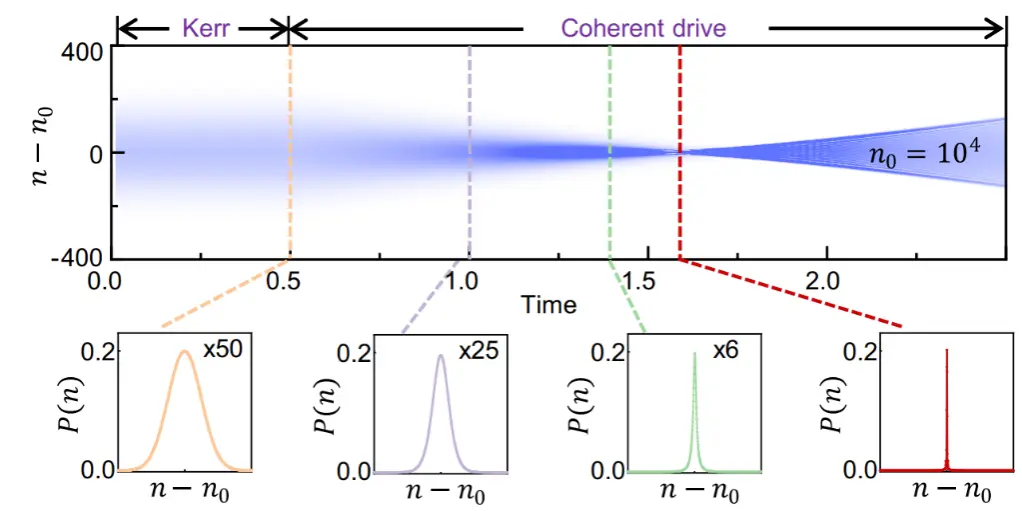
Researchers in China have developed a new theory allowing for the creation of Fock states containing over 10,000 photons. The team led by Academician Guo Guangcan, introduced Fock-space optics, applying principles of classical wave optics to quantum state regulation. This approach constructs “Fock-space lenses” to focus quantum states, overcoming scalability limits imposed by photon loss and increasing complexity in traditional methods. The research published on November 19, 2023, in Physical Review Letters, proposes a scheme where.
Fock-Space Optics Theory Enables Scalable Quantum State Manipulation
The preparation of a 10,000-photon Fock state, previously hampered by scalability issues, is now achievable through a theoretical framework developed by the team of Academician Guo Guangcan, led by Zou Changling and Researcher Li Ming, in collaboration with the research group of Professor Sun Luyi. This advance, dubbed Fock-space optics, uses principles from classical wave optics to manipulate quantum states, circumventing limitations imposed by increasing complexity and photon loss.
The team demonstrated the focusing of coherent states with a broad photon number distribution onto a target Fock state using constructed “Fock-space lenses”. This approach stems from a recognition of the mathematical correspondence between the evolution of quantum states in Fock space and the propagation of classical light waves, a connection that allowed the researchers to translate established optical techniques to the quantum realm.
By treating different photon numbers as grid points in a virtual space, they applied coherent driving to achieve quantum wave function propagation and nonlinear interactions to regulate wavefronts, effectively extending classical optical principles like propagation, refraction and interference into the quantum domain. This provides both an intuitive understanding and an efficient method for managing large-scale quantum states. Numerical simulations revealed that preparing a 10,000-photon Fock state requires only three Fock-space lenses, achieving fidelities reaching 73% for each lens.
The computational complexity of this scheme remains constant regardless of the target photon number, a significant departure from traditional methods. The preparation time, conversely, decreases with increasing photon number, an unexpected result that mitigates the impact of photon loss on large-scale state preparation.
Researchers successfully demonstrated basic optical phenomena, propagation, refraction, focusing, dispersion, and interference, within Fock space, extending wave optics principles to the regulation of quantum states involving 180 photons, with results published in Nature Physics. Building on this, the team developed Fock-space quantum confocal microscopy, inspired by its classical counterpart, to address the challenges of preparing and efficiently detecting large-scale non-classical quantum states.
This microscopy enabled the deterministic preparation of non-classical quantum states with an average photon number of up to 500, and achieved a quantum precision measurement gain exceeding the standard quantum limit by 19.2dB. Associate Professor Li Ming is the first author of the Physical Review Letters paper detailing this work, with Professor Zou Changling and Professor Sun Luyi serving as co-corresponding authors.
The universality of this theoretical framework suggests potential applications beyond the current experimental implementations, extending to other bosonic quantum systems such as optics, superconducting microwaves and phonons. This opens avenues for exploring macroscopic quantum phenomena, developing high-performance quantum precision measurement tools, and advancing bosonic quantum information processing technologies. The researchers anticipate that this approach will facilitate the creation of increasingly complex and robust quantum systems.


See today’s quantum computing news on Quantum Zeitgeist for the latest breakthroughs in qubits, hardware, algorithms, and industry deals.