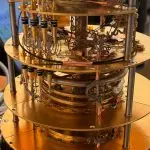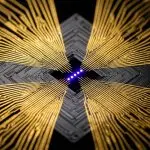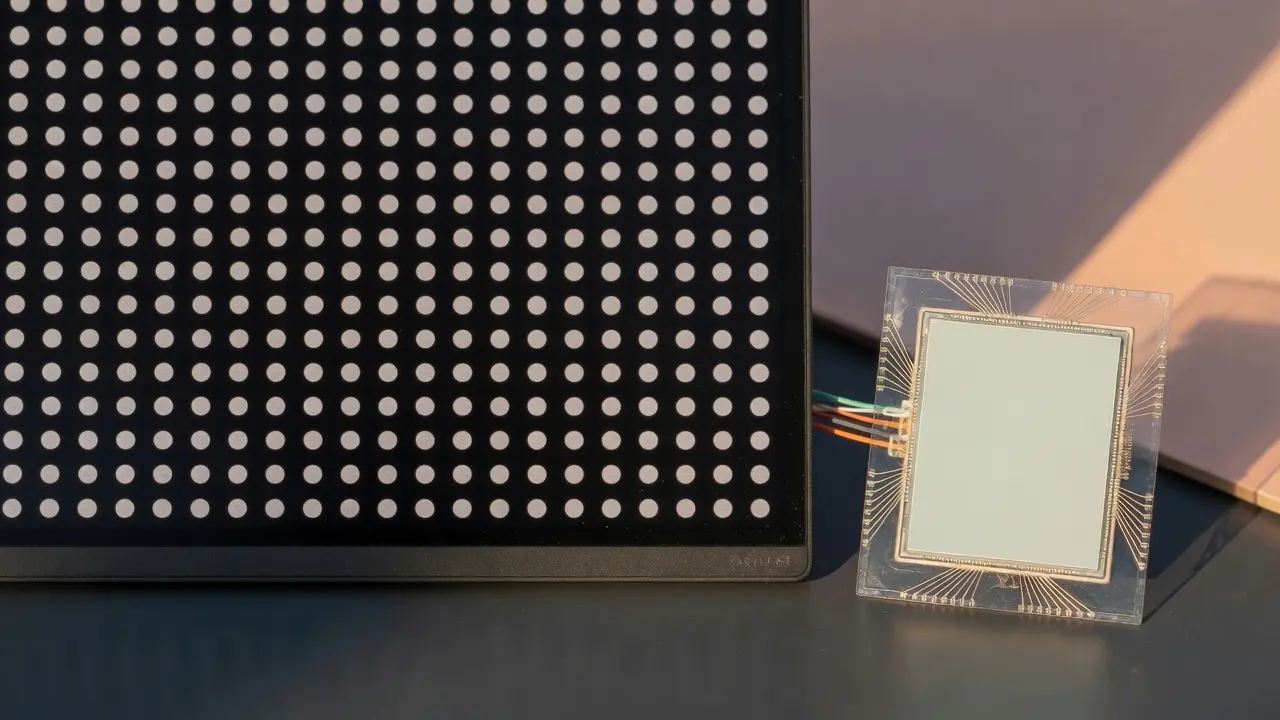
Guo Guangcan’s team in China has achieved over 90% efficiency in integrated quantum storage, a feat previously limited to less practical atomic gases. This breakthrough, detailed in an “Editor’s Choice” article in Physical Review Letters and highlighted by the American Physical Society as “Read More Photons from Quantum Storage,” addresses a critical bottleneck in building scalable quantum networks. Storage efficiency is paramount; even a drop to 89% can increase quantum information distribution time by over 10%. The team combined a waveguide microcavity with a time-reversal waveform optimization strategy to surpass the 90% threshold.
Waveguide Microcavity Design Achieves 90% Integrated Quantum Storage
Achieving over 90% efficiency, the team in China has demonstrably shrunk the physical footprint of high-performance quantum storage to just 1.2 × 10⁻³ mm³, a reduction of three orders of magnitude compared to systems relying on atomic gases. This miniaturization is critical; previously, reaching comparable storage efficiencies necessitated bulky atomic gas setups, hindering practical deployment in quantum networks.
An assessment of the work notes that “the central novelty claim that this is the first integrated solid-state quantum memory to surpass the 90% efficiency threshold is well-supported and represents a major milestone,” and that “the authors achieve record-high efficiency while maintaining a single-class population that is physically compatible with future spin-wave storage.” The team built upon prior work where they achieved 80.3% efficiency by forming a waveguide microcavity, addressing the weak absorption characteristic of rare-earth ions used in the storage medium. The challenge then shifted to compensating for dispersion effects caused by the rare-earth ions’ absorption band, effectively turning the system into a time-reversal system with limited bandwidth.
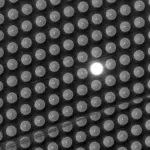
To overcome this, the team “tailor-made” the shape of the incoming photon pulse to maximize absorption and subsequent read-out from the storage medium. After four rounds of time-reversal optimization, storage efficiency reached 90.2%, as demonstrated by single-photon counting maps.
Time-Reversal Waveform Optimization Boosts Storage Efficiency & Fidelity
The team’s success stemmed from addressing dispersion effects inherent in the rare-earth ion system used for storage; these effects limit bandwidth and distort incoming signals. Rather than attempt to eliminate dispersion, the researchers embraced the time-reversal properties of the system, iteratively refining the shape of the input photon pulse. They began with an arbitrary square pulse, recorded its waveform after storage, and then time-reversed that waveform to create the input for the next iteration.
Through this process of self-evolution, repeated over four rounds, the input waveform converged on a shape that maximized storage efficiency, reaching 90.2%, a significant improvement over the 84.2% achieved with conventional Gaussian pulses. Encoding time-bin quantum bits within this optimized system yielded a quantum storage fidelity of 99.3%, exceeding the classical limit.
The team’s design also uses a single type of rare-earth ion, a factor that simplifies integration with spin-wave storage and allows for the development of longer-lived quantum memories. This compatibility, the researchers note, provides “a physical prerequisite for further realizing high-efficiency and long-lived quantum storage.”


See today’s quantum computing news on Quantum Zeitgeist for the latest breakthroughs in qubits, hardware, algorithms, and industry deals.