Quantinuum’s 98-qubit Helios system is demonstrating increasingly reliable performance in collaborative tests with Sandia National Laboratories, edging closer to the threshold for practical quantum computation. Results published in Nature reveal the commercial system achieved 99.5 percent fidelity in single-qubit operations and 99.1 percent fidelity when manipulating two qubits, metrics crucial for building more complex algorithms. This progress establishes Helios as Quantinuum’s most reliable quantum computer to date, representing a step toward fault-tolerant systems capable of tackling significant challenges. “As a national resource, we are committed to accelerating quantum computing technology in support of economic and national security,” said Sandia senior manager Mike Descour, highlighting the importance of public-private partnerships in advancing the field.
Helios System Achieves High Fidelity with 98 Qubits
Boasting 98 qubits and demonstrating a level of operational accuracy signaling continued advancement in the field, Quantinuum’s Helios system had its results independently verified by Sandia National Laboratories in a study published in Nature. The collaboration focused on refining the reliability of individual quantum operations, achieving 99.5 percent fidelity when manipulating single qubits, rather than simply increasing qubit count. This high single-qubit fidelity represents a substantial improvement over previous generations of quantum processors and highlights a key area of current success for the Helios architecture. While single-qubit control is progressing rapidly, maintaining accuracy becomes significantly more challenging as the number of interacting qubits increases; the Helios system also achieved 99.1 percent fidelity in operations involving two qubits.
Sandia researchers contributed a new benchmarking methodology to assess the performance of mid-circuit measurements, essential for identifying and correcting errors that inevitably arise in quantum computations. “The most important aspect of quantum computers is not speed, but reliability,” explained Sandia’s Robin Blume-Kohout, a co-author on the paper, emphasizing the critical need to address error rates before scaling up to more complex systems. The partnership between Sandia and Quantinuum, formalized through a Cooperative Research and Development Agreement, leverages Sandia’s expertise in microelectronics and photonics to improve the scalability of Quantinuum’s trapped ion quantum computer design. Integrated photonics, energy-efficient chips that transmit information via light, are a key focus, promising to reduce energy consumption and facilitate the construction of larger, more practical quantum computers.
In operations that involved only one or two qubits, or quantum bits, the system demonstrated very high fidelity – % and %, respectively.
Sandia National Laboratories
Sandia & Quantinuum Advance Integrated Photonics for Scalability
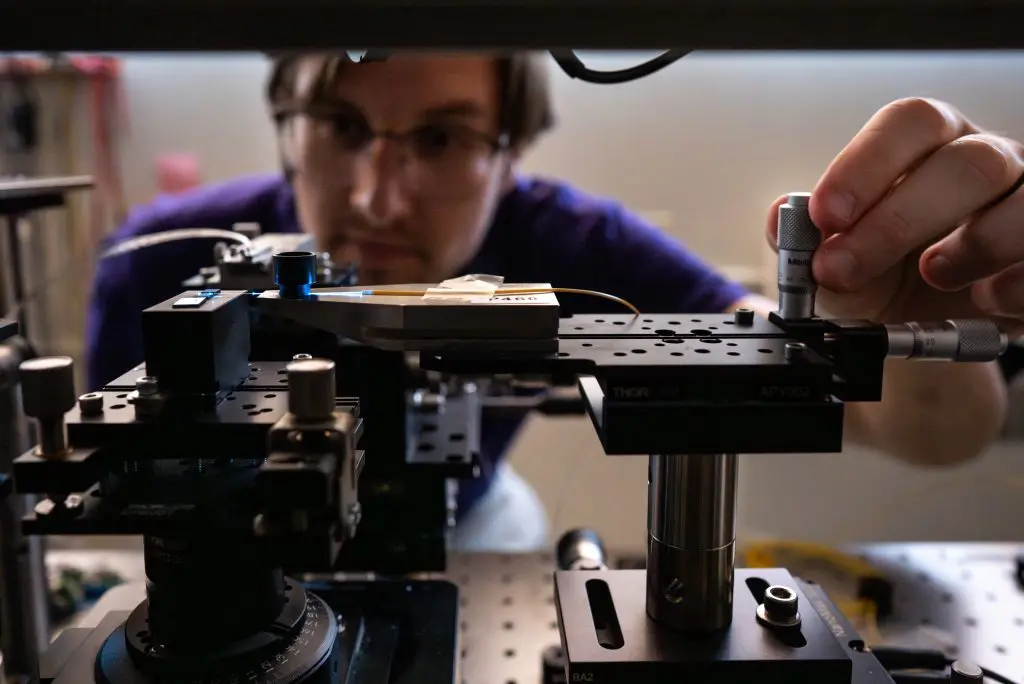
Rigorous testing of Quantinuum’s Helios system, featuring 98 qubits and debuting last year, is currently underway in collaboration with Sandia National Laboratories, pushing the boundaries of scalable quantum hardware. Sandia is actively designing and testing components intended for future quantum platforms, focusing on integrated photonics, energy-efficient chips that utilize light to transmit information. These photonic circuits promise to address critical limitations in quantum technology by reducing energy consumption and improving scalability, a major hurdle in building practical quantum computers. The collaboration’s recent findings, published in Nature, detail Helios’ performance, revealing 99.5 percent and 99.1 percent fidelity, respectively. This level of accuracy is particularly noteworthy given the inherent challenges of maintaining quantum states; researchers have pioneered debugging methods and benchmarking techniques, including a novel methodology for assessing mid-circuit measurements essential for error correction.
Sandia’s role extends beyond performance evaluation; the laboratory is actively contributing to the foundational technologies underpinning Helios, specifically in the realm of integrated photonics for trapped ion quantum computers. Chris DeRose, Sandia’s photonics manager, emphasized the laboratory’s open approach to collaboration, stating, “We welcome collaboration with any interested partner including universities, industry and other national laboratories.” The ultimate goal, as articulated by Quantinuum’s Tony Ransford, Helios lead architect, is to create systems that operate beyond the capabilities of classical simulation alone and establish a new benchmark of fidelity and complexity for quantum computers.
As a national resource, we are committed to accelerating quantum computing technology in support of economic and national security.
National Lab Validates Helios Performance with New Benchmarking
Sandia National Laboratories is playing a crucial role in validating the performance of commercial quantum systems, recently completing a detailed assessment of Quantinuum’s 98-qubit Helios computer. The Nature publication detailing Helios’ performance highlights a significant achievement in single-qubit fidelity, demonstrating 99.5 percent accuracy. While two-qubit operations currently achieve 99.1 percent fidelity, the results nonetheless establish Helios as Quantinuum’s most advanced quantum computer to date. This focus on reliability, rather than sheer computational speed, is a deliberate strategy, according to Robin Blume-Kohout of Sandia. Sandia’s assessment goes beyond simply confirming specifications; the lab is actively contributing to the scalability of quantum technology.
Helios operates beyond the capabilities of classical simulation alone and established a new benchmark of fidelity and complexity for quantum computers.

See today’s quantum computing news on Quantum Zeitgeist for the latest breakthroughs in qubits, hardware, algorithms, and industry deals.