Researchers of the Chinese Academy of Sciences and Beijing Normal University have achieved direct nanoscale visualization of spin-wave propagation in two technologically important magnetic materials using scanning nitrogen-vacancy (NV) center spectroscopy. With Yangmu Li as the submitting author, the team successfully imaged spin waves in yttrium-iron-garnet (YIG) and lanthanum strontium manganese oxide (LSMO), overcoming a longstanding challenge in observing spin dynamics within materials exhibiting complex magnetic textures. Their experiments reveal a wavelength-dependent spin-wave filtering effect near point-like magnetic scatterers and modified spin wavefronts within antiferromagnetically coupled stripe domains. The findings demonstrate that scanning NV center spectroscopy provides a powerful platform for studying spin-wave behavior in magnetic systems beyond simple, uniformly magnetized films.
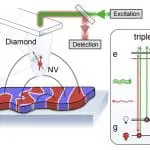
Spin waves, also known as magnons, are collective excitations of electron spins that can transport information without requiring the movement of electric charge, making them promising candidates for next-generation low-power computing and spintronic technologies. However, directly imaging their propagation at the nanoscale has remained difficult, particularly in materials with complex magnetic structures where conventional techniques often lack either sufficient spatial resolution or sensitivity. The researchers addressed this challenge by employing scanning NV center spectroscopy, which uses atomic-scale defects in diamond as highly sensitive magnetic field sensors capable of mapping spin-wave dynamics in real space.
Applying this technique to YIG and LSMO films, the researchers observed that magnetic defects and domain structures significantly influence spin-wave propagation. They identified a wavelength-dependent filtering effect near point-like magnetic scatterers, demonstrating that different spin-wave wavelengths interact differently with localized magnetic features. In addition, they found that antiferromagnetically coupled stripe domains modify the shape of propagating spin-wave fronts, revealing how complex magnetic textures can control the flow of spin information within a material.
Micromagnetic simulations and analytical calculations closely matched the experimental observations, confirming both the accuracy of the imaging technique and the physical mechanisms responsible for the measured wavefront distortions. These results establish scanning NV center spectroscopy as a versatile tool for investigating spin dynamics across a broad range of magnetic materials, extending its capabilities beyond previously studied uniform magnetic systems.
By enabling direct real-space imaging of spin-wave propagation in materials with intricate magnetic structures, the research opens new opportunities for understanding and controlling spin transport at the nanoscale. The ability to visualize how magnetic defects and domain configurations shape spin-wave behavior could support the development of advanced magnonic circuits, spintronic devices, and energy-efficient information processing technologies. More broadly, the work provides a powerful experimental platform for exploring fundamental spin dynamics and designing future quantum and magnetic devices.
Source: https://arxiv.org/abs/2607.06941
See today’s quantum computing news on Quantum Zeitgeist for the latest breakthroughs in qubits, hardware, algorithms, and industry deals.