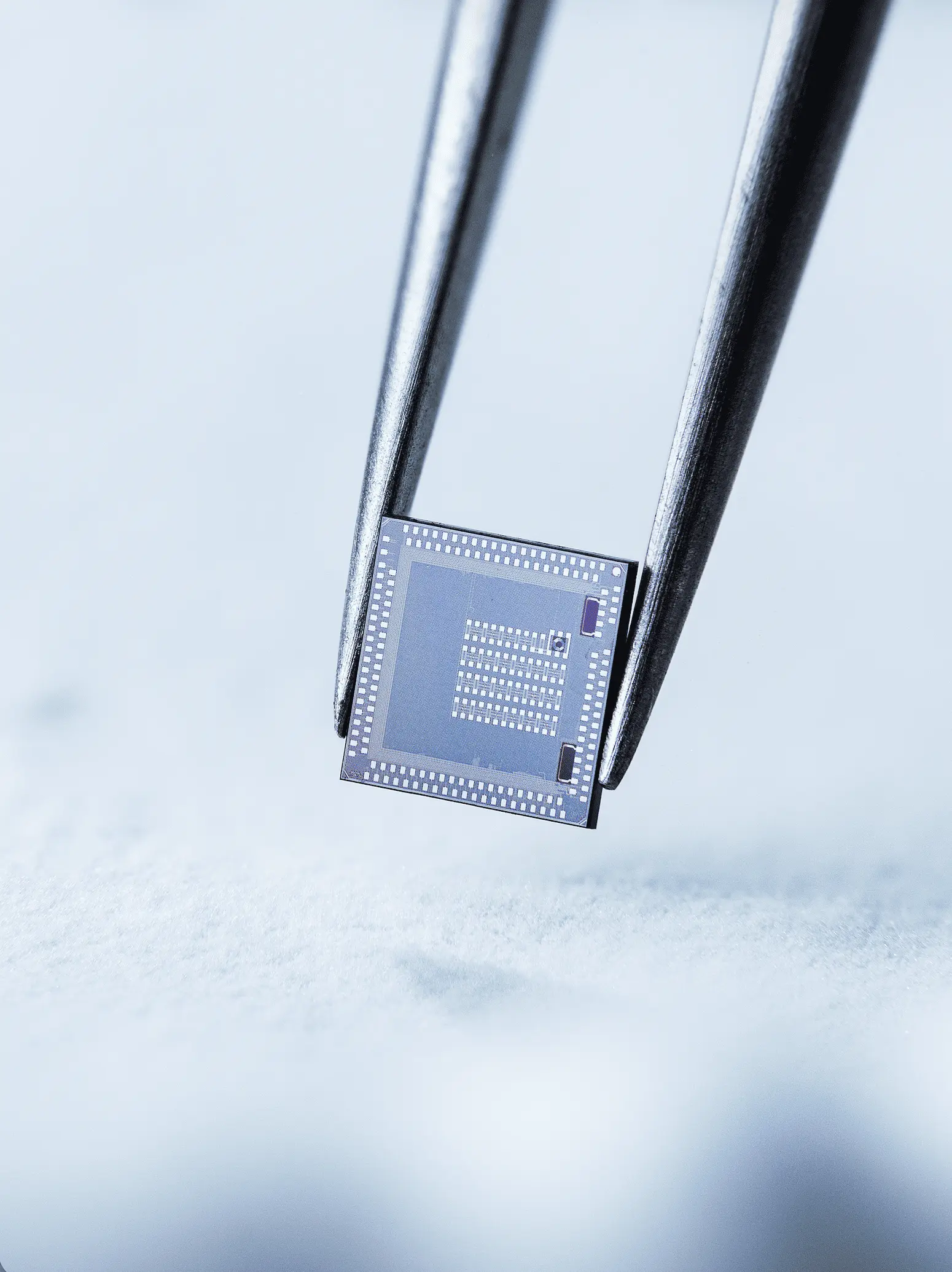
Researchers from nanoGUNE, Quantum Motion, and Imperial College London have fabricated a new superinductor within a silicon integrated circuit using a standard commercial complementary metal-oxide-semiconductor (CMOS) process. The device uses titanium nitride (TiN) for its high kinetic inductance, enabling the creation of compact, high-inductance circuit elements for superconducting qubits and quantum circuits, nanoGUNE says.
This technology aims to create a radiofrequency single-electron transistor capable of spin readout speeds below the microsecond timescale; the research team states that the applications of the TiN-based CMOS inductors could expand well beyond quantum sensing and computing for spin qubits, impacting areas such as radio-astronomy, low-power cryoelectronics and quantum sensing and simulations.
Titanium Nitride Superinductor Fabrication in CMOS Silicon Circuits
This approach allows for compact, high-inductance circuit elements while preserving superconducting properties, a critical feature for manipulating quantum behavior within circuits. Researchers successfully demonstrated a non-linear superinductor integrated directly into silicon. The resulting system is designed to create a radiofrequency single-electron transistor, a sensor commonly used for semiconductor spin qubits, with a significantly reduced physical size and improved sensitivity.
the applications of the TiN-based CMOS inductors could expand well beyond quantum sensing and computing for spin qubits, impacting areas such as radio-astronomy, low-power cryoelectronics and quantum sensing and simulations.




See today’s quantum computing news on Quantum Zeitgeist for the latest breakthroughs in qubits, hardware, algorithms, and industry deals.