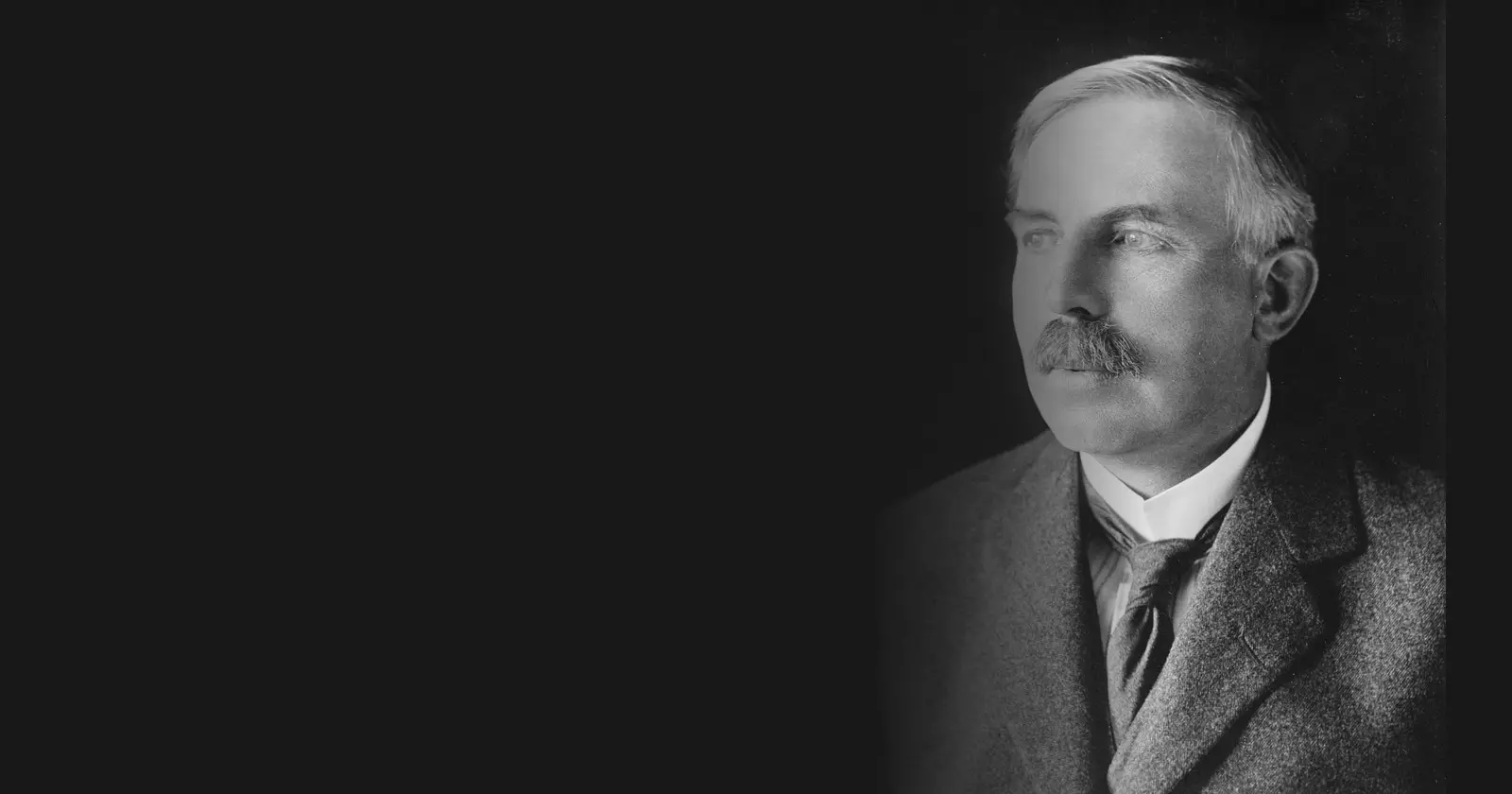
- Who Ernest Rutherford was
- From a New Zealand farm to the Cavendish
- Radioactivity, transmutation and a chemistry prize
- The experiment that found the nucleus
- The problem he handed to quantum theory
- Splitting the atom and naming the proton
- The Cavendish and the school he built
- The moonshine he did not live to see disproved
- What Ernest Rutherford has to do with quantum computing
- Why Ernest Rutherford matters
- Frequently asked questions
In 1909 two men in a darkened room in Manchester spent weeks counting faint flashes of light on a screen. Ernest Marsden, an undergraduate whom Hans Geiger had judged ready for a project of his own, had been set a question by his professor that nobody expected to yield anything. He was firing alpha particles at a metal plate, with the detecting screen on the same side as the source, and looking for particles that came back.
Some did. Roughly one in eight thousand bounced off a platinum reflector at ninety degrees or more. Nothing in the accepted picture of the atom could turn a fast alpha particle round, and the man who had set the question spent the better part of two years working out what it meant.
That man was Ernest Rutherford. His answer, published in 1911, was that the atom is almost entirely empty, and that its positive charge and nearly all of its mass sit in a core so small it occupies a vanishing fraction of the volume. He had found the atomic nucleus. It is the single most consequential thing anyone discovered about matter in the twentieth century, and it created a crisis that took another fifteen years and the invention of quantum mechanics to resolve.
This profile traces what Ernest Rutherford actually did, in what order, and with whom. It separates the results that are securely his from the ones his students earned, treats the famous quotations with the scepticism their provenance deserves, and sets out honestly why a man who died in 1937 belongs on a site about quantum computing.
Ernest Rutherford discovered the atomic nucleus, publishing the interpretation in 1911 after Hans Geiger and Ernest Marsden observed large-angle alpha scattering in 1909.
He won the Nobel Prize in Chemistry, not Physics, in 1908, for showing that radioactive elements transform into other elements as they decay.
His nuclear atom was unstable under classical physics, and that failure is precisely the problem Niels Bohr solved in 1913 by quantising the electron’s orbit.
He achieved the first artificial disintegration of a nucleus, knocking hydrogen out of nitrogen, and gave the proton its name.
He dismissed the prospect of useful energy from the atom as moonshine, and Leo Szilard conceived the nuclear chain reaction shortly after reading about the speech.
Who Ernest Rutherford was
Ernest Rutherford was an experimental physicist who spent his career taking the atom apart, and who did it almost entirely by watching what happened when he fired small fast things at large slow things. He was not a theorist and made no secret of it. His gift was for designing experiments whose results admitted only one interpretation, and then for having the nerve to accept the interpretation even when it destroyed the model everyone was working with, including his own teacher’s.
He worked in three countries and changed his field in each of them. In Montreal he established that radioactivity is the spontaneous transformation of one element into another, which won him a Nobel Prize. In Manchester he found the nucleus and became the first person to break a nucleus apart deliberately. In Cambridge he ran the laboratory that discovered the neutron and split the lithium nucleus with an accelerator, though by then the discoveries were being made by the people he had gathered rather than by his own hands.
The short version of the career
Ernest Rutherford was born on a smallholding in New Zealand in 1871, the fourth of twelve children, and reached England in 1895 on a scholarship. He was Macdonald Professor of Physics at McGill University in Montreal, then Langworthy Professor at Manchester, then Cavendish Professor at Cambridge, the most senior experimental physics post in Britain. He was knighted, ennobled, given the Order of Merit, and elected President of the Royal Society.
The compression is worth noticing. A man who grew up digging potatoes and who had to win a scholarship twice over to get out of the colony ended his life as a baron buried a few feet from Isaac Newton. Almost nothing in his career happened because of connections he was born with.
| Year | Where | What happened |
|---|---|---|
| 1871 | Near Nelson, New Zealand | Born, the fourth of twelve children |
| 1895 | Cavendish Laboratory, Cambridge | Arrives on an 1851 Exhibition Scholarship to work under J. J. Thomson |
| 1898 | McGill University, Montreal | Takes the Macdonald chair of physics |
| 1902 to 1903 | Montreal | With Frederick Soddy, establishes that radioactive elements transmute as they decay |
| 1907 | University of Manchester | Becomes Langworthy Professor |
| 1908 | Stockholm | Nobel Prize in Chemistry for the disintegration of the elements |
| 1909 | Manchester | Geiger and Marsden observe large-angle alpha scattering |
| 1911 | Manchester | Publishes the nuclear model of the atom |
| 1912 | Manchester | Niels Bohr joins him; quantises the atom the following year |
| 1919 | Manchester, then Cambridge | Reports the first artificial transmutation; succeeds Thomson as Cavendish Professor |
| 1920 | Royal Society, then Cardiff | Bakerian Lecture predicts a neutral particle; names the proton at the British Association that August |
| 1932 | Cavendish Laboratory | Chadwick finds the neutron; Cockcroft and Walton split lithium |
| 1933 | British Association | Calls atomic power moonshine; Szilard conceives the chain reaction |
| 1937 | Cambridge | Dies, and is buried in Westminster Abbey |
From a New Zealand farm to the Cavendish
Rutherford was born on 30 August 1871 near Nelson, at the top of New Zealand’s South Island, into a family of modest means and considerable size. His father was a tradesman who later ran a flax mill, his mother had been the local schoolteacher, and the children worked alongside their parents. The path out was scholarships, and he won them repeatedly, first to Nelson College and then to Canterbury College in Christchurch, where he took degrees and began building his own apparatus for detecting radio waves.
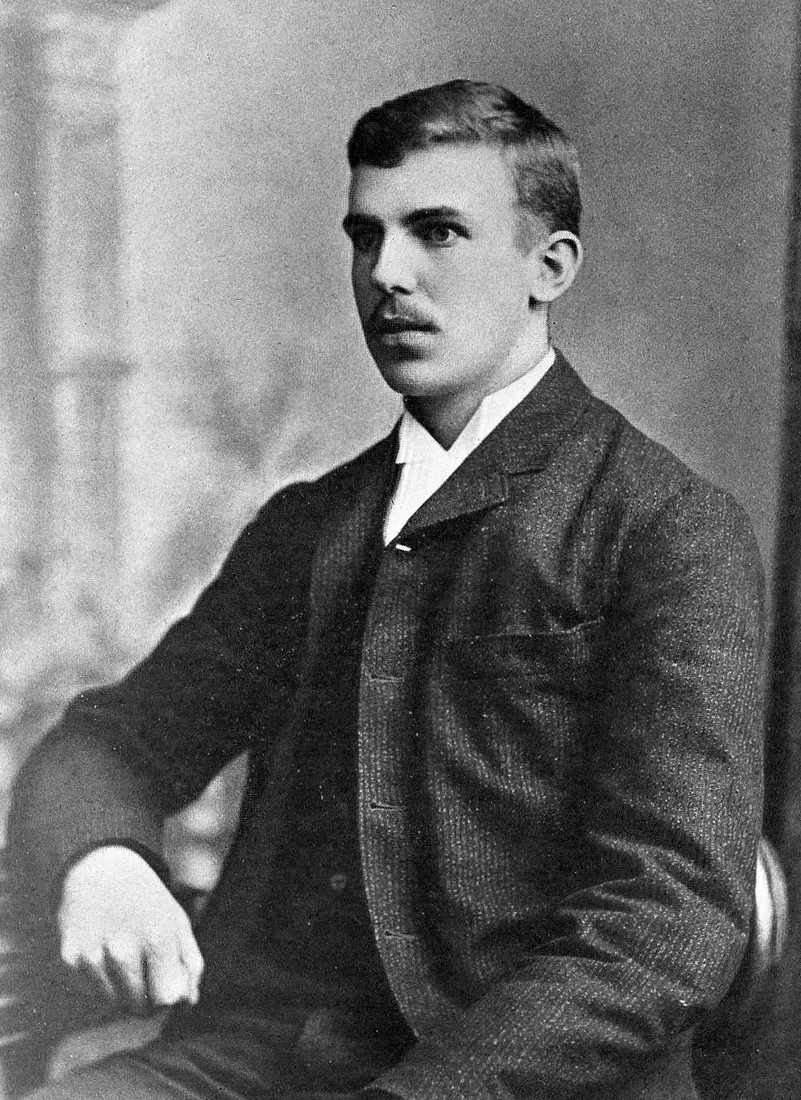
In 1895 an 1851 Exhibition Scholarship took him to the Cavendish Laboratory in Cambridge to work under J. J. Thomson, who two years later would identify the electron. He was the first graduate of another university admitted to Cambridge as a research student, under an arrangement new enough that his presence was faintly controversial. He began on radio detection and moved quickly to the newly discovered radiation coming out of uranium, which is where he stayed.
Sorting the radiation into kinds
His first substantial contribution was taxonomic and it has lasted. Studying how the radiation from uranium was absorbed by successive layers of foil, he found that it came in at least two distinct varieties, one stopped almost immediately and one far more penetrating. He named them alpha and beta. A third and still more penetrating component, discovered by Paul Villard in 1900, he named gamma three years later, completing the set.
The naming looks like bookkeeping and was in fact the beginning of everything else he did. The alpha particle, which he would later show to be a stripped helium atom, became his tool. Every major result of his career was obtained by firing alpha particles at something and watching carefully.
Proving what an alpha particle is
Naming the alpha particle was not the same as knowing what it was, and Rutherford settled that question too. Working with Thomas Royds at Manchester, he sealed radium emanation inside a glass tube whose walls were thin enough for alpha particles to pass through, surrounded it with an evacuated outer tube, and waited. After several days a spectrum taken of the gas that had accumulated in the outer tube showed the unmistakable lines of helium.
The alpha particle was a helium atom stripped of its electrons, which is what we now call a helium nucleus, though the nucleus itself would not be proposed for another three years. That result mattered for two reasons beyond its own interest. It told Rutherford exactly what he was firing in every subsequent experiment, including the scattering work, and it gave him the mass and charge he needed to turn the scattering counts into a quantitative argument. His most famous discovery rests on this less famous one.
Radioactivity, transmutation and a chemistry prize
Rutherford took the Macdonald chair at McGill University in Montreal in 1898, and it was there, working with the young chemist Frederick Soddy, that he established what radioactivity actually is. The pair showed that radioactive elements are not simply emitting something while remaining themselves, but are transforming into different elements altogether, with each species decaying at its own characteristic rate.
This was a genuinely shocking claim. The transmutation of elements was the ambition of alchemy, and respectable nineteenth-century chemistry rested on elements being immutable. Rutherford and Soddy were saying that nature performs transmutation continuously and without assistance, and they had the decay curves to prove it.
Why the chemists claimed him
The 1908 Nobel Prize that followed was awarded in Chemistry rather than Physics, for his investigations into the disintegration of the elements and the chemistry of radioactive substances. Rutherford regarded himself as a physicist without qualification, and his reaction survives in his own hand. Writing to Otto Hahn on 29 November 1908, in a letter printed in his authorised Life and Letters, he said that the award was very unexpected and that he was very startled at his metamorphosis into a chemist.
The better-known version of the story, in which he told the Stockholm banquet that he had dealt with many transformations but none so rapid as his own from physicist to chemist, should be handled more carefully. It reaches us as a third-person paraphrase in his authorised biography, attributed to an unnamed eye-witness, so it is characteristic rather than verbatim and does not belong inside quotation marks.
What is not in doubt is the classification itself, which the Nobel Foundation’s record for Ernest Rutherford lists under Chemistry, and which is why a man remembered as one of the greatest of all experimental physicists holds a chemistry prize. James Chadwick, in a recollection printed in the same volume, recorded that it remained a good joke against him to the end, and one he thoroughly appreciated, that he was branded for all time a chemist and no true physicist.
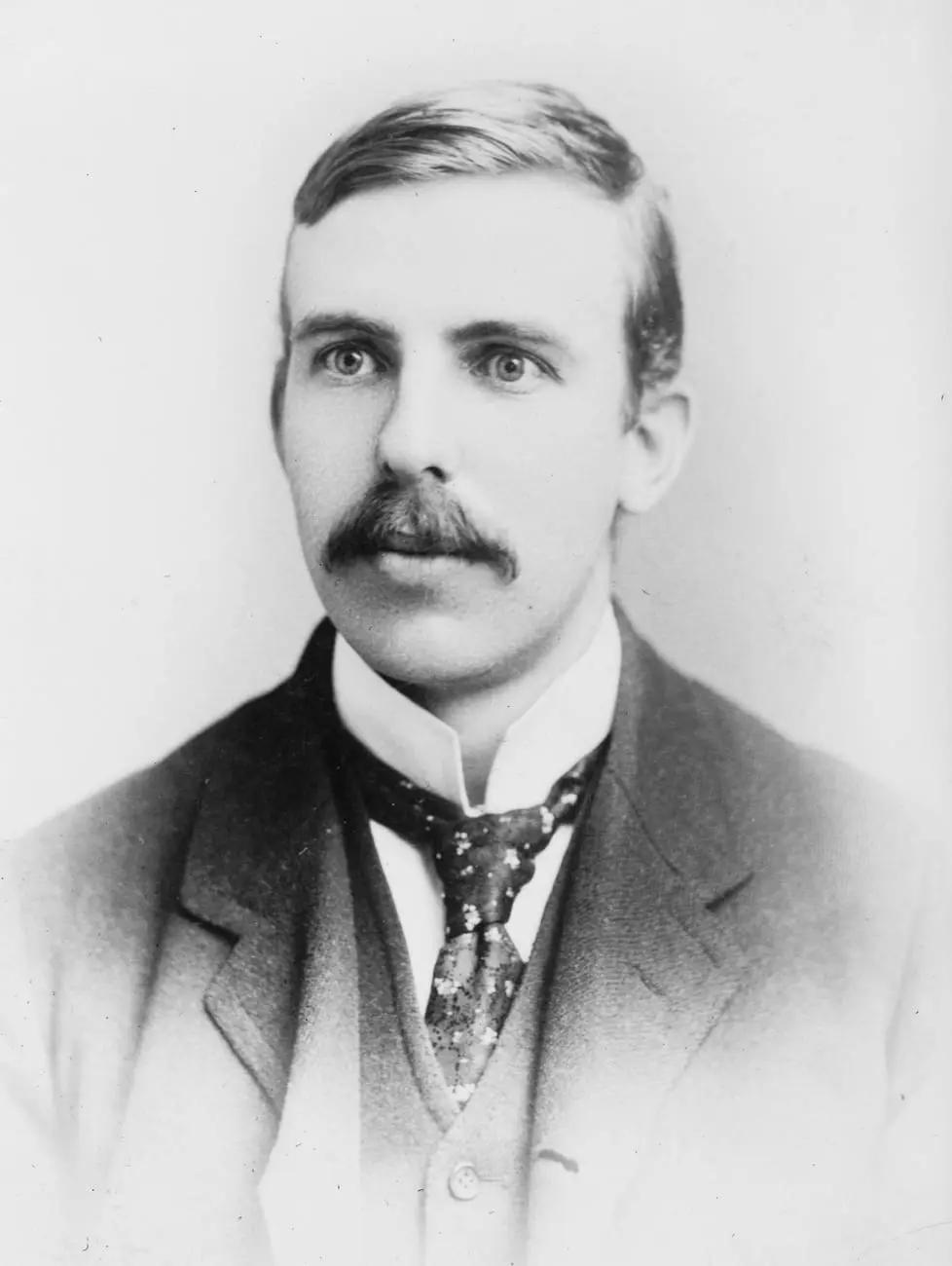
The experiment that found the nucleus
By 1907 Ernest Rutherford had moved to Manchester, and it was there that he set Hans Geiger and Ernest Marsden the work that changed physics. The prevailing picture of the atom was J. J. Thomson’s, in which the negative electrons were embedded in a diffuse sphere of positive charge, an arrangement usually described as the plum pudding. Under that model an alpha particle fired at thin metal should pass through with only slight deflection, because there is nothing concentrated enough inside to turn it sharply, and nothing at all should come back.
That is broadly what happened, for almost every particle. The exception was the finding of 1909, when a small fraction were reflected back towards the source, and it was followed by transmission experiments through thin gold leaf between 1910 and 1913 which measured how the number of deflected particles fell away with angle. Together the two established that a very small number of alpha particles are turned through enormous angles.
Nothing in the diffuse model could do that. Deflecting a fast alpha particle backwards requires it to encounter something both very small and very massive, and the fact that it happened rarely meant that whatever it hit occupied a tiny fraction of the atom.
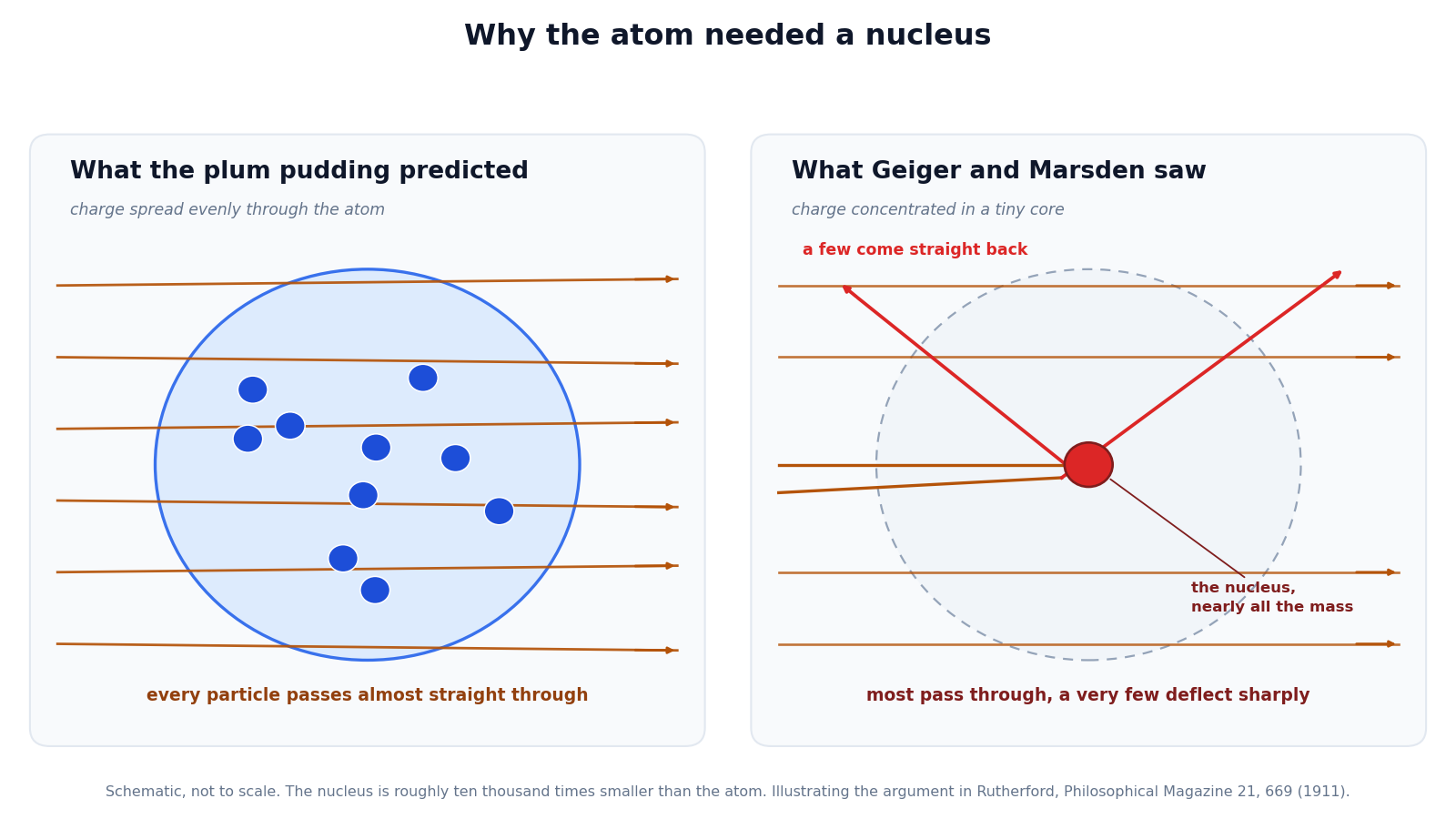
What Geiger and Marsden actually did
Credit here needs care, because the popular account compresses several separate things. Geiger ran the scattering programme and supervised; Marsden, an undergraduate, did the reflection experiment; and the tedium of it deserves recording, since the detection method was a human observer sitting in the dark watching a zinc sulphide screen for individual scintillations. Rutherford supplied the question and, two years later, the interpretation, which is the part that required a theorist’s nerve rather than an observer’s patience. He never put his name on their paper.
The interpretation appeared in the Philosophical Magazine in 1911, and what it offered was not merely a picture but a quantitative law. Rutherford worked out how the number of particles scattered should vary with angle if the deflection came from a single encounter with a concentrated charge. He was careful about the standing of that result, closing the paper by reserving further questions until the main deductions had been tested experimentally, and noting that Geiger and Marsden had such experiments already in progress. Their systematic test appeared in 1913 and confirmed the law, and it was that agreement, rather than the vividness of the image, that made the nuclear atom impossible to dismiss.
What the 1911 paper actually says
Two details of that paper are routinely lost, and both are worth recovering because they show how carefully he worked. The first is that the word nucleus does not appear in it. Rutherford’s term throughout is the central charge, and his summary sentence says only that the atom contains a central charge distributed through a very small volume, and that the large single deflexions are due to that charge as a whole rather than to its constituents.
The second is that he declined to say whether the central charge was positive or negative. He noted that the main deductions of the theory did not depend on the sign, assumed a positive one for convenience, and stated plainly in his conclusion that no definite evidence yet existed either way. A man popularly remembered for a bold leap was in fact refusing to claim anything his data did not force.
How small the nucleus turned out to be
The scattering data did more than establish that a nucleus exists. Because the deflection depends on how closely a particle approaches the central charge, and because the alpha particles arrived with a known energy, Rutherford could put an upper bound on the size of the thing they were bouncing off. The number that came out was startling, and it remains the most quoted fact about atomic structure.
The nucleus is smaller than the atom by a factor of roughly ten thousand or more in radius, which means the atom is empty to a degree that has no everyday analogy. Solid matter is very nearly nothing at all, held apart by electrical forces rather than by any filling of space. That conclusion followed from counting flashes of light, and it is the reason the experiment is still taught to schoolchildren more than a century later.
The problem he handed to quantum theory
The nuclear atom was immediately, obviously, catastrophically broken. If the electrons orbit a central nucleus, then under Maxwell’s electrodynamics they are accelerating charges, and accelerating charges radiate. An orbiting electron should therefore lose energy continuously and spiral into the nucleus, and the calculation gives a lifetime for a hydrogen atom of about ten picoseconds. Matter should not exist. It plainly does.
This is the most productive failure in the history of physics. Rutherford’s experiment had established beyond argument that the nucleus is there, and classical physics said that an atom built that way cannot last. One of the two had to give, and it was not going to be the experiment.
Rutherford saw the difficulty and deliberately declined it. The stability of the atom he was proposing, he wrote in the 1911 paper, need not be considered yet, because it would depend on details of internal structure and motion that he was in no position to specify. He set the problem down and walked away from it, which was the right instinct for an experimentalist and left the hardest theoretical question of the age lying in the open.
The nucleus was not a discovery that quantum mechanics explained. It was the discovery that made quantum mechanics necessary.
The problem Rutherford created in 1911, and Bohr attacked in 1913
Bohr in Manchester
The young Danish theorist Niels Bohr came to work with Rutherford in Manchester in 1912, arriving just as the implications of the nuclear atom were becoming inescapable. Bohr’s solution, published the following year, was to assert that the electron may only occupy certain permitted orbits, that it does not radiate while in them, and that light is emitted only when it jumps between them. The permitted orbits are fixed by a quantum condition.
Bohr named the problem in his opening pages, writing that an attempt to explain the properties of matter on this model met difficulties of a serious nature arising from the apparent instability of the system of electrons, and that the inadequacy of classical electrodynamics at atomic scale had become generally acknowledged. His remedy was to import Planck’s constant, a quantity foreign to classical electrodynamics, and let it fix the permitted orbits.
There is a detail here that deserves to be better known. The paper carries the footnote that it was communicated to the Philosophical Magazine by Professor E. Rutherford. He personally submitted for publication the work that repaired his own model, and by every account was delighted by it, his only recorded complaint being that Bohr wrote at excessive length.
This was, by the standards of classical physics, an outrageous move, and Bohr made it because Rutherford’s experiment left no alternative. The model was superseded within about a decade by the full quantum mechanics of Heisenberg and Schrödinger, but the essential idea, that atomic states are discrete rather than continuous, survived and is the foundation everything since has been built on. Every qubit that encodes information in two atomic energy levels is working with the consequence of that argument.
Splitting the atom and naming the proton
During and just after the First World War, Rutherford returned to firing alpha particles at things, this time at nitrogen gas. He found that the collisions were knocking hydrogen nuclei out of the nitrogen, and concluded that the hydrogen nucleus is one of the components from which the nitrogen nucleus is built. The work was done in 1917 and published in 1919.
It is worth being exact about what he claimed, because the textbook version overstates it. Rutherford reported the ejected hydrogen nuclei. He did not report having made oxygen. The identification of the residual nucleus as an oxygen isotope came six years later from Patrick Blackett, using a cloud chamber, and it is Blackett who completed the reaction now written as nitrogen-14 plus an alpha particle giving oxygen-17 plus a proton.
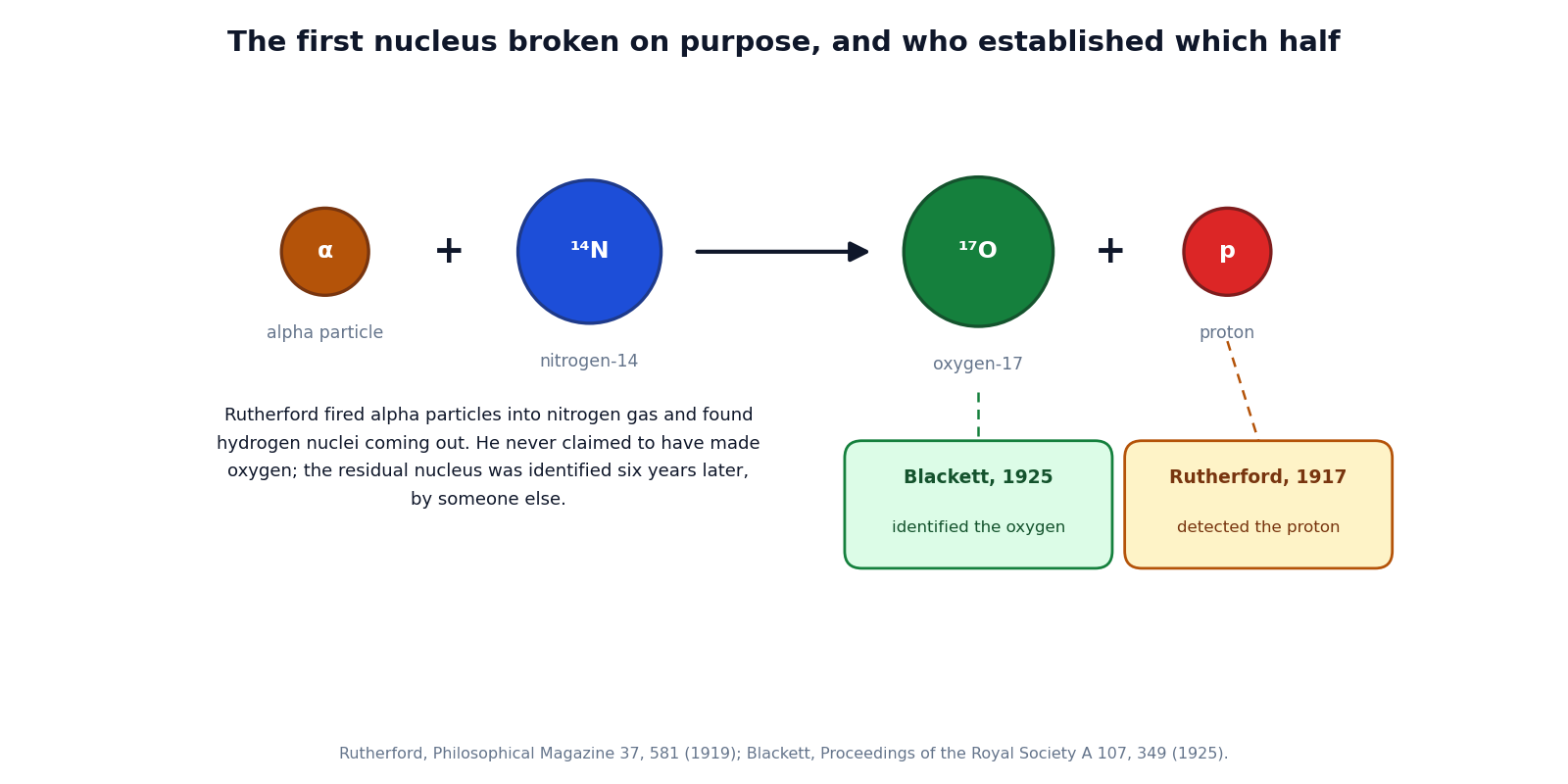
The hydrogen nucleus that came out of these collisions was clearly a fundamental constituent of other nuclei, and it needed a name. Rutherford proposed one at the British Association meeting in Cardiff in the summer of 1920, and the proton has been called that ever since. The word does not appear in his Bakerian Lecture of that June, where he was still writing of the H nucleus, so the naming can be dated fairly precisely to the weeks in between. The word is one of the very few pieces of physics vocabulary that can be traced to a single person with confidence.
The neutron he predicted and Chadwick found
In his Bakerian Lecture to the Royal Society in 1920, Rutherford argued that nuclei should contain a further particle, of mass comparable to the proton but carrying no charge. His reasoning was partly arithmetical, since nuclear masses did not add up if nuclei contained only protons and electrons, and partly practical, since a neutral particle would be able to penetrate a nucleus without being repelled.
It took twelve years to find. James Chadwick, working in Rutherford’s Cavendish, identified the neutron in 1932 and won the Nobel Prize in Physics for it three years later. The prediction and the discovery are a striking demonstration of what Rutherford’s laboratory was for, which was to keep a hard problem in front of good people until one of them solved it.
The Cavendish and the school he built
Rutherford succeeded J. J. Thomson as Cavendish Professor in 1919 and held the post until he died. The laboratory he ran in those years has a claim to being the most productive physics department that has ever existed, and its output is best understood as a list of people rather than a list of results.
| Who | What they did | Nobel Prize |
|---|---|---|
| Frederick Soddy | Worked with Rutherford at McGill on radioactive transformation; later isotopes | Chemistry, 1921 |
| Niels Bohr | Came to Manchester in 1912; quantised the Rutherford atom in 1913 | Physics, 1922 |
| James Chadwick | Discovered the neutron at the Cavendish in 1932 | Physics, 1935 |
| John Cockcroft and Ernest Walton | Split the lithium nucleus with an accelerator in 1932 | Physics, 1951 |
| Patrick Blackett | Cloud chamber work on nuclear transmutation and cosmic rays | Physics, 1948 |
| Pyotr Kapitsa | Ran the Mond Laboratory at the Cavendish; later low-temperature physics | Physics, 1978 |
The 1932 results are the ones that mattered most and they came within months of each other. Chadwick’s neutron gave physics a projectile that could enter a nucleus without being turned away by its charge, which is the tool that made nuclear fission discoverable six years later. Cockcroft and Walton’s accelerator showed that a nucleus could be broken apart by machine rather than by waiting for a naturally radioactive source to oblige.
Rutherford’s method as a director of research is well attested and unfashionable. He preferred cheap apparatus, distrusted elaborate funding, kept the problems in front of his people rather than distributing them, and was famously loud. What he did not do was put his name on work he had not done, which in an era when heads of laboratory routinely did is worth stating plainly.
The way he ran a laboratory
The accounts left by people who worked for him agree on the essentials. He was loud, physically large, given to singing tunelessly in the laboratory, and impatient with anything he regarded as showing off. He wanted to know what an experiment would settle before he would agree it was worth doing, and he preferred apparatus that could be built quickly out of whatever was to hand.
That preference has been romanticised since, usually as string and sealing wax, and it is worth resisting the romance. Cheap apparatus was a method rather than a virtue, and its point was speed. A device that takes a month to build permits one idea a month, and Rutherford’s productivity across four decades came in large part from refusing to wait. The Cavendish under his direction was not underfunded so much as deliberately impatient.
He was also, by the standards of his era, unusually willing to let young people run important experiments. Marsden was an undergraduate when he was given the scattering work. Chadwick, Blackett, Cockcroft and Walton all did their prize-winning work as relatively junior figures in a laboratory Rutherford directed but did not crowd. Whatever else the Cavendish record demonstrates, it shows that his judgement about people was as good as his judgement about experiments.
The moonshine he did not live to see disproved
On the morning of 11 September 1933, at the British Association meeting in Leicester, Rutherford opened a sectional discussion on atomic transmutation and dismissed the idea that the energy locked in nuclei could ever be put to practical use. The Times reported him in indirect speech the following day, saying that it was a very poor and inefficient way of producing energy, and that anyone who looked for a source of power in the transformation of the atoms was talking moonshine.
It is the most famous wrong prediction in the history of science, and it was made by the person then living who understood nuclei best. It is also worth noting that the papers covering the same remarks filed materially different wordings, and that the crisper sentence in wide circulation is not the one The Times printed. There is no single canonical version, which is worth knowing before quoting it as though there were.
The refutation was almost immediate. Leo Szilard, who read about the speech in the London papers and was by his own account irritated by pronouncements from experts that something cannot be done, conceived the idea of a neutron-induced chain reaction, in which a nucleus struck by a neutron releases more neutrons and the process sustains itself. He recalled the idea arriving as he crossed the road at Southampton Row.
That insight is the basis of both reactors and weapons. Szilard never gave a date for it, and the famous next-day timing is a later inference by his biographers rather than his own testimony, though it is a reasonable one. He filed a patent on the chain reaction the following year, and did not know at the time which element might sustain it. He connected the idea to uranium only in 1939.
Why this matters for reading technology forecasts. Rutherford was not being careless, and he was not talking about the thing he is now mocked for missing. His subject that morning was accelerator-driven disintegration, and his pessimism was arithmetic about beam efficiency, since almost every accelerated particle misses and the input energy dwarfs the yield. By his own published figure only about one alpha particle in three hundred thousand came close enough to a nitrogen nucleus to do anything at all.
Nuclear fission did not exist as a concept in 1933. It was observed by Hahn and Strassmann in December 1938 and interpreted by Meitner and Frisch in early 1939, fourteen months after Rutherford was dead. He was right about the process he was describing, and the mechanism that changed the accounting had not been discovered. That is the characteristic shape of a wrong technology forecast, and it is worth holding in mind when reading confident statements about what quantum computers will never do.
The line he almost certainly never said
The sentence most often hung on him is that all science is either physics or stamp collecting. It cannot be traced to him. Its earliest appearance is a passing, unquoted paraphrase on page nine of J. D. Bernal’s The Social Function of Science of 1939, published two years after Rutherford was dead, which reports only that he used to divide science into physics and stamp collecting. There are no quotation marks, no date, no occasion and no witness.
The familiar sentence in its modern form does not surface until the 1950s, and when it does it is credited not to Rutherford but to an unnamed person overheard after one of his lectures. His authorised Life and Letters, assembled from his own papers and correspondence, contains no instance of the phrase at all. It is a good line and it suits him, which is presumably why it stuck, but it is not his.
What Ernest Rutherford has to do with quantum computing
The honest answer has two parts, one historical and one physical, and neither requires stretching. It is worth setting out plainly, because profiles of historical scientists on technology sites often reach for a connection that is not there.
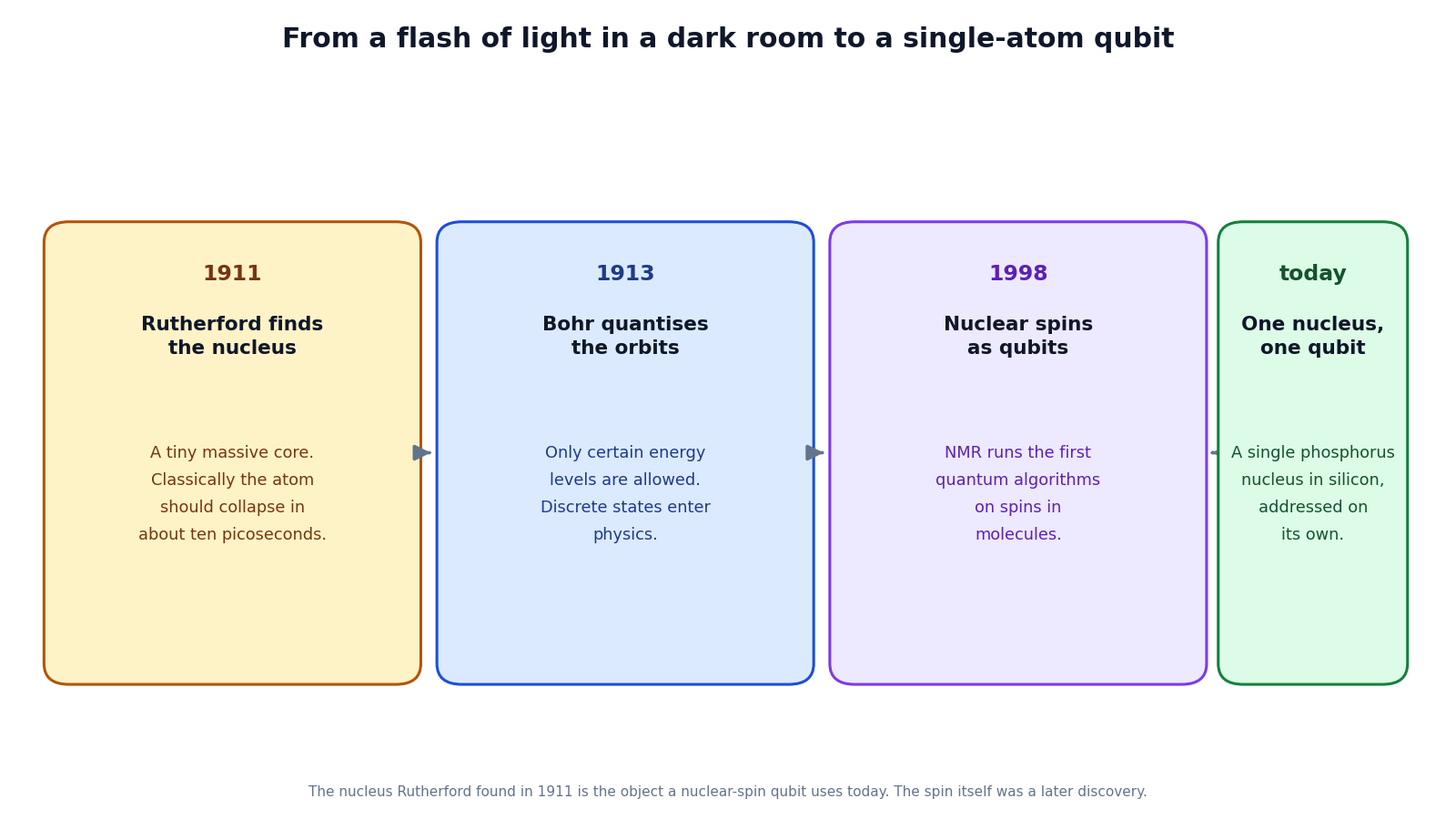
The historical part is the argument already made. Rutherford’s nucleus is what broke the classical atom, and quantum theory was constructed to repair the damage. Discrete energy levels, the thing that makes a qubit possible at all, entered physics as Bohr’s response to a problem Rutherford had created. A machine that stores information in two levels of an atom or an ion is operating inside a conceptual structure that begins with the 1911 paper.
Nuclei as qubits, literally
The physical part is more direct, and it is the one that would probably have pleased Ernest Rutherford most. Atomic nuclei are themselves used as quantum bits. One qualification belongs here for accuracy, which is that the property exploited is nuclear spin, and spin was not what Rutherford found. He established the nucleus as a concentration of charge and mass, and its spin was a later discovery. The object is his; the handle used to grip it is not.
With that said, the line runs straight. Nuclear spins were the medium of the earliest working demonstrations of quantum algorithms, carried out with nuclear magnetic resonance in the late 1990s, and the 2001 experiment that ran Shor’s factoring algorithm used seven spin-half nuclei in a molecule as its qubits. That approach later ran into a wall, and its own practitioners were candid about it, since the liquid-state technique struggled to demonstrate genuine entanglement and does not scale.
The thread was picked up in solid-state physics instead. A single phosphorus nucleus implanted in silicon was operated as a qubit in 2013, and a three-qubit donor processor built the same way reported one-qubit gate fidelities above 99.9% in 2022. Nuclear spins also serve as long-lived quantum memory alongside faster but noisier electron spins, and donor nuclei are among the architectures pursued by companies working on silicon spin qubits.
So the object Rutherford discovered by counting flashes of light in a dark room is, a century later, a component. A single atomic nucleus, addressed individually, holding one bit of quantum information. He would have wanted to know the error rate.
Why Ernest Rutherford matters
Ernest Rutherford matters because he established, by experiment rather than by argument, what the inside of matter looks like. Before him the atom was a hypothesis with a debatable interior. After him it had a structure that could be measured, and the structure was so strange that the physics of the preceding two centuries could not accommodate it.
He also matters as a demonstration of what an experimentalist is for. He did not derive the nucleus, he found it, and he found it because he asked two junior colleagues to look in a direction where the prevailing theory promised there would be nothing to see. The instinct to check the boring case is not a glamorous scientific virtue and it has produced a disproportionate share of the important results.
The last thing worth taking from him is the moonshine. A man of exceptional judgement, working at the limit of what was known, was confidently wrong about the applications of his own field within his own lifetime, and the correction came from someone reading a newspaper. Anyone forecasting the future of quantum technology should keep that story close, in both directions, because it cuts against the sceptics as sharply as it cuts against the enthusiasts.
He died in Cambridge on 19 October 1937, aged sixty-six, following complications of a strangulated hernia, and his ashes were interred in Westminster Abbey close to Isaac Newton and Lord Kelvin. Element 104 carries his name, proposed by its Berkeley discoverers in 1969 and formally adopted by the international chemistry body in 1997 after a long priority dispute, and so does a good deal of New Zealand, which has never quite got over having produced him. The country put him on its highest-denomination banknote, which is a fair measure of how a small nation regards the one of its sons who rearranged the physical sciences.
- Niels Bohr, who quantised the atom Rutherford discovered
- History of quantum computing, the complete timeline
- What is a qubit, a beginner’s guide
- What is superposition
- Nuclear spins as long-lived quantum storage
- Silicon spin quantum computing companies
- The Manhattan Project and how physics changed war
There is a final irony worth recording. Ernest Rutherford spent his life insisting that physics was the business of measuring things rather than of theorising about them, and the measurement he is most famous for is the one that forced physics into its most abstract turn. He handed the theorists a problem they could not solve with the tools they had, and the tools they built to solve it are the ones the quantum industry now uses to make machines.
Frequently asked questions
Who was Ernest Rutherford?
What did Ernest Rutherford discover?
What was the gold foil experiment?
Why did Ernest Rutherford win the Nobel Prize in Chemistry rather than Physics?
How is Ernest Rutherford connected to quantum theory?
Did Ernest Rutherford split the atom?
Who named the proton?
What was Rutherford’s moonshine remark?
Are atomic nuclei used in quantum computing?
Why does Ernest Rutherford matter today?




See today’s quantum computing news on Quantum Zeitgeist for the latest breakthroughs in qubits, hardware, algorithms, and industry deals.