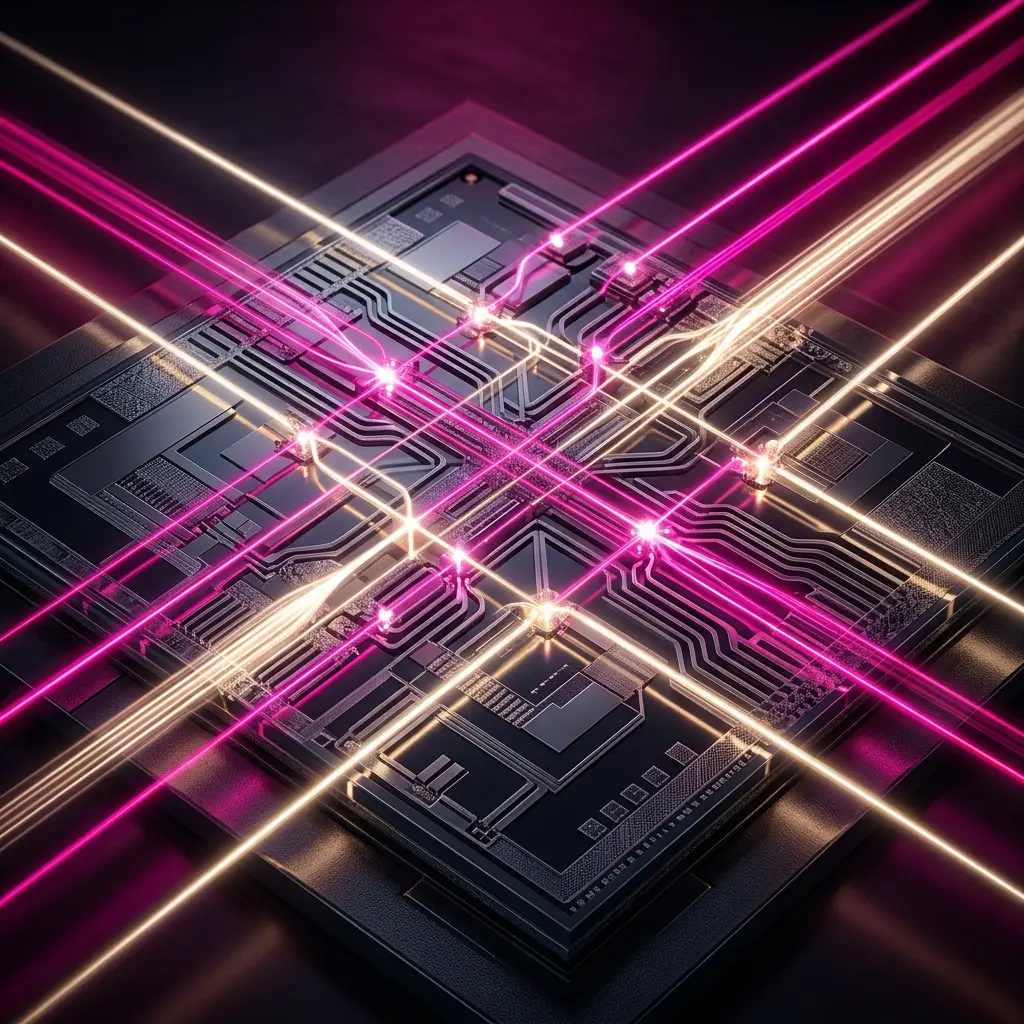
The leading top silicon spin quantum computing companies in 2026 build their qubits from single electron spins. Each electron sits in a tiny quantum dot etched into silicon or germanium. These dots are made on the same 300mm CMOS production lines that turn out ordinary logic chips.
This shared manufacturing path gives silicon spin the deepest route to scale of any quantum architecture. The eight commercial vendors split into three design families. Five build gate-defined quantum dots on silicon-28 (Intel, Diraq, Quantum Motion, Equal1, Quobly). One uses atomic-precision donor qubits (Silicon Quantum Computing), one uses germanium quantum dots (Groove Quantum), and one uses silicon T-centre spin-photon qubits (Photonic Inc).
The pace of progress turned sharp in late 2025. In December 2025 SQC reached 99.99% two-qubit fidelity, which matched the trapped-ion industry record. Diraq separately showed working qubits at 1 Kelvin, which means silicon spin can scale without a full dilution refrigerator. These vendors are the youngest slice of the quantum-hardware industry, yet also the fastest growing. DARPA QBI Stage B picked four of the eight in November 2025, and total funding across the field crossed $900M entering 2026.
Why silicon spin is the late-arriving modality that may scale fastest
Silicon spin has the shortest commercial history of any major modality. The first commercial pure-plays date only to 2016 and 2017. Despite that late start, it has the steepest path to large-scale manufacturing.
Superconducting and trapped-ion still lead on raw qubit counts and gate-fidelity records. Silicon spin counters with three structural advantages that neither rival can match. First, it runs on 300mm CMOS foundry lines at GlobalFoundries, IMEC, Intel, and STMicroelectronics, which means it reuses existing chip factories instead of building bespoke ones. Second, its qubits are roughly 1,000 times smaller than the transmons used in superconducting machines, so far more fit on a single chip. Third, it has run at 1 Kelvin rather than the 15 millikelvin that superconducting platforms demand.
These advantages matter because they attack the cost and complexity of scaling, not just the physics. A warmer operating point cuts the refrigeration bill, smaller qubits raise the count per wafer, and a foundry path means volume production is a known process rather than a research project. Together they explain why a late-arriving modality is taken seriously as a long-run scaling winner.
Closing the fidelity gap
The work through 2025 and 2026 has had one clear goal. The vendors are closing the gate-fidelity gap to the trapped-ion benchmark while keeping the foundry scaling story intact. The published numbers tell the story. Silicon Quantum Computing reached 99.99% two-qubit fidelity in December 2025, which matched the IonQ record. Diraq hit 98.92% two-qubit fidelity at 1 Kelvin in 2025 using hot-qubit operation. Equal1 shipped its Bell-1 system at 99.4% single-qubit and 98.4% two-qubit fidelity on the GlobalFoundries 22FDX process, and Quantum Motion validated a 1,024-quantum-dot array in under five minutes ahead of its September 2025 NQCC delivery.
The programme funders have noticed this progress. DARPA selected Diraq, Quantum Motion, SQC, and Photonic Inc for Quantum Benchmarking Initiative Stage B in November 2025. That is four of the eleven vendors, the deepest representation of any single modality in the programme.
How silicon spin quantum computing works
A silicon-spin processor stores each qubit in the spin of a single electron. Spin has two states, up or down, and those two states are the 0 and 1 of the qubit. The electron is held in a quantum dot, which is a nanoscale trap built by patterning tiny electrostatic gates on the chip surface.
That chip surface is isotopically enriched silicon-28. Natural silicon contains a mix of isotopes, and some of them carry a nuclear spin that disturbs the qubit. Enriching the material to silicon-28 strips out those magnetic isotopes, which means the electron spin stays coherent far longer.
Two-qubit gates work by briefly lowering the barrier between two neighbouring dots so their electrons interact, an effect called exchange coupling. Readout is done by dispersive sensing, where a charge sensor or a single-electron transistor detects the spin state. The whole device sits on a chip about the size of a fingertip, far smaller than the centimetre-scale resonators that superconducting hardware needs.
Foundry-process maturity is the scaling primitive
The factor that decides scaling here is foundry-process maturity, which means how proven the chip-making line already is. Intel runs its Tunnel Falls chip on the same 300mm D1 line that makes its commercial 14-nanometre logic. Quobly builds on the STMicroelectronics 28nm FDSOI line, with isotopically enriched silicon-28 entering that production line in December 2025. Diraq has shown high-fidelity qubits on 300mm wafers at both GlobalFoundries and IMEC.
Control electronics are the second place where silicon spin pulls ahead of superconducting. The goal is to put the control circuits next to the qubits inside the cold chamber, which removes the bulky room-temperature wiring that limits superconducting systems. Equal1 runs Arm Cortex cores at 300 millikelvin on the qubit die itself, and Intel’s Horse Ridge II control chip operates at 4 Kelvin. Diraq’s 1 Kelvin operating point goes further still, because it lets the whole system use a single-stage cryostat instead of a full dilution refrigerator.
The top silicon spin quantum computing companies
Eight commercial vendors define the field in 2026, and each one represents a different country or design bet. Intel Quantum is the US semiconductor giant with the deepest fab-process capability in the modality. Two are Australian pure-plays, Diraq out of UNSW and SQC from UNSW under Michelle Simmons. Quantum Motion is the UK leader, spun out of Oxford and UCL, and Equal1 is the Irish specialist from UCD.
The rest round out the map. Quobly is the French CEA-Leti spinout, Photonic Inc is the Canadian T-centre pioneer under Stephanie Simmons, and Groove Quantum is the most recent QuTech spinout, running germanium quantum dots. The Entangled Future tracks the top silicon spin quantum computing companies alongside the broader quantum-hardware ecosystem, with quarterly status updates on QPU access and milestones.
Independent directories of the top silicon spin quantum computing companies list a similar shortlist of names. The profiles below cover the leading organisations in depth.






Emerging silicon-spin platforms


The cryo-CMOS supply chain

Helsinki, Finland • Founded 2023 • ~€25.5M raised
Founded in 2023 as a spinout from VTT Technical Research Centre of Finland, SemiQon builds silicon-spin qubit processors designed for millikelvin cryogenic operation using standard CMOS tooling. Their cryo-CMOS transistor architecture, unveiled in November 2024, consumes 100 times less power than room-temperature CMOS and generates 1,000 times less heat inside the cryostat, directly addressing the heat-load bottleneck that limits how many qubits a dilution refrigerator can host. The architecture uses quantum dot arrays patterned on silicon wafers, with the control layer integrated at the same cryogenic temperature as the qubits rather than relying on room-temperature electronics connected by cable bundles.
In October 2025 SemiQon completed their first production run and began shipping the SemiQIT 4-qubit silicon quantum dot processor to research partners across Europe. That same month they won the EARTO Innovation Award for deep-tech impact. A €15M equity round from the European Innovation Council in 2025, on top of their €8M seed in 2024, reflects the EU’s strategic interest in developing a domestic silicon-spin fabrication chain independent of US and Australian supply lines. SemiQon sits at the intersection of qubit hardware and cryo-electronics manufacturing, occupying a supply-chain role that could prove as valuable as the qubit count itself as the modality scales.
What the lineup reveals
The first thing to notice is geography. Silicon spin is more globally spread than any other modality, and no single country dominates it. The eleven vendors sit across the US, Australia, the UK, Ireland, France, Canada, the Netherlands, and Finland.
That spread matters for funding and policy, because several governments each have a national stake in the technology. The DARPA QBI Stage B selection in November 2025 narrowed the list, picking four of the eleven vendors. It is the closest thing the modality has to an industry shortlist.
The foundry-scale story
The second point is that manufacturing matters more here than today’s qubit counts. Those counts are still small. Tunnel Falls runs 12 qubits, Bell-1 runs 6, and the SQC processor runs 10, which trails superconducting by roughly ten times.
The scaling proofs tell a different story. Quantum Motion validated a 1,024-quantum-dot array in under five minutes, SQC patterned 250,000 qubit registers in eight hours, and isotopically enriched silicon-28 entered STMicroelectronics 300mm production. These are the building blocks that point toward a million-qubit silicon-spin chip made on foundry tooling that already exists.
Architectural variance is the highest of any modality
The third point is that the design diversity is wider than it looks from outside. Gate-defined quantum dots on silicon-28 dominate the lineup, used by Intel, Diraq, Quantum Motion, Equal1, and Quobly. SQC runs a different physics path entirely, placing donor atoms with atomic-precision STM tools. Groove uses germanium dots for stronger spin-orbit coupling, and Photonic Inc uses silicon T-centre spin-photon qubits for a networking path no other vendor has.
That range is unusual for a single modality. Photonic vendors mostly differ on photon-encoding schemes, and trapped-ion vendors mostly differ on laser versus microwave control. Silicon spin instead spreads its bets across several distinct architectures at once, which gives the field multiple independent shots on goal.
Donor atoms, quantum dots, and T-centres: the architectural fork
The central choice in silicon-spin computing is which kind of spin to use as the qubit. Gate-defined quantum dots are the industry consensus, and they sit behind Intel, Diraq, Quantum Motion, Equal1, and Quobly. The qubit is the spin of a single electron, held in an electrostatic well shaped by patterned gates on the chip.
This is the same basic step used to build transistors in ordinary logic chips, which is why the approach inherits a mature factory process. Two-qubit gates work through exchange coupling, where the barrier between two neighbouring dots is briefly lowered so their electrons interact. Because these dots are made with standard CMOS lithography, they have the deepest foundry maturity of any silicon-spin variant.
Donor atoms and T-centres: the unconventional routes
Donor-atom qubits take a different route, and this is the SQC architecture first developed at Michelle Simmons’ CQC2T. The method places individual phosphorus atoms into silicon with atomic-scale precision using an STM tip, then buries them inside a silicon crystal. The qubit is the spin of that buried donor atom, either its nuclear or electron spin.
This approach gives up easy CMOS-foundry compatibility in exchange for something valuable, which is the deeper coherence of a single atom inside an isotopically pure lattice. For a long time the worry was throughput, because placing atoms one at a time sounds slow. The November 2025 SQC result of 250,000 registers patterned in eight hours shows that throughput is starting to converge with the quantum-dot variant.
T-centres are the third route, and they are the basis of the Photonic Inc architecture. A T-centre is a defect complex bound inside silicon that emits a telecom-wavelength photon when its spin state is excited. Those photons travel well through ordinary optical fibre, which is the wavelength the telecom industry already uses.
That photon emission is what gives Photonic Inc a networking path no other silicon-spin vendor has. The qubits can be entangled across fibre links directly through their own physics, rather than through a separate networking layer bolted on afterwards. Because of this, Photonic Inc is the only one of the top silicon spin quantum computing companies with a distributed-computing roadmap built into the qubit itself.
CMOS-foundry scaling: the structural advantage
The single most important feature of silicon spin is where it is built. The modality runs on the same 300mm CMOS lines that already produce billions of logic transistors per chip. That reuse of existing factories is the structural advantage everything else rests on.
The foundry map
The vendor map makes this concrete. Intel’s D1 fab in Hillsboro, Oregon makes Tunnel Falls on standard 14nm-class tooling. STMicroelectronics runs Quobly’s 28nm FDSOI silicon-spin process next to its commercial mixed-signal output. GlobalFoundries 22FDX hosts Equal1 Bell-1 on the same line that turns out commercial RF and IoT silicon, and IMEC runs Diraq on its multi-customer 300mm pilot line.
This advantage grows when you compare the alternatives. Superconducting needs every qubit chip designed, fabricated, and tested in specialist clean rooms. Photonic needs custom silicon-nitride or silicon-on-insulator foundry runs, and neutral-atom and trapped-ion both need bespoke ultra-high-vacuum chambers and laser stacks. Silicon spin instead sits on the standard CMOS infrastructure that already makes the world’s logic chips in volume.
There is a catch, and it explains the modality’s late arrival. The same foundry path that should let silicon spin scale fastest is also why it reached the capability benchmarks last. Tuning a full production process to make good qubits took longer than building bespoke quantum hardware by hand. The upfront cost was higher, which means the long-run payoff is only now starting to show.
When silicon spin matters for your industry
Government, defence, and sovereign HPC
The DARPA Quantum Benchmarking Initiative selected four silicon-spin vendors for Stage B in November 2025: Diraq, Quantum Motion, SQC, and Photonic. That is the deepest single-modality representation in the programme. The reason is sovereign manufacturing, which means the ability to build the hardware inside your own borders. Silicon spin runs on the same CMOS lines that make commercial logic, so it is the only architecture with a believable path to volume production inside the US, UK, EU, Australia, and Canada.
Real deployments already anchor each region. The September 2025 Quantum Motion delivery at NQCC Harwell is the first full-stack silicon-spin quantum computer in the UK. The Intel Argonne Tunnel Falls deployment in January 2026 anchors the US national-laboratory deployment, and the Quobly partnership with STMicroelectronics on 300mm wafers is the EU pillar.
Cryptography and post-quantum migration
Cryptography is where the compactness of silicon spin pays off most directly. Because the qubits are tiny and built on a standard foundry path, the modality is a strong candidate to host post-quantum cryptography hardware. That is one of the nearest-term commercial uses of quantum-capable silicon.
The deals already point this way. SEALSQ led Quobly’s EUR 115M Series A in June 2026 through its $200M Quantum Fund, which anchors the post-quantum integration story. The shared fab tooling means a single 300mm wafer can carry both classical cryptographic acceleration logic and the silicon-spin qubits that will one day attack RSA-style algorithms, which puts both halves of the security problem on the same chip.
Pharmaceutical, materials, and chemistry research
Chemistry workloads are still ahead of the current hardware, and the qubit counts show why. Tunnel Falls runs 12 qubits, SQC processors run 10 to 12, and Equal1 Bell-1 runs 6. Those numbers sit below the variational-chemistry threshold that superconducting and trapped-ion have already crossed.
The foundry path is what closes the gap. Silicon spin should reach Quobly’s 100-qubit target and the 1,024-quantum-dot scale that Quantum Motion has demonstrated within two to three years. The Goldman Sachs partnership with Quantum Motion on quantum finance, plus the SQC Quantum Twins Simulator running 15,000 qubit registers, position the modality for first-generation enterprise chemistry and finance work through 2027 and 2028.
Frequently asked questions
Who are the leading top silicon spin quantum computing companies in 2026?
Eight commercial vendors define the modality. Intel Quantum (12-qubit Tunnel Falls on 300mm CMOS, Horse Ridge II cryo-CMOS control, January 2026 Argonne deployment) is the largest by R&D capital, Diraq (Sydney, 99.85% single-qubit and 98.92% two-qubit fidelity at 1 Kelvin, $190M+) and Silicon Quantum Computing (Sydney, Michelle Simmons, donor-atom qubits, 99.99% 2Q fidelity December 2025, $200M+) are the Australian pure-plays.
Quantum Motion (London, 384-qubit chip + 1,024-dot array, NQCC delivery September 2025, $200M+) is the UK leader, and Equal1 (Dublin, Bell-1 6-qubit SiGe with on-chip Arm cores, $90M+) is the Irish pure-play. Quobly (Grenoble CEA-Leti spinout, STMicroelectronics 28nm FDSOI, EUR 115M Series A, SEALSQ-led) is the French champion, Photonic Inc (Vancouver, T-centre spin-photon qubits, CA$375M, $2B valuation) is the Canadian pioneer, and Groove Quantum (Delft QuTech spinout, germanium quantum dots, 18 operational qubits May 2026, EUR 16M) rounds out the lineup.
What is a silicon spin qubit?
A silicon spin qubit encodes quantum information in the spin state of an individual electron (up or down) trapped in a silicon quantum dot, a nanoscale potential well defined by lithographically patterned electrostatic gates on top of an isotopically enriched silicon-28 substrate. The qubit is the spin-1/2 degree of freedom of the trapped electron, and the gate operations are applied through microwave or radio-frequency pulses on the control gates.
The two-qubit gate is mediated by exchange coupling between adjacent dots when the inter-dot barrier is briefly lowered. Silicon spin qubits are roughly 1,000 times smaller than transmon superconducting qubits and are fabricated on the same 300mm CMOS lines that produce commercial logic chips, the architectural primitive that gives the modality its long-run scaling advantage.
How many qubits do the top silicon spin quantum computing companies operate?
The published qubit counts in the silicon-spin modality lag superconducting and neutral-atom by an order of magnitude, but the scaling proofs point toward a much steeper trajectory. Intel runs the 12-qubit Tunnel Falls chip on its 300mm CMOS line. Silicon Quantum Computing has demonstrated 10-qubit phosphorus-donor processors and patterned 250,000 qubit registers in eight hours. Quantum Motion validated a 1,024-quantum-dot array in under five minutes and demonstrated a 384-qubit silicon-quantum-dot chip with integrated cryogenic CMOS control. Equal1 ships Bell-1 with a 6-qubit SiGe array. Quobly is targeting 100 physical qubits on the STMicroelectronics 28nm FDSOI process. Diraq has demonstrated high-fidelity two-qubit operation on 300mm wafers at GlobalFoundries and IMEC. Groove Quantum reached 18 operational germanium qubits in May 2026. Photonic Inc is targeting four logical qubits near-term.
Why does Diraq operate at 1 Kelvin and what does that mean for scaling?
Most superconducting and silicon-spin quantum computers run at roughly 15 millikelvin, which requires a multi-stage dilution refrigerator the size of a small car and is the dominant capital-expenditure line item in deploying a quantum computer. Diraq’s 2025 hot-qubits breakthrough showed silicon-spin qubits can hit 99.85% single-qubit and 98.92% two-qubit fidelity at 1 Kelvin, roughly 70x warmer than the standard millikelvin baseline.
The hot-qubit operating point is the architectural feature that lets the system run on a single-stage helium cryostat at a fraction of the capital and operating cost. The 1 Kelvin baseline is roughly 1,000x more thermal energy than the standard millikelvin range yet still cold enough to preserve silicon spin coherence, which lets Diraq integrate cryo-CMOS control electronics directly with the qubit chip without the cooling-power constraints of full dilution-refrigerator stacks.
Are silicon spin quantum computing companies publicly traded?
None of the silicon-spin pure-plays are currently publicly traded, but Intel Quantum is a programme inside Intel Corporation on Nasdaq. The largest private valuations are Photonic Inc at $2B post-money (May 2026), Silicon Quantum Computing with $200M+ raised, Diraq at $190M+, Equal1 with the January 2026 $60M Series B ($90M+ total), Quantum Motion with $200M+, and Quobly with about EUR 115M. The financing pace through 2025-2026 (Series B at Equal1, Series B at Photonic, $100M+ at Diraq, the SEALSQ-led EUR 115M Series A at Quobly) is steeper than any other modality on a per-vendor basis, which makes an IPO or SPAC by one of the top silicon-spin quantum computing companies plausible inside the next 24 months as silicon-spin gate fidelities cross the trapped-ion benchmark.
How does silicon spin compare with superconducting, trapped-ion, and neutral-atom modalities?
Silicon spin lags superconducting on raw qubit count (12 on Tunnel Falls versus 1,121 on IBM Condor) and trails trapped-ion on gate-fidelity records (until December 2025 SQC matched IonQ at 99.99%), but the modality has the deepest manufacturing-scale path of any quantum architecture. Silicon-spin qubits are roughly 1,000 times smaller than transmons, and the standard CMOS-foundry tooling that produces commercial logic chips also produces silicon-spin qubits.
Operating temperatures can be 70x warmer (1 Kelvin instead of 15 millikelvin) with the Diraq hot-qubit approach. The trade-off is that the silicon-spin field is the latest-arriving on most capability benchmarks, with commercial pure-plays only dating to 2016-2022 versus superconducting commercial work from the early 2010s, and in 2026 the four modalities (superconducting, silicon-spin, trapped-ion, neutral-atom) complement rather than compete on production workloads.
What is the difference between donor qubits and quantum-dot qubits?
The two architectural variants in silicon spin sit on opposite ends of the foundry-versus-precision spectrum. Donor qubits (the SQC architecture pioneered at the Centre for Quantum Computation and Communication Technology) place individual phosphorus dopant atoms in a silicon crystal with atomic-scale precision using STM-tip lithography, encapsulate them in pure silicon, and use the donor electron or nuclear spin as the qubit.
The donor-qubit fabrication primitive trades CMOS-foundry compatibility for the deep coherence of an individual atom in an isotopically pure crystal lattice. Gate-defined quantum-dot qubits (the Intel, Diraq, Quantum Motion, Equal1, and Quobly architecture) trap individual electrons in lithographically patterned electrostatic potential wells on top of isotopically enriched silicon-28, and the November 2025 SQC milestone of 250,000 registers in eight hours suggests the throughput gap between the two variants is closing rapidly.
What is the role of silicon spin in quantum error correction?
Silicon-spin is the modality with the smallest physical-qubit footprint and the deepest manufacturing-scale path, the two architectural primitives that should let the modality reach the millions of physical qubits required for full fault-tolerance through a surface code or qLDPC code at the lowest capital cost. The current published logical-qubit demonstrations sit on other modalities (Google Willow on superconducting, QuEra 96 LQ on neutral-atom, Quantinuum Helios 48 LQ on trapped-ion).
The silicon-spin fidelity numbers crossed the threshold for surface-code error correction in 2025 (SQC at 99.99%, Diraq at 98.92% at 1 Kelvin, Equal1 at 98.4%), and the Photonic Inc roadmap targets four logical qubits near-term using the T-centre spin-photon architecture. The modality is the lowest-cost path to fault-tolerant utility-scale by 2033 if the foundry-scaling story plays out as the vendors expect. See our quantum logical-qubit leaderboard for the latest verified numbers across all modalities.
Technology deep-dive
What is isotopically enriched silicon-28 and why does it matter?
Natural silicon is a mixture of three stable isotopes: silicon-28 (92.2%), silicon-29 (4.7%), and silicon-30 (3.1%). Silicon-29 has a non-zero nuclear spin, which creates a fluctuating magnetic field that disturbs nearby electron spin qubits and reduces the time the qubit can hold its state before errors accumulate.
Isotopically enriched silicon-28 removes nearly all silicon-29 and silicon-30, leaving a substrate where more than 99.9% of atoms have zero nuclear spin. The result is a far quieter electromagnetic environment for the qubit. Coherence times in enriched silicon-28 are typically 10 to 100 times longer than in natural silicon, which is why every leading silicon-spin vendor either already uses it or is actively moving their process to it. Quobly entering the STMicroelectronics 300mm production line with enriched silicon-28 in December 2025 was significant because it demonstrated that the enrichment process can run inside a volume CMOS fab.
What is cryo-CMOS and why does it matter for scaling silicon-spin quantum computers?
A quantum computer’s qubit chip sits inside a cryostat at millikelvin or kelvin temperatures, but the classical electronics that send pulses to the qubits normally run at room temperature. At small qubit counts every control signal travels down a coaxial cable from room temperature into the cryostat. As qubit counts grow into the hundreds or thousands, the number of cables becomes a physical bottleneck that limits how many qubits can be controlled at once.
Cryo-CMOS moves the control electronics inside the cryostat itself, either on the same silicon die as the qubits or on a tightly coupled chip placed close to the qubit layer. Equal1 integrates Arm Cortex processor cores directly on the qubit die at 300 millikelvin. Intel’s Horse Ridge II cryo-CMOS controller operates at 4 Kelvin. Diraq’s 1 Kelvin operating point means the entire control stack fits inside a single-stage helium cryostat rather than a full dilution refrigerator. Eliminating the room-temperature cable bundle is the reason silicon-spin companies argue their modality can scale to millions of qubits where superconducting systems face a physical wiring barrier above a few thousand.
Which silicon-spin companies have deployed working quantum systems outside a research lab?
Several vendors have moved beyond internal lab work to external deployments as of mid-2026. Quantum Motion delivered the first full-stack silicon-spin quantum computer to the UK National Quantum Computing Centre at Harwell in September 2025. Intel installed a 12-qubit Tunnel Falls processor at Argonne National Laboratory in January 2026. Equal1 ships the Bell-1 as a rack-mountable quantum computer server and launched the follow-on RacQ system in May 2026, both designed for standard data-centre environments.
Arque Systems deployed a 5-qubit silicon spin processor at Forschungszentrum Jülich integrated with the NVIDIA DGX Quantum stack in September 2025. Diraq demonstrated one million fault-tolerant operations in under a minute via the NVQLink NVIDIA collaboration in October 2025. The pace of external deployments in 2025 to 2026 is faster than the superconducting field reached at a comparable stage of development, which reflects the structural advantage of running on commercial CMOS fabrication infrastructure.
What is the DARPA Quantum Benchmarking Initiative Stage B and which silicon-spin companies were selected?
The DARPA Quantum Benchmarking Initiative is a multi-phase US government programme that independently verifies the hardware performance claims of quantum computing vendors. Stage A involved initial screening and scoping. Stage B is the substantive verification phase, where selected vendors must demonstrate specific hardware benchmarks under DARPA-supervised conditions rather than self-reporting numbers. Selection for Stage B signals that DARPA considers a vendor technically credible and its performance claims worth independent verification.
In November 2025 DARPA selected four silicon-spin vendors for Stage B: Diraq, Quantum Motion, Silicon Quantum Computing, and Photonic Inc. That is the highest single-modality count in the programme and reflects the fidelity progress the field made in 2025. The selection carries practical weight beyond recognition: it feeds directly into US and allied defence procurement decisions about which quantum architectures to invest in for sovereign computing infrastructure over the next decade.
Disclaimer. This article is for informational purposes only and does not constitute investment, financial or professional advice. The quantum technology industry evolves rapidly and information may become outdated. Always conduct your own research and consult qualified advisers before making investment decisions. Investing in quantum computing companies involves significant risk, including the potential loss of your entire investment, and past performance is not indicative of future results.




See today’s quantum computing news on Quantum Zeitgeist for the latest breakthroughs in qubits, hardware, algorithms, and industry deals.