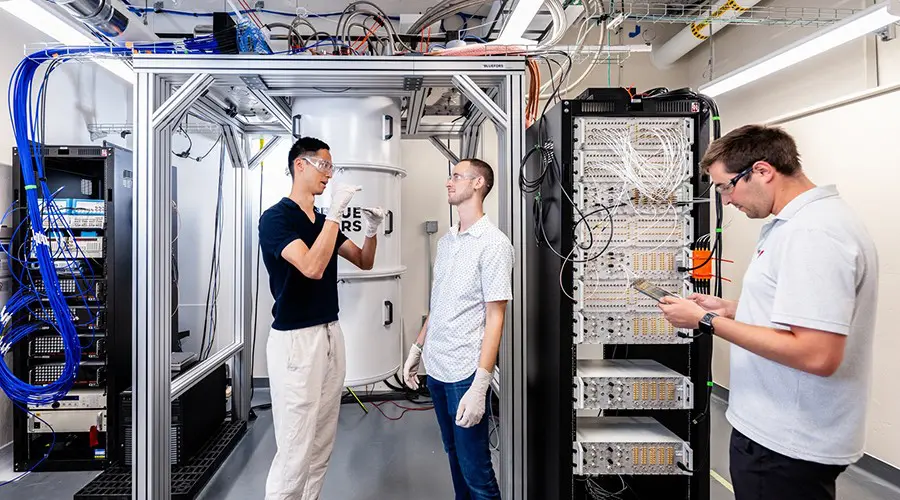
The US tech giant and national laboratory deploy a 12-qubit processor based on quantum dots, signalling a strategic pivot towards semiconductor-native approaches that could reshape the quantum industry’s economics
The transistor, that humble component which shrank computers from room-sized behemoths to pocket-sized devices, may be poised for its most consequential transformation yet. In a collaboration that marries Silicon Valley engineering prowess with US government research infrastructure, Intel and Argonne National Laboratory have successfully deployed a 12-qubit quantum processor built on quantum dot technology, marking a significant milestone in the race to develop practical quantum computers.
The partnership, announced in January 2026 with findings published in Nature Communications, represents a calculated bet that the semiconductor industry’s seven decades of transistor expertise can be repurposed for the quantum age. Rather than pursuing exotic approaches favoured by some competitors, the collaboration leverages the same silicon-based manufacturing processes that have powered the classical computing revolution.
The Transistor’s Quantum Descendant
At the heart of this initiative lies a deceptively simple premise: what if quantum computers could be built using essentially the same materials and processes that produce the chips in smartphones and laptops?
“What if we do at a single-electron level what transistors already do? What if we make quantum technology out of the same building blocks that we already make classical technology out of? You can draw a very direct line from the first transistor to a quantum dot.”
The quantum dot approach exploits a peculiarity of quantum physics. When particles are confined to spaces smaller than their wavelength, they are forced into discrete, tuneable energy levels. By manipulating the quantum spin of individual electrons trapped in these nanoscale structures, researchers can create qubits, the fundamental units of quantum information, that operate on the same principles as classical transistors, but at the quantum scale.
This lineage matters commercially. While rival quantum computing approaches require exotic materials, extreme cooling systems, or entirely novel manufacturing processes, silicon quantum dots can theoretically be produced using existing semiconductor fabrication infrastructure, the very facilities that already churn out billions of conventional chips annually.
National Laboratory Meets Corporate Engineering
The collaboration operates under the aegis of Q-NEXT, a US Department of Energy National Quantum Information Science Research Center hosted by Argonne. The structure reflects an increasingly common model in quantum development: national laboratories providing fundamental research capabilities while industrial partners contribute manufacturing expertise and commercial discipline.
“This collaboration between Argonne and Intel is a cornerstone of Q-NEXT. It shows the impact of a national quantum research centre: Only at this scale can industry and discovery-driven organisations like the national laboratories combine their strengths to build such a complex system. Together, we accomplish advances that would be challenging for a single investigator, or even a single institution, to achieve alone.”
David Awschalom, Inaugural Director, Q-NEXT
Awschalom, who also serves as a senior scientist at Argonne, the Liew Family professor and director of the Chicago Quantum Institute at UChicago PME, and founding director of the Chicago Quantum Exchange, emphasises that the scale of national research centres enables partnerships that would otherwise be impossible.
The division of labour is clear. Intel provides the engineering muscle, designing, fabricating and testing increasingly sophisticated quantum dot processors. Argonne contributes the scientific rigour needed to understand how these devices behave and how they might be improved.
The Scaling Imperative
The immediate challenge confronting all quantum computing approaches is scale. Current devices, including this 12-qubit system, remain far from the threshold needed for commercially useful calculations. The quantum computing industry broadly agrees that practical applications will require hundreds, thousands, or even millions of qubits working in concert.
“To do complicated quantum information processing, to do something useful with these devices, you need hundreds, thousands, millions of qubits. That scaling is difficult,” Marcks acknowledged.
This is where the silicon-based approach may offer structural advantages. Semiconductor fabs already operate at scales that would be difficult to replicate with other quantum technologies. If quantum dots can be manufactured using substantially similar processes, the path to mass production becomes considerably shorter.
“We are eager to continue work with Q-NEXT as we scale to hundreds of dots. Intel’s design, fabrication and test teams make it possible to scale up quantum processors based on silicon quantum dot qubits. By working with scientists at Argonne, we enable cutting-edge science and benefit from DOE’s world-class capability for materials and qubit characterization.”
Nathan Bishop, Quantum Systems Technology Director, Intel
Probing the Unknown
The current phase of research focuses on characterising how qubits behave within Intel’s 12-dot system, a prerequisite for designing larger, more capable devices. Questions being investigated include optimal methods for coordinating multiple qubits, the effects of scaling on system behaviour, and how material properties influence quantum dot performance.
“We’re accelerating research by getting over one of the really big hurdles to doing this work. It can be difficult to build even a few quantum dot qubits,” Marcks said. “But with Intel, the prospect of making a ton of qubits on a practical device using quantum dots suddenly seems a lot more realistic.”
The research model creates a feedback loop between laboratory discovery and industrial development. Insights from Argonne’s characterisation work inform Intel’s next generation of quantum dot processors, which are then returned to Argonne for further investigation.
“How these qubits behave together requires a lot of physics research and insight, so we’re conducting experiments to see what’s possible,” Marcks explained. “And that’s where Argonne excels. There’s a lot of exploratory science to be done that can feed back into engineering better devices.”
Intel provides the capabilities for building and manufacturing high-tech devices. Argonne provides the expertise to put Intel’s quantum dot qubits through their paces. This iterative process, the partners argue, accelerates progress beyond what either organisation could achieve independently.
“There’s a good match between Intel’s manufactured devices and our open-science approach, figuring out the appropriate questions to ask,” Marcks said. “Together, we’ll be able to scale up the number of qubits to a point that’s relevant for quantum computing.”
The Promise of Versatility
“Argonne and the national labs excel at basic science and understanding how complex systems function. And companies can make high-quality devices. As a company, Intel is invested in engineering fully integrated quantum processors that we can study in the lab, and everyone benefits from more research into these systems. You need both partners to ultimately build something useful.”
Jonathan Marcks, Scientist, Argonne National Laboratory
While quantum computing captures headlines, the technology under development at Argonne and Intel may find applications across multiple domains. Quantum dots, by virtue of their tuneable properties, could theoretically be configured for purposes ranging from medical diagnostics to logistics optimisation.
The collaboration notes that quantum dot qubits could potentially be tuned one way to sense disease in human tissue and another way to calculate optimal routing for transportation networks. Such versatility, if realised, would distinguish silicon quantum dots from more specialised quantum approaches.
Argonne’s feedback to Intel will help the development of progressively larger quantum dot systems, which in turn can be installed at Argonne for more tests and exploration, taking the creation of semiconducting devices to the quantum limit.
Mature Silicon Industry Could Yield The Qubit Tech of The Future
The collaboration between Argonne and Intel represents a measured, methodical approach to quantum computing development, one that prioritises eventual manufacturability over near-term demonstrations of quantum advantage. This strategy carries both promise and risk.
The promise lies in the potential to leverage seven decades of semiconductor manufacturing expertise. The original source material draws a direct historical line from the vacuum tube to the transistor to the quantum dot, a lineage that is more than merely rhetorical. If quantum dots can indeed be produced using existing or modestly modified fabrication processes, the economic barriers to scaling quantum computers could be substantially lower than for competing approaches. The partnership between a world-class research institution and a semiconductor manufacturing giant provides both the scientific depth and engineering capability to explore this possibility systematically.
The risk, however, is that silicon quantum dots may prove inherently limited in ways that become apparent only as the technology scales. Qubit coherence times, error rates and connectivity constraints could ultimately favour alternative architectures, leaving the silicon approach as an interesting scientific detour rather than a commercial thoroughfare.
Moreover, with only 12 qubits currently operational and “hundreds of dots” as the stated near-term ambition, this collaboration remains in early stages. The gap between hundreds and the millions of qubits that may be required for transformative applications remains daunting.
What can be said with confidence is that the collaboration exemplifies a thoughtful model for public-private partnership in emerging technology development. The combination of Argonne’s fundamental research capabilities with Intel’s manufacturing expertise creates a credible pathway for investigating whether silicon quantum dots can deliver on their theoretical promise. The answer to that question will likely take years to emerge, but the systematic approach being taken suggests that when it does, it will be grounded in rigorous science rather than wishful thinking.
For quantum computing’s long-term commercialisation prospects, the Argonne-Intel collaboration may ultimately prove more significant for the questions it answers than for the devices it produces. Understanding whether the transistor’s direct descendants can power the quantum future is, after all, a question worth investigating properly.
To provide the best experiences, we use technologies like cookies to store and/or access device information. Consenting to these technologies will allow us to process data such as browsing behavior or unique IDs on this site. Not consenting or withdrawing consent, may adversely affect certain features and functions.
Functional
Always active
The technical storage or access is strictly necessary for the legitimate purpose of enabling the use of a specific service explicitly requested by the subscriber or user, or for the sole purpose of carrying out the transmission of a communication over an electronic communications network.
Preferences
The technical storage or access is necessary for the legitimate purpose of storing preferences that are not requested by the subscriber or user.
Statistics
The technical storage or access that is used exclusively for statistical purposes.The technical storage or access that is used exclusively for anonymous statistical purposes. Without a subpoena, voluntary compliance on the part of your Internet Service Provider, or additional records from a third party, information stored or retrieved for this purpose alone cannot usually be used to identify you.
Marketing
The technical storage or access is required to create user profiles to send advertising, or to track the user on a website or across several websites for similar marketing purposes.
To provide the best experiences, we use technologies like cookies to store and/or access device information. Consenting to these technologies will allow us to process data such as browsing behavior or unique IDs on this site. Not consenting or withdrawing consent, may adversely affect certain features and functions.
Functional
Always active
The technical storage or access is strictly necessary for the legitimate purpose of enabling the use of a specific service explicitly requested by the subscriber or user, or for the sole purpose of carrying out the transmission of a communication over an electronic communications network.
Preferences
The technical storage or access is necessary for the legitimate purpose of storing preferences that are not requested by the subscriber or user.
Statistics
The technical storage or access that is used exclusively for statistical purposes.The technical storage or access that is used exclusively for anonymous statistical purposes. Without a subpoena, voluntary compliance on the part of your Internet Service Provider, or additional records from a third party, information stored or retrieved for this purpose alone cannot usually be used to identify you.
Marketing
The technical storage or access is required to create user profiles to send advertising, or to track the user on a website or across several websites for similar marketing purposes.