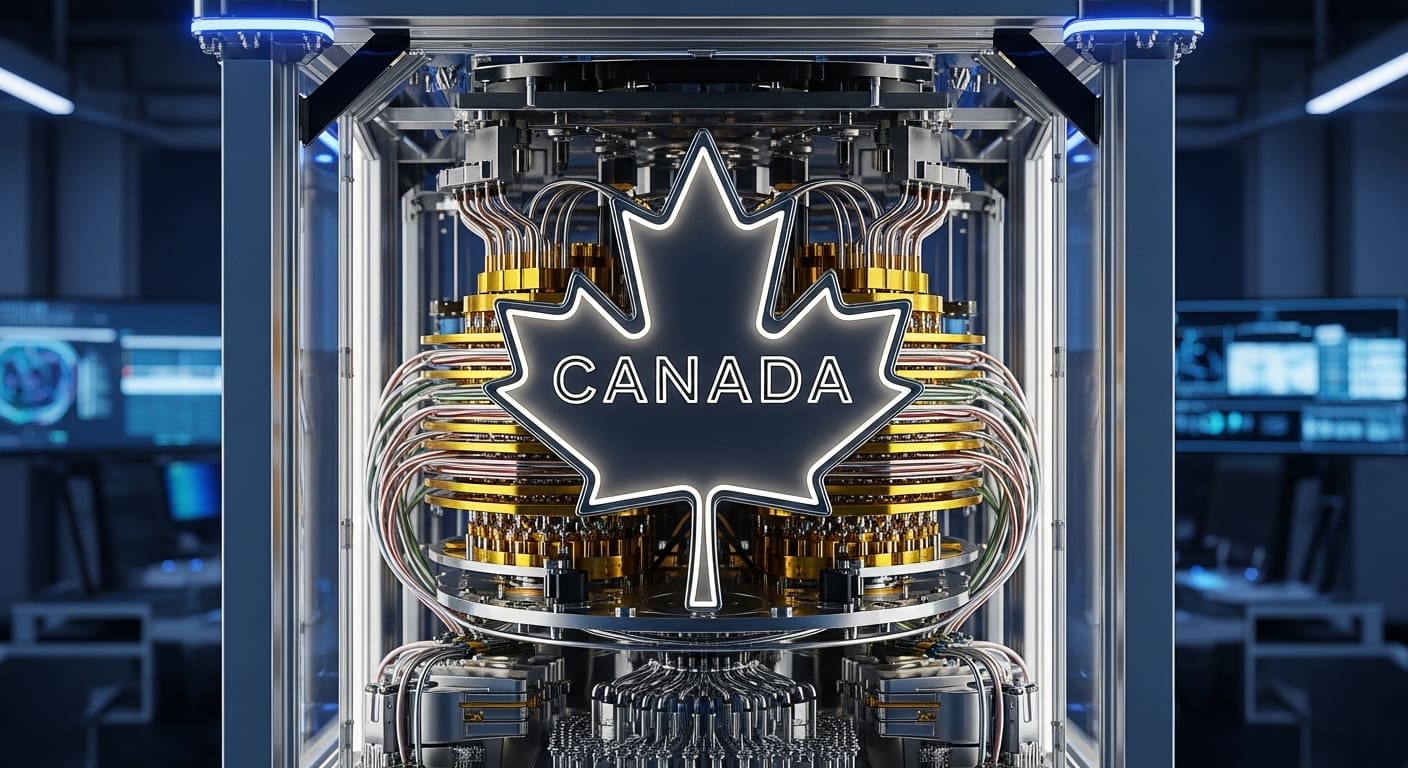
Canada built the first commercial quantum-hardware company and the first dedicated quantum-software company, and its Waterloo, Quebec and Vancouver clusters still anchor a deep research base. This guide profiles the leading Canadian vendors and then maps the wider field of companies tracked behind them.
The leading canada quantum computing companies in 2026 sit inside one of the oldest and most research-dense quantum ecosystems in the world, built on two decades of investment at the University of Waterloo and the Universite de Sherbrooke. Canada produced the first commercial quantum hardware company, D-Wave, and the first dedicated quantum software company, 1QBit, yet it has also watched its commercial leaders drift toward larger American capital markets. This guide profiles the companies and institutions that define the canada quantum computing companies, from photonic and superconducting hardware to post-quantum cryptography and quantum sensing, and explains how the Waterloo and Quebec clusters and a new federal champions programme fit together.
Key takeaways
1. Canada has deep roots and two strong clusters. The Waterloo to Toronto corridor and the Sherbrooke to Montreal axis anchor the sector, supported by the Institute for Quantum Computing, Perimeter Institute and the Institut quantique.
2. Hardware spans several modalities. Xanadu builds photonic processors, Photonic builds silicon T-centre spin qubits, Nord Quantique and Anyon Systems build superconducting machines in Quebec, and D-Wave pioneered quantum annealing.
3. Software and quantum-AI are a genuine strength. 1QBit, SoftwareQ and ProteinQure give Canada one of the deepest commercial track records in quantum applications and orchestration.
4. Quantum security is a national priority. evolutionQ, Crypto4A, Quantropi, Quantum Bridge and QEYnet carry Canada’s post-quantum cryptography and quantum communications work, building on Michele Mosca’s foundational role in the field.
5. Sovereignty drives policy. The Canadian Quantum Champions Program ties CA$23 million grants to a Canadian-headquarters requirement, a direct response to D-Wave’s move to Palo Alto.
6. Capital scale is the main constraint. Canada has world-class research and talent, but its private venture market is smaller than the United States, which is why several leaders have raised abroad or gone public on US exchanges.
Why Canada matters in quantum computing
Canada was an early mover in quantum technology and still carries that lead in research depth and commercial firsts. D-Wave shipped the first commercial quantum computers from Burnaby in the 2010s, and 1QBit built quantum software in Vancouver years before most hardware startups existed. That history gives the country a commercial track record that few national ecosystems can match, even though its overall scale is smaller than the United States or China.
The strength is concentrated rather than broad, and it rests on sustained institutional investment rather than a large consumer-technology base. Two decades of funding at the University of Waterloo and the Universite de Sherbrooke produced a dense pool of quantum-trained researchers, and the founders of Xanadu, Nord Quantique, Photonic and evolutionQ all came through those institutions. The result is a system that competes at the frontier on talent and ideas while it works to close a persistent gap in private capital.
How the canada quantum computing companies are organised
The canada quantum computing companies divide cleanly into a few layers, which is how this guide groups them. At the base sit the hardware builders across photonic, silicon spin, superconducting and annealing approaches, then a strong software and quantum-AI layer, a quantum-security layer carrying the country’s post-quantum work, and a quantum-sensing layer. Around all of them sits a research and funding ecosystem of universities, federal programmes and investment vehicles that gives the canada quantum computing companies their unusual depth for a mid-sized economy.
The Waterloo and Quebec clusters
Canada’s quantum activity concentrates in two regional clusters with distinct characters. The Waterloo to Toronto corridor, often called Quantum Valley, hosts more than 20 companies and institutions and has attracted over CA$1.5 billion in quantum-related investment, anchored by the Institute for Quantum Computing and the Perimeter Institute. The Quebec axis, running from Sherbrooke to Montreal, is built around the Institut quantique and a provincial commitment of nearly CA$200 million since 2019.
The two clusters specialise differently, which is part of their strength. Waterloo leans toward software, post-quantum cryptography and quantum sensing, drawing on the IQC and Perimeter talent base, while Quebec has become the country’s superconducting hardware centre, home to Nord Quantique, Anyon Systems and the public-access MonarQ machine. Together they give the canada quantum computing companies coverage across almost every layer of the quantum stack.
Quantum hardware companies
Canadian hardware spans photonic, silicon spin, superconducting, annealing and analog approaches. Xanadu and Photonic lead the photonic and silicon routes, Quebec hosts the superconducting cluster, and D-Wave remains the commercial veteran. For the worldwide picture, see our global quantum computing companies guide, and independent directories of the canada quantum computing companies reach a similar shortlist.
Photonic and silicon-spin hardware
Two of Canada’s most prominent hardware bets avoid the deep cryogenics that superconducting machines need. Xanadu builds room-temperature photonic processors and is now public, while Photonic builds silicon T-centre spin qubits designed to network over standard telecom fibre. Both sit among the four federally backed canada quantum computing companies.
Xanadu Quantum Technologies
Photonic · Toronto, ON · Nasdaq / TSX: XNDU
Xanadu builds room-temperature photonic quantum processors and develops PennyLane, one of the most widely used open-source quantum machine-learning frameworks. The company became the first pure-play photonic quantum computing firm to go public, listing on Nasdaq and the Toronto Stock Exchange under the ticker XNDU on 27 March 2026 with roughly $302 million in gross proceeds. Founder and chief executive Christian Weedbrook leads its push toward a fault-tolerant photonic architecture, and Xanadu is one of the four companies backed by the federal Canadian Quantum Champions Program.
Annealing + gate-model · Founded Burnaby, BC · NYSE: QBTS
D-Wave is the most commercially mature quantum hardware company by revenue, founded in Burnaby, British Columbia in 1999 and the pioneer of quantum annealing. Its 5,000-plus qubit Advantage system remains the largest commercially accessible quantum processor by qubit count, served through the Leap cloud platform. In January 2026 D-Wave agreed to acquire Quantum Circuits Inc. for $550 million, adding superconducting gate-model technology to its annealing heritage, and its migration from BC to Palo Alto is cited in Canadian policy documents as the case study that motivates sovereign-retention rules.
Silicon T-centre spin qubits · Coquitlam, BC · Microsoft-backed
Photonic uses T-centre defects in silicon to create spin qubits that emit photons at standard telecom wavelengths near 1326 nm, an architecture designed to link quantum nodes across existing fibre without frequency conversion. Founder and Chief Quantum Officer Dr. Stephanie Simmons of Simon Fraser University set the technical direction, and the company appointed Don Mattrick as chief executive in March 2026 after a CA$180 million first close led by Planet First Partners with RBC and TELUS. Microsoft, BCI and the UK government have all backed the company, and DARPA advanced it to Stage B of its Quantum Benchmarking Initiative in November 2025.
Bosonic qubits · Sherbrooke, QC · DARPA QBI Stage B
Nord Quantique is one of a small number of companies pursuing bosonic qubits, encoding information in the oscillation modes of a microwave cavity and correcting errors at the level of the individual qubit rather than across a large array. CEO and co-founder Julien Camirand Lemyre trained in the Universite de Sherbrooke quantum cluster that produced the company’s foundational research. DARPA selected the company for Stage B of its Quantum Benchmarking Initiative in November 2025, and a 2026 funding round took Nord Quantique to a valuation around $1.4 billion as it works toward fault tolerance by 2030.
Full-stack superconducting · Montreal, QC · Founded 2014
Anyon Systems designs, manufactures and integrates every major subsystem of a superconducting quantum computer in house, from qubit processors to dilution refrigerators and control electronics, and it has never raised venture capital. Founded in 2014 by Dr. Alireza Najafi-Yazdi, it delivered Yukon, Canada’s first gate-based quantum computer, to Defence Research and Development Canada in 2021, then MonarQ, a 24-qubit public-access system, to Calcul Quebec in 2022. The company received CA$23 million through the Canadian Quantum Champions Program and is an anchor partner at the C2MI nanofabrication facility in Bromont.
The remaining hardware names cover superconducting, annealing and analog routes. Nord Quantique and Anyon Systems anchor Quebec’s superconducting cluster, D-Wave carries the annealing heritage from its Burnaby origins. Together they show how broad the hardware coverage among the canada quantum computing companies has become.
Software, algorithms and quantum-AI
Canada produced the world’s first dedicated quantum software company in 2012, and the software layer is where the country has the deepest commercial track record. These firms cover algorithms, chemistry simulation, workflow orchestration and quantum-assisted drug discovery, the areas where near-term revenue is most likely to be captured.
Why software is Canada’s strongest layer
The software firms among the canada quantum computing companies are hardware-agnostic by design, which makes them useful today rather than only after large fault-tolerant machines arrive. 1QBit and SoftwareQ run across IBM, D-Wave, IonQ and classical backends, capturing value on specific high-demand workloads. That positioning is why several of them have outlasted better-funded hardware pure-plays, and why the layer remains the most commercially durable part of the Canadian ecosystem.
1QBit
Quantum software · Vancouver, BC · Founded 2012
Founded in 2012 by Andrew Fursman and Landon Downs, 1QBit is widely regarded as the world’s first dedicated quantum software company, predating most hardware pure-plays by several years. The Vancouver firm builds hardware-agnostic algorithms and quantum-inspired optimisation for finance, logistics and life sciences, and it has raised more than CA$35 million. It also operates as an incubation platform, having spun out Good Chemistry in 2022 and Synthesise in 2021 as standalone companies.
Quantum-assisted peptide therapeutics · San Francisco, USA / Toronto, Canada · Founded 2018
Menten AI uses quantum computing and machine learning to design novel proteins and peptides from scratch for therapeutic applications. Founded by Hans Melo and Petr Kristufek, the company used a D-Wave annealer in 2020 to design and experimentally validate a novel peptide inhibitor, one of the first published examples of a quantum computer contributing to a real drug-discovery result. Its pipeline pairs quantum optimisation with structure-prediction models across antivirals, oncology and rare diseases.
Quantum compilers & algorithms · Waterloo, ON · IQC spinout
SoftwareQ is a Waterloo company founded in 2017 by Vlad Gheorghiu and Michele Mosca, spun out of the Institute for Quantum Computing to commercialise quantum compilers, circuit optimisers and simulators. It has developed many standard quantum algorithmic primitives, including eigenvalue and amplitude estimation, and its open-source tools are used by researchers worldwide. Commercially it holds a multi-million-dollar DARPA award, an NRC contract with Riverlane on fault-tolerant applications, and a Canada-UK collaboration with Nu Quantum on networked compilation.
Open-source trapped ion · Waterloo, ON · Non-profit
Open Quantum Design is building the world’s first open-source full-stack quantum computer using trapped-ion technology, releasing CAD files, fabrication procedures and FPGA software under an Apache 2.0 licence. Founded at Waterloo by Crystal Senko, Rajibul Islam and Roger Melko with CEO Greg Dick, it operates as a non-profit aiming to democratise quantum hardware. Xanadu has already collaborated with OQD to compile PennyLane down to OQD trapped-ion hardware, demonstrating cross-ecosystem interoperability.
Computational peptide therapeutics · Toronto, ON · Series A 2025
ProteinQure applies quantum computing and reinforcement learning to the design of cyclic peptides and protein scaffolds for therapeutics. Founded in 2017 by Lucas Siow and Christopher Ing at the University of Toronto, it combines quantum annealing on D-Wave hardware with atomistic molecular dynamics to target structures that conventional drug design cannot reach. The company raised an $11 million Series A in May 2025 led by Felicis Ventures, bringing total funding to about $15 million, and lists NVIDIA, IBM, D-Wave, Rigetti and Microsoft among its collaborators.
Mission 2 of the National Quantum Strategy targets cyber-security through post-quantum cryptography and a sovereign quantum communications network. Canada holds an unusual lead here because Michele Mosca of IQC helped shape the NIST standardisation process. These companies run from software-layer migration tools through hardware security modules up to satellite quantum key distribution.
From algorithms to satellites in one cluster
The security group spans the whole stack, from software that migrates encryption to hardware that anchors keys and satellites that distribute them. evolutionQ and Quantropi work at the software and protocol layer, Crypto4A provides the hardware root of trust, and Quantum Bridge and QEYnet build the physical quantum communications layer. That breadth makes quantum security one of the most complete subsectors among the canada quantum computing companies.
evolutionQ
Quantum-safe cybersecurity · Waterloo, ON · Founded 2015
evolutionQ is the most strategically significant quantum-security company in Canada, founded by IQC co-founder Michele Mosca, whose framing of cryptographic quantum risk shaped national post-quantum migration programmes worldwide. The company provides quantum risk assessment, quantum-safe network architecture and the tooling organisations need to migrate from RSA and elliptic-curve encryption to NIST-standardised algorithms. Its BasejumpQDN platform simulates and manages quantum network infrastructure for banks, critical-infrastructure operators and government agencies.
Quantum-safe HSMs · Ottawa, ON · FIPS 140-2 Level 3+ validated
Crypto4A is Canada’s most significant quantum-safe hardware-security company, and in March 2025 it became the first organisation to submit a post-quantum-capable Hardware Security Module for FIPS 140-3 Level 3 certification. Founded in Ottawa by CEO Bruno Couillard, its QxHSM platform integrates NIST post-quantum algorithms in hardware with a crypto-agile FPGA design that loads new algorithms through quantum-safe firmware updates. The company appeared across ten Gartner reports in 2025, a reach few Canadian quantum-security firms have matched.
Quantum-secure communications · Ottawa, ON · QiSpace platform
Quantropi is an Ottawa company whose QiSpace platform delivers quantum-secure communications across existing fibre, copper and wireless networks without quantum hardware at either end. Founded in 2018 by CEO James Nguyen and CTO Randy Kuang, its three product lines cover post-quantum asymmetric encryption, quantum entropy expansion and quantum-secure key distribution. The company has raised about $12.75 million, employs around 28 people in Ottawa, and positions itself as a fully Canadian innovator with no foreign venture backing.
Distributed symmetric key establishment (DSKE) · Toronto, ON
Quantum Bridge Technologies develops quantum key distribution systems and quantum networking hardware aimed at the sovereign quantum communications network that Mission 2 of the National Quantum Strategy commits Canada to building. QKD uses the quantum properties of single photons to distribute encryption keys in a way that is physically impossible to intercept without leaving a measurable signature. The company targets government, financial-services and critical-infrastructure customers where that physics-based guarantee justifies the infrastructure investment.
QEYnet is building a commercial quantum key distribution satellite network, attacking the limit of fibre-based QKD, which loses most photons beyond 100 kilometres, by placing trusted relay nodes in orbit. Its quantum payloads draw on intellectual property from Professor Thomas Jennewein’s team at IQC, which also leads the science team for the Canadian Space Agency’s QEYSSat mission. In January 2025 the Canadian Space Agency awarded QEYnet more than CA$1.4 million for an orbital demonstration, and the company is a funded participant in a Department of National Defence project on next-generation QKD networks.
Quantum random number generation · Montreal, QC · NYSE American: QNC
Quantum eMotion builds quantum-based and quantum-resistant cybersecurity products around a patented Quantum Random Number Generator for secure keying and encryption. Founded in Montreal in 2007 and led by chief executive Francis Bellido, the company uplisted to NYSE American under the ticker QNC on 24 February 2026 while remaining on the TSX Venture Exchange. It reported its first early commercial revenue for the quarter ending March 2026 and completed the cross-border acquisition of California cybersecurity firm SKV Technology in April 2026.
Mission 3 targets quantum sensors for defence, navigation and health care, and these devices do not need the large-scale error correction that keeps fault-tolerant computing years away. The cluster below spans pharmaceutical research, enhanced MRI, quantum LiDAR, Rydberg RF sensing and quantum machine learning for radio signals, one of the broadest sensing line-ups anywhere.
The near-term commercial edge of quantum sensing
Quantum sensing is the part of the field closest to revenue today, because a sensor exploits quantum coherence in a single device rather than the large entangled arrays that computing requires. High Q has already launched a product and made first sales, and Foqus is working through FDA approval for its MRI software. The cluster is a reminder that several canada quantum computing companies are commercial businesses now, not bets on a distant fault-tolerant future.
SBQuantum
Diamond quantum magnetometry · Sherbrooke, QC · Founded 2017 · CEO Eric Giroux
SBQuantum builds diamond-based quantum magnetometers that read the Earth’s magnetic field for navigation in places where GPS is unavailable or jammed. Led by CEO Eric Giroux, the Sherbrooke company gained international recognition through the MagQuest magnetic-navigation challenge and works with defence, aerospace and resource-exploration customers. Its sensors combine nitrogen-vacancy diamond readout with proprietary field modelling to deliver full-vector measurements from a compact package.
Quantum EPR spectrometers · Waterloo, ON · FATHOM launched 2025
High Q Technologies has built and commercially launched the world’s first quantum-enabled Electron Paramagnetic Resonance spectrometer, making it the most commercially mature quantum-sensing company from Canada. Spun out of the Institute for Quantum Computing in 2013, it uses proprietary planar superconducting resonators that compress measurement times from days to hours for structural biology and drug discovery. The company launched its FATHOM spectrometer in January 2025, has received over $10 million in federal funding, and is backed by BlackBerry co-founders Mike Lazaridis and Doug Fregin.
Quantum-enhanced MRI software · Toronto, ON · FDA clearance pending
Foqus Technologies uses quantum algorithms to compress MRI scan times from around 60 minutes to under five, a problem with direct implications for healthcare access and early diagnosis. Founded in 2021 by Dr. Sadegh Raeisi, the company builds software that sits between quantum algorithms and existing MRI workstations and requires no hardware modification. Its approach has been validated on more than 20,000 MRI images through a pilot with the Robarts Research Institute, and the product is undergoing FDA approval.
Phantom Photonics builds quantum-coherence LiDAR sensors that the company says operate far beyond classical LiDAR range, detect a single returning photon and resist adversarial jamming. Founded in 2023 by Alex Maierean, Dr. Shihan Sajeed and Professor Thomas Jennewein, it spun out of the Quantum Photonics Lab at IQC and encodes light using techniques inspired by QKD time-binning. The company is a NATO DIANA selection targeting undersea monitoring, satellite anti-collision and marine infrastructure inspection.
Rydberg atom RF sensors · Waterloo, ON · QVIL spinout
WaveRyde commercialises Rydberg atom sensors for radio-frequency measurement, a class of quantum device that detects RF signals across a wide range without metal components or external calibration. Spun out of Quantum Valley Ideas Lab by Dr. James Shaffer after a three-year NRC collaboration, its sensors use atoms in highly excited Rydberg states whose transitions are fixed by fundamental physics, making them self-referencing standards. Two external collaborators were testing prototypes as of early 2026, marking the move from laboratory demonstration to commercial validation.
AI for software-defined radio, with quantum machine-learning research · Toronto, ON
Qoherent applies quantum machine learning to radio-frequency signal sensing, a defence-adjacent bet aligned with Mission 3 of the National Quantum Strategy and Department of National Defence procurement interest. The Toronto company builds machine-learning signal processing for RF systems and investigates quantum-classical hybrid algorithms for signal classification and target detection. It received funding through FedDev Ontario’s Regional Quantum Initiative and participated in the Innovative Solutions Canada programme for quantum-enhanced RF sensing.
The commercial canada quantum computing companies above sit on top of a policy, research and investment layer without which the clusters would not function. The organisations below set the funding, run the shared infrastructure and provide the independent benchmarking that anchors Canada’s quantum strategy.
Policy and academic anchors
The first group sets the strategy and trains the people. Federal programmes such as the National Quantum Strategy and the Canadian Quantum Champions Program provide the funding and the sovereignty conditions, while the Institute for Quantum Computing, the Perimeter Institute and the Institut quantique supply the research base behind the canada quantum computing companies.
Canadian Quantum Champions Program (CQCP)
Federal · CA$334M commitment · Announced Dec 2025
The Canadian Quantum Champions Program is the centrepiece of Canada’s quantum industrial policy, a shift from funding research outputs to protecting commercial quantum assets as sovereign infrastructure. Phase 1, announced in December 2025, committed up to CA$92 million across four companies at CA$23 million each: Xanadu, Photonic, Nord Quantique and Anyon Systems, within a broader CA$334.3 million five-year commitment. Its central condition, that participating companies remain headquartered in Canada, is the mechanism designed to prevent a repeat of D-Wave’s departure.
Canada’s National Quantum Strategy, launched in 2023, sets out three missions that map onto the commercial ecosystem. Mission 1 targets quantum computing hardware, Mission 2 targets cyber-security through post-quantum cryptography and a sovereign quantum communications network, and Mission 3 targets quantum sensors for defence, navigation and health care. Canada committed more than CA$1 billion to quantum research between 2012 and 2022, with private investors contributing a further CA$1 billion, and Budget 2025 added CA$334.3 million over five years.
Research institute, University of Waterloo · Waterloo, ON · Founded 2002 · 23 active startups
The Institute for Quantum Computing at the University of Waterloo is the anchor of Quantum Valley, the corridor that now hosts more than 20 quantum companies and institutions and over CA$1.5 billion in investment. Founded in 2002 with funding from Mike Lazaridis and co-founded by Michele Mosca, it has trained more than 3,500 people and launched 25 spinout companies employing hundreds in the Waterloo area. Its Quantum-Nano Fabrication and Characterization Facility provides the build-and-test infrastructure that supports hardware startups in the region.
Waterloo, ON · Founded 2000 · Physics-based AI lab
The Perimeter Institute for Theoretical Physics, founded in 2000 by Mike Lazaridis, hosts the Perimeter Institute Quantum Intelligence Lab, established in 2019 by Roger Melko as a research lab working between quantum computing and machine learning. Its partners include 1QBit, the Vector Institute and Creative Destruction Labs. Together with IQC, Perimeter has trained the talent base from which Xanadu, Nord Quantique, Photonic and evolutionQ drew their technical founders, giving the Waterloo corridor a researcher density that is hard to reproduce.
Research institute, Universite de Sherbrooke · Sherbrooke, QC · Anchor of the DistriQ quantum innovation zone
The Institut quantique at the Universite de Sherbrooke is the academic anchor of Canada’s Quebec quantum cluster and the institution from which Nord Quantique’s bosonic-qubit research emerged. The Quebec government committed CA$131 million to the Sherbrooke Quantum Innovation Institute, co-locating research, fabrication infrastructure and commercial spinout activity. The institute runs programmes in superconducting qubits, quantum error correction and quantum materials, and its proximity to Nord Quantique is the deliberate result of Quebec’s cluster-building strategy.
The second group runs the shared machines, the money and the government demand. Calcul Quebec operates the public-access MonarQ computer, Quantum Valley Investments and Quantum Valley Ideas Lab supply seed capital and applied research, and DRDC and the NRC act as procurer and independent benchmarker. This layer turns research into the operating environment that the canada quantum computing companies depend on.
Calcul Quebec is the high-performance computing consortium serving Quebec’s universities, and in 2022 it became the operator of MonarQ, the 24-qubit superconducting machine built by Anyon Systems and the first quantum computer in Canada made available for open public research access. That delivery showed Canada could build, procure and operate a gate-based quantum computer domestically. Its role mirrors what national supercomputing centres play for classical computing, providing shared infrastructure that individual universities cannot build alone.
Startup accelerator · Quantum stream at CDL-Toronto, CDL-Montreal and CDL-San Sebastian
Creative Destruction Labs runs Canada’s most active quantum startup programme through its Quantum Stream, which has supported more than 50 quantum startups to date. The programme pairs a technical and business bootcamp with objective-setting sessions that connect early-stage companies to mentors from industry, academia and investment. BMO became Canada’s first major bank to join the IBM Quantum Network in 2025, a shift partly attributed to the enterprise quantum awareness that CDL has helped build.
Quantum Valley Investments is the CA$100 million seed-stage fund established by Mike Lazaridis in 2013, one of the earliest dedicated quantum investment vehicles anywhere and a decade ahead of most national strategies. It operates alongside Quantum Valley Ideas Lab, a Waterloo commercialisation facility providing fabrication resources and technical expertise. The gap between Canadian and US venture scale remains the single most significant structural challenge facing Canadian companies at the frontier, and closing it is the underlying purpose of the CQCP.
Applied research · Waterloo, ON · DARPA SAVaNT & Quantum Apertures
Quantum Valley Ideas Lab is the applied-research vehicle between IQC academic research and QVI commercial investment, a non-profit laboratory in Waterloo dedicated to translating quantum sensing from table-top experiments into prototype products. Founded in 2016 by Mike Lazaridis and Doug Fregin, its most successful output to date is WaveRyde, commercialising Rydberg atom RF sensors. QVIL holds DARPA funding for its SAVaNT and Quantum Apertures programmes, and Ontario invested CA$14.9 million in the lab in January 2024.
Defence Research and Development Canada provides science and technology to the Canadian Armed Forces, and in 2021 it became the first customer to take delivery of a Canadian-built gate-based quantum computer when Anyon Systems delivered the Yukon system. That purchase established the federal government as an actual quantum hardware procurer rather than only a research funder. DRDC’s interests span all three National Quantum Strategy missions, including quantum magnetometry and gravimetry for submarine detection and GPS-independent navigation.
The National Research Council of Canada administers the Benchmarking Quantum Platforms initiative established as part of the CQCP, providing the independent technical assessment against which Xanadu, Photonic, Nord Quantique and Anyon Systems are evaluated as they deploy their funding. This ensures money flows on verified technical progress rather than commercial claims. The NRC also operates quantum fabrication and measurement facilities and hosts computing and communications research that feeds talent and intellectual property into the commercial sector.
Why capital scale shapes the canada quantum computing companies
The defining tension in Canada’s quantum sector is the gap between its research strength and its private capital. The country trains world-class quantum scientists and seeds excellent companies, but the venture market for deep quantum hardware is far smaller than the United States, where investors deploy bets measured in hundreds of millions. That imbalance is why D-Wave moved to Palo Alto, why Xanadu raised much of its growth capital through a US listing, and why Nord Quantique reached a billion-dollar valuation partly through international investors.
The federal response has been to attach conditions to public money rather than to try to match American cheque sizes directly. The Canadian Quantum Champions Program ties its CA$23 million grants to a Canadian-headquarters requirement, an explicit attempt to anchor quantum intellectual property domestically. Whether that approach holds the next generation of companies in Canada, or whether the pull of larger capital markets proves stronger, is the open question that will define the canada quantum computing companies over the coming decade.
The wider Canadian quantum ecosystem
Beyond the vendors profiled above, the field of Canada quantum computing companies extends across sensing, post-quantum security, enabling hardware and quantum-AI software. The Quantum Navigator tracks 66 Canadian companies in total, and the grouping below shows how broad that bench is.
Quantum sensing and magnetometry
Cerca Magnetics (Montreal) develops optically pumped magnetometers for brain imaging and biomagnetic sensing.
GEM Systems (Markham) manufactures high-precision quantum magnetometers for geophysical survey.
Orbital Quantum (Toronto) develops quantum sensors for pharmaceutical and industrial applications.
Post-quantum and quantum security
BTQ (Toronto) develops quantum-resistant cryptography and secure hardware.
ISARA (Waterloo) pioneered cryptographic-agility software for the migration to post-quantum standards.
Quantum Numbers Corp (Toronto) builds quantum random number generation for security applications.
01 Communique (Mississauga) develops the IronCAP post-quantum encryption platform.
Abe Quantum Solutions and SilQ Connect develop quantum key distribution and secure networking.
Hardware and enabling technology
Aeponyx (Montreal) and Ki3 Photonics design silicon-photonic integrated circuits for quantum and communications.
QuantumCore (Waterloo) builds cryogenic readout amplifiers for scalable quantum systems.
Zero Point Cryogenics (Edmonton) manufactures dilution refrigerators, the only such maker in Canada.
Applied Quantum Materials (Edmonton) produces silicon quantum dots and related materials.
Omni Circuit Boards (Richmond) and Aquabits (Waterloo) supply superconducting boards and trapped-ion hardware.
Software, simulation and quantum-AI
Nanoacademic (Montreal) develops quantum-device and materials simulation software.
CogniFrame, Boxcat, Phaseshift, ReactiveQ and Kothar build quantum and quantum-inspired software for finance, materials and optimisation.
AbaQus, Adaptive Finance, Ergo Quantum, Compute Everything and Quiminex develop hybrid quantum-classical platforms for enterprise workloads.
ZebraKet, Pine.ly, Snowdrop Quantum, yiyaniQ, Q-Block Computing and SuperQ round out an active early-stage software and hardware cohort.
Infrastructure, telecom and capital
Telecom programmes at Bell Canada, Rogers and Telus run quantum key distribution and network security trials.
Investors and incubators including Quantum Valley Investments, Creative Destruction Lab and Tensor Ventures anchor the capital base alongside the national programmes profiled above.
Track Canadian quantum every week
Get the week’s most important quantum-computing developments from Canada and the global ecosystem, curated and sent to your inbox. It is a short, serious read for people who follow this industry closely.
Free to join, and you can unsubscribe at any time. Emails are handled by Substack; see our privacy policy.
Who are the leading canada quantum computing companies in 2026?
The Canadian ecosystem covers the full quantum stack. On hardware, Xanadu builds photonic processors and is now public on Nasdaq and the TSX as XNDU, Photonic builds silicon T-centre spin qubits, Nord Quantique and Anyon Systems build superconducting machines in Quebec, and D-Wave pioneered quantum annealing. On software, 1QBit, SoftwareQ and ProteinQure lead, while evolutionQ, Crypto4A, Quantropi and QEYnet anchor quantum security. The Institute for Quantum Computing in Waterloo and the Institut quantique in Sherbrooke are the academic anchors behind most of them.
Is Xanadu a public company?
Yes. Xanadu Quantum Technologies became the first pure-play photonic quantum computing company to go public, listing on the Nasdaq and the Toronto Stock Exchange under the ticker XNDU on 27 March 2026 through a business combination with Crane Harbor Acquisition Corp. The deal provided roughly $302 million in gross proceeds, with further funding negotiated from the Canadian and Ontario governments. Founder Christian Weedbrook remains chief executive, and the company builds room-temperature photonic processors and the PennyLane software framework.
Why is D-Wave no longer considered a Canadian company?
D-Wave was founded in Burnaby, British Columbia in 1999 and spent two decades as the most commercially active quantum hardware company in the world, but it relocated its headquarters to Palo Alto and now trades on the New York Stock Exchange as QBTS. That move is cited in Canadian government briefings as the benchmark event that motivates sovereign-retention policy. In January 2026 D-Wave agreed to acquire Quantum Circuits Inc. for $550 million, adding superconducting gate-model technology to its annealing heritage.
What is the Canadian Quantum Champions Program?
The Canadian Quantum Champions Program is the federal government’s flagship quantum industrial policy, announced in December 2025. Its first phase committed up to CA$92 million across four companies at CA$23 million each, namely Xanadu, Photonic, Nord Quantique and Anyon Systems, within a broader CA$334.3 million five-year commitment from Budget 2025. The defining condition is that participating companies must remain headquartered in Canada, a mechanism designed to prevent a repeat of D-Wave’s departure to the United States.
Where are Canada’s quantum companies located?
Canadian quantum activity concentrates in two clusters. The Waterloo to Toronto corridor, known as Quantum Valley, hosts more than 20 companies and institutions and is anchored by the Institute for Quantum Computing and the Perimeter Institute. The Quebec axis from Sherbrooke to Montreal is built around the Institut quantique and is home to the superconducting hardware companies Nord Quantique and Anyon Systems. Vancouver and British Columbia add D-Wave’s heritage, Photonic and the 1QBit software lineage.
Does Canada lead in post-quantum cryptography?
Canada holds an unusually strong position in post-quantum cryptography. Michele Mosca of the Institute for Quantum Computing co-shaped the scientific process behind the NIST standardisation programme, and his framing of cryptographic quantum risk now guides national migration efforts worldwide. That academic lead translates into commercial strength through evolutionQ, which Mosca founded, Crypto4A, which built the first post-quantum hardware security module submitted for FIPS 140-3 Level 3 certification, and Quantropi, which delivers quantum-secure communications software.
What quantum sensing companies does Canada have?
Canada has one of the broadest quantum sensing clusters in the world, mostly spun out of the Institute for Quantum Computing and Quantum Valley Ideas Lab. High Q Technologies launched the first quantum-enabled EPR spectrometer, Foqus Technologies compresses MRI scan times with quantum algorithms, Phantom Photonics builds quantum LiDAR and is a NATO DIANA company, WaveRyde commercialises Rydberg atom RF sensors, and Qoherent applies quantum machine learning to radio-frequency sensing. These companies align with Mission 3 of the National Quantum Strategy and active defence procurement interest.
What is the biggest challenge facing Canadian quantum companies?
The biggest challenge is the gap between Canada’s research strength and its private capital. The country produces world-class quantum scientists and excellent early-stage companies, but its venture market for deep quantum hardware is far smaller than the United States, where investors deploy bets in the hundreds of millions. That imbalance has pushed several leaders to raise abroad or list on US exchanges, and closing the gap is the underlying purpose of the Canadian Quantum Champions Program and its Canadian-headquarters condition.
Disclaimer. This article is for informational purposes only and does not constitute investment, financial or professional advice. The quantum technology industry evolves rapidly and information may become outdated. Always conduct your own research and consult qualified advisers before making investment decisions. Investing in quantum computing companies involves significant risk, including the potential loss of your entire investment, and past performance is not indicative of future results.
Stay current
See today’s quantum computing news on Quantum Zeitgeist for the latest breakthroughs in qubits, hardware, algorithms, and industry deals.
To provide the best experiences, we use technologies like cookies to store and/or access device information. Consenting to these technologies will allow us to process data such as browsing behavior or unique IDs on this site. Not consenting or withdrawing consent, may adversely affect certain features and functions.
Functional
Always active
The technical storage or access is strictly necessary for the legitimate purpose of enabling the use of a specific service explicitly requested by the subscriber or user, or for the sole purpose of carrying out the transmission of a communication over an electronic communications network.
Preferences
The technical storage or access is necessary for the legitimate purpose of storing preferences that are not requested by the subscriber or user.
Statistics
The technical storage or access that is used exclusively for statistical purposes.The technical storage or access that is used exclusively for anonymous statistical purposes. Without a subpoena, voluntary compliance on the part of your Internet Service Provider, or additional records from a third party, information stored or retrieved for this purpose alone cannot usually be used to identify you.
Marketing
The technical storage or access is required to create user profiles to send advertising, or to track the user on a website or across several websites for similar marketing purposes.