SemiQon, a Finnish company specializing in quantum computing hardware, has announced a breakthrough in cryogenic electronics with the release of the world’s first transistor fully optimized for extremely low temperatures. This innovation is expected to dramatically increase the performance of electronics by eliminating heat dissipation and enabling the scalability of quantum computers. The new transistor can be mass-produced using existing CMOS fabrication plants, requiring no new infrastructure.
According to Himadri Majumdar, CEO and Co-Founder of SemiQon, this technology will offer substantial value to users in the advanced computing sector. Erja Turunen, Executive Vice President at VTT in Finland, praised the pioneering work as an important milestone in the development of future quantum computers. The cryo-CMOS transistor is specifically engineered to perform optimally at temperatures of 1 Kelvin and lower, consuming only 0.1% of the power and delivering heat dissipation levels 1,000 times lower than traditional room-temperature transistors. This technology has far-reaching implications for energy efficiency in high-performance computing, spaceborne applications, and quantum computing.
“It was clear to us and others in the scientific community, that a transistor which can operate efficiently at ultra-low temperatures would offer substantial value to users in the advanced computing sector and wherever these devices are required to function in cryogenic conditions.”
Himadri Majumdar, CEO and Co-Founder of SemiQon.
Cryogenic CMOS Transistors: A Breakthrough in Quantum Computing Hardware
The development of quantum computing hardware has reached a significant milestone with the release of the world’s first transistor capable of functioning efficiently in cryogenic conditions. This innovation, achieved by SemiQon, an emerging company in the field of quantum computing hardware, addresses the critical challenge of scaling today’s quantum computers to fault-tolerant levels.
Traditional electronic components have typically been used in ultra-low temperatures, but they chronically underperform in such conditions. This represents a major roadblock on the path to reaching fault-tolerance. The new transistor, specifically engineered to perform optimally at temperatures of 1 Kelvin and lower, offers extensive advantages. These include consuming 0.1% of the power and delivering heat dissipation levels 1,000 times lower than traditional room-temperature transistors.
The drastic reduction of heat dissipation allows for control and readout electronics to be placed directly inside a cryostat, alongside the processors, without causing disruption to these systems. This simplifies the growing complexity around control and read-out of quantum processors as they continue to scale up, which is a serious challenge with few other viable solutions.
The Significance of Cryogenic CMOS Transistors in Quantum Computing
The new transistor has the potential to make operating both traditional high-performance computing (HPC) and quantum computing far less costly, while also cutting emissions. For quantum computing, the cost of cooling required for these cryogenic CMOS transistors can be more than fully recovered through their 1,000x more efficient power consumption.
The benefits of this innovation are not limited to quantum computing. These devices also have the potential to improve energy efficiency in HPC and spaceborne applications, providing important cost savings in those industries. The costs of cooling huge datacenters, estimated to grow from $16 billion this year to more than $42 billion by 2032, can be significantly reduced.
Scalability and Cost-Effectiveness: Key Challenges in Quantum Computing
Quantum technology is set to revolutionize industries, but scalability and price are current challenges. The optimized transistor capable of functioning efficiently in cryogenic conditions is an important milestone in the development of future quantum computers. Its pioneering work aims to make deep-tech innovation profitable.
In the near term, these cryo-CMOS transistors will reduce the amount of expensive control electronics infrastructure required for quantum computers, making these machines significantly less cumbersome to build and more efficient to operate. The company anticipates that these benefits will be popular among makers of quantum computers and their investors as these machines continue to grow in complexity on their journey toward fault-tolerance.
Mass Production and Commercial Viability
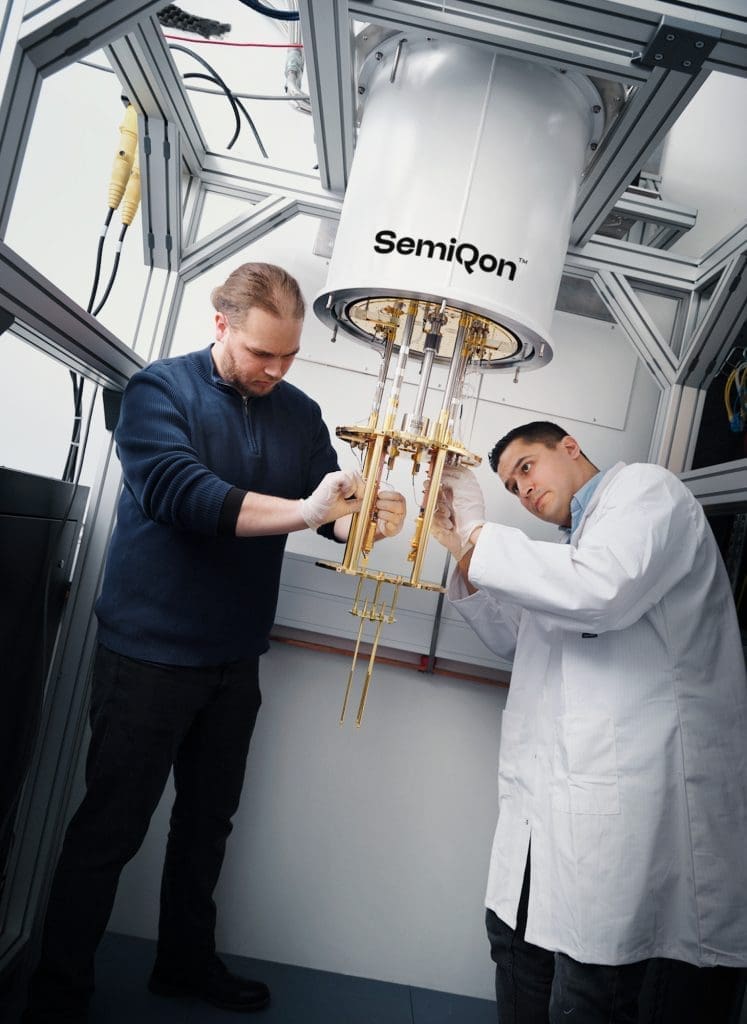
SemiQon’s technology builds upon decades of development and know-how from the semiconductor industry, making its silicon processors commercially competitive and well-suited for mass-production versus alternative solutions. The company expects to deliver its first cryo-optimized CMOS transistors to customers in 2025.
“Our company is just 2 years old, and already we’ve delivered something which the world has never seen before. Our cryo-CMOS transistor will provide considerable advantages to users both in terms of CapEx and OpEx, as well as by enhancing the functionality of their hardware. This could potentially accelerate the development of quantum technologies, or even enable a new era of cryogenic electronics.”
The commercial viability of this innovation is significant, as it has the potential to make operating quantum computers far less costly, while also cutting emissions. This breakthrough could pave the way for widespread adoption of quantum computing technology, revolutionizing industries and transforming the way we live and work.
External Link: Click Here For More