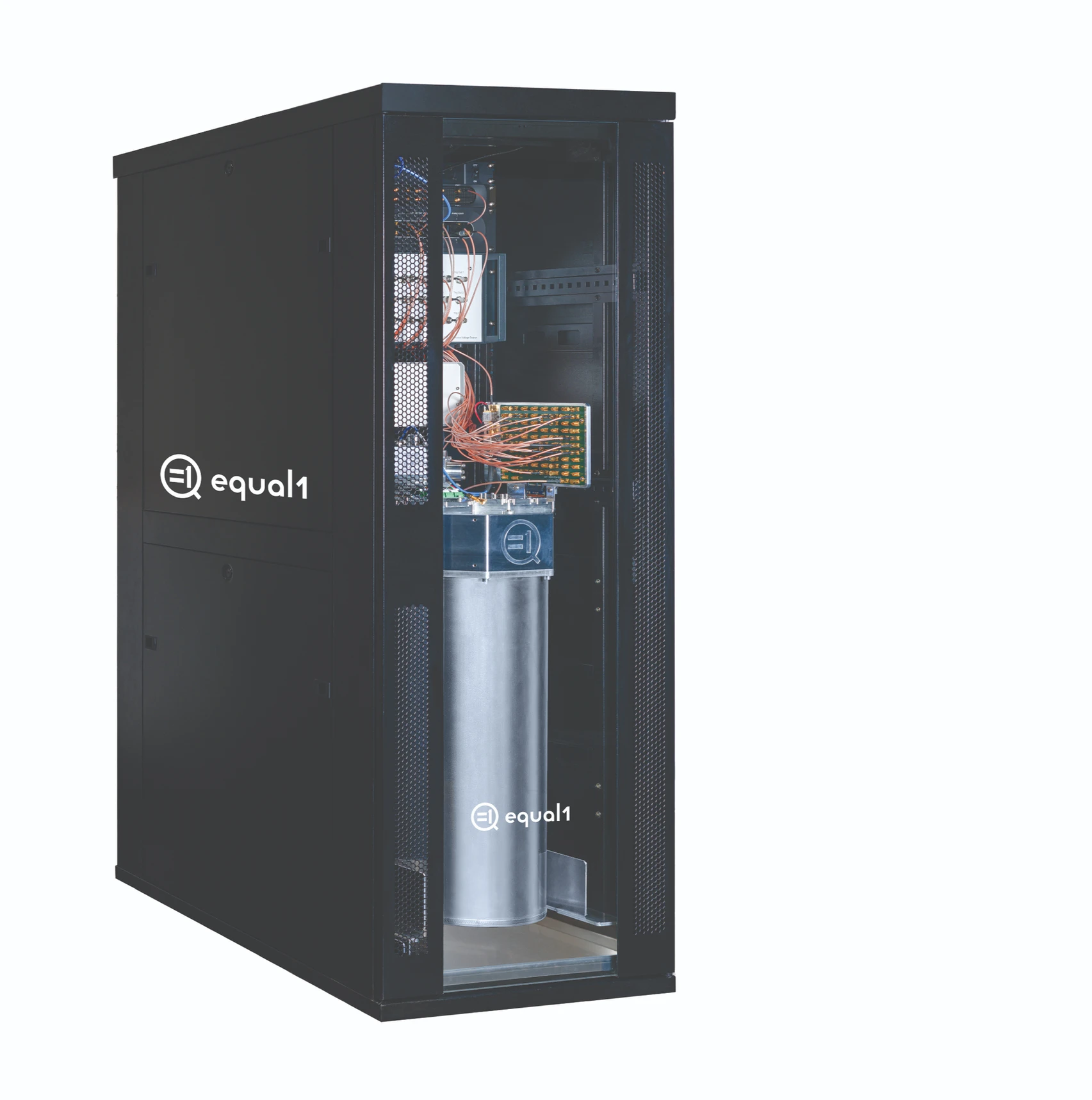
Equal1 has introduced Bell-1, the first quantum system tailored for the HPC era, designed for seamless deployment in existing high-performance computing environments. Unlike earlier quantum computers requiring specialized infrastructure, Bell-1 is a compact, rack-mountable server that integrates effortlessly into current data centres.
Utilizing silicon-based technology with a 6-qubit processor and self-contained cryo-cooling, it operates at -272.85°C without external cooling systems and consumes just 1600 W of power. This innovation enables businesses to leverage quantum computing for applications such as AI, financial modelling, and pharmaceutical research, marking the onset of Quantum Computing 2.0 with a focus on accessibility and practicality.
Equal1 Launches Bell-1: A Quantum System for HPC Environments
Equal1 has introduced the Bell-1, a quantum system designed explicitly for High-Performance Computing (HPC) environments. This innovation marks a significant shift from traditional quantum computing setups by offering seamless integration into existing data centres without requiring specialized infrastructure.
The Bell-1 features a 6-qubit silicon-based processor operating at an ultra-low temperature of 0.3 Kelvin using self-contained cryo-cooling. It consumes only 1600 watts of power and weighs approximately 200 kg and fits within a standard rack. This compact design allows it to be easily deployed alongside classical servers, making it accessible for businesses without major infrastructure overhauls.
This quantum server is engineered to handle computationally intensive tasks across various industries, such as artificial intelligence, financial modelling, pharmaceutical research, and materials science. By integrating into HPC environments, Bell-1 bridges the gap between experimental quantum computing and practical applications, enabling real-world problem-solving.
Looking ahead, Equal1 plans to enhance Bell-1’s capabilities through future upgrades, including increased qubit capacity and improved cooling efficiency. This forward-thinking approach ensures the system remains scalable and adaptable to evolving technological demands, positioning it as a cornerstone for next-generation quantum computing solutions.
Technical Specifications of the Bell-1 Quantum Server
The Bell-1 is built around a 6-qubit silicon-based processor designed to operate at an ultra-low temperature of 0.3 Kelvin using self-contained cryo-cooling technology. The system consumes only 1600 watts of power and weighs approximately 200 kg and fits within a standard rack. This compact design allows for easy deployment alongside classical servers in existing data centers.
The Bell-1 is engineered to handle complex computational tasks across multiple industries, including artificial intelligence, financial modelling, pharmaceutical research, and materials science. Its integration into HPC environments bridges the gap between experimental quantum computing and practical applications, enabling real-world problem-solving.
Seamless Integration into Data Centers
The Bell-1 is designed for seamless integration into existing High-Performance Computing (HPC) environments. Its compact design allows it to fit within standard racks, weighing approximately 200 kg and occupying minimal space. This makes deployment in data centres straightforward without requiring significant infrastructure changes.
A key feature of the Bell-1 is its self-contained cryo-cooling system, which enables operation at an ultra-low temperature of 0.3 Kelvin without needing external refrigeration equipment. This eliminates a major barrier to integration and simplifies installation compared to previous quantum systems.
The server’s power consumption of 1600 watts is comparable to existing servers, making it easy to integrate into data centres without overhauling power distribution systems. This compatibility ensures smooth adoption within current IT infrastructures.
Future Scalability and Enhancements
Equal1 plans to enhance the Bell-1’s capabilities through future upgrades, including increased qubit capacity and improved cooling efficiency. These advancements aim to optimize performance and reduce operational challenges as quantum computing technology matures.
The company intends to leverage progress in quantum processing to expand the Bell-1’s capabilities, ensuring it remains a viable solution for complex computational tasks across industries. By focusing on scalability and adaptability, the Bell-1 is positioned to play a pivotal role in the ongoing evolution of quantum computing within HPC environments.
Industry Impact and the Dawn of Quantum Computing
The Bell-1 represents a significant step in making quantum computing accessible to various industries. Its seamless integration into existing HPC environments, compact design, and self-contained cooling system make it a practical solution for organizations looking to adopt quantum technologies.
As Equal1 continues to develop the Bell-1’s capabilities through future upgrades, the system is poised to become an essential tool for tackling complex computational challenges across multiple sectors. This marks the beginning of a new era where quantum computing moves from theoretical potential to real-world applications.
More information
External Link: Click Here For More
See today’s quantum computing news on Quantum Zeitgeist for the latest breakthroughs in qubits, hardware, algorithms, and industry deals.