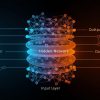
A reconfigurable quantum key distribution (QKD) network connecting four users is now operational; it uses polarization entanglement alongside a software-defined key management system. This integration orchestrates dynamic optical switching and real-time key provisioning, key components for secure applications previously demonstrated separately. By combining physical wavelength division multiplexing with advanced software control, entanglement distribution at the hardware level connects with higher layer key management in one unified framework.
Researchers have built a functioning quantum key distribution (QKD) network connecting four users; it uses entangled photons to create shared encryption keys. The system integrates physical components, wavelength division multiplexing distributes these photon pairs, with software that dynamically reconfigures connections between users as needed. Importantly, this setup also manages those resulting cryptographic keys in real time for use by other systems, moving beyond previous isolated demonstrations towards practical networks.
This integration allows dynamic reconfiguration of connections between users and real-time provisioning of cryptographic keys for applications needing enhanced security. Importantly, they’ve moved beyond isolated demonstrations towards practical networks that can dynamically adapt; but will this simplified switching engine prove sufficient as the network scales up to accommodate more users and greater data demands.
Dynamic four-user quantum key distribution achieves high throughput and network reconfiguration
Secret key rates ranged from 4060 to 7081 bits per second, a first demonstration of dynamic four-user quantum key distribution exceeding previously isolated systems limited to single links or static configurations. This capability enables real-time provisioning of cryptographic keys across an actively reconfigurable network, a crucial step toward practical deployment beyond laboratory settings. Polarization entanglement was used with a software-defined key management system that coordinated optical switching while simultaneously managing secure keys; this maintained low Quantum Bit Error Rates between 0.5% and 3%.
Coincidence rates, essential for entanglement distribution through successful simultaneous detections, reached 10k to 17k per second thanks to low detector jitter and short fibre optic links utilising narrow timing windows from 100 to 150 picoseconds. The system provisioned secure keys via an ETSI 014 interface to FortiGate Next Generation Firewalls establishing quantum-encrypted IPsec tunnels, these encryptors requested keys at a rate of 0.5 key per minute per node as the system delivered one key every second from each QKD provider buffer holding up to 10,000 bits. Analysis revealed that all user buffers accumulated surplus key material throughout the hour-long experiment because generation exceeded consumption rates across active links.
Entangled Photon Distribution via Reconfigurable Optical Networks and Software Defined Key Management
The breakthrough hinged on combining wavelength division multiplexing, sending multiple streams of light at slightly different colours along the same fibre optic cable, with low-loss optical switches; these devices act like microscopic railway points directing individual photons towards specific destinations within the network. This allowed distribution of pairs of entangled photons, linked particles sharing a correlated fate regardless of distance, between four users without relying on trusted nodes or complex intermediate hardware.
The system reconfigured this physical layer not simply by connecting wires differently but integrated it with a custom-built software-defined key management system akin to an automated vault manager controlling access requests for secure items. A significant benefit is that this approach avoids trusted nodes and complex hardware found in alternative systems, simplifying infrastructure needed for secure communication while allowing light at wavelengths centred around 1550.12nm to be distributed via wavelength division multiplexing alongside low-loss optical switches directing photons within the network.
The demonstration highlights how entanglement distribution can work seamlessly with software control delivering keys automatically to standard encryption systems like IPsec VPNs, a move beyond isolated demonstrations towards genuinely deployable networks capable of responding in real time.
Dynamic key establishment validates initial steps toward scalable quantum networking
Successfully connecting four users with dynamically provisioned keys represents a vital step toward practical quantum networks, yet scaling remains an open question; achieving full connectivity between many more nodes could prove substantially challenging without incurring prohibitive overheads in hardware complexity and resource demands. The current architecture relies on direct links for enabling entanglement distribution, which becomes increasingly difficult as network size grows due to the exponential increase in required connections. Despite acknowledged challenges in scaling up to larger networks where building connections between numerous users is complex, this proves dynamic quantum links can be established and managed using software control alongside entanglement distribution.
This research demonstrated a reconfigurable quantum key distribution network connecting four users through polarization-entangled photons at wavelengths around 1550.12nm. By integrating this physical layer with a custom software-defined system, the network dynamically provisioned keys without relying on trusted nodes or complicated hardware. This approach allows for real-time key delivery to standard encryption systems like IPsec VPNs, offering an alternative infrastructure for secure communication. The authors note that scaling up connectivity in larger networks presents challenges related to increasing connection demands.
👉 More information
🗞 Full Mesh Dynamic Four-User Entanglement-based Switched QKD Network Integrated with SD-KMS
✍️ Nikolas Makris, Persefoni Konteli, Zafeirios Georgiadis, Alkinoos Papageorgopoulos, Grigorios Anastasiou, Panagiotis Papanastasiou, Konstantinos Tsimvrakidis and George T. Kanellos (National and Kapodistrian University of Athens)
🧠 ArXiv: https://arxiv.org/abs/2611.15374

See today’s quantum computing news on Quantum Zeitgeist for the latest breakthroughs in qubits, hardware, algorithms, and industry deals.