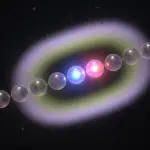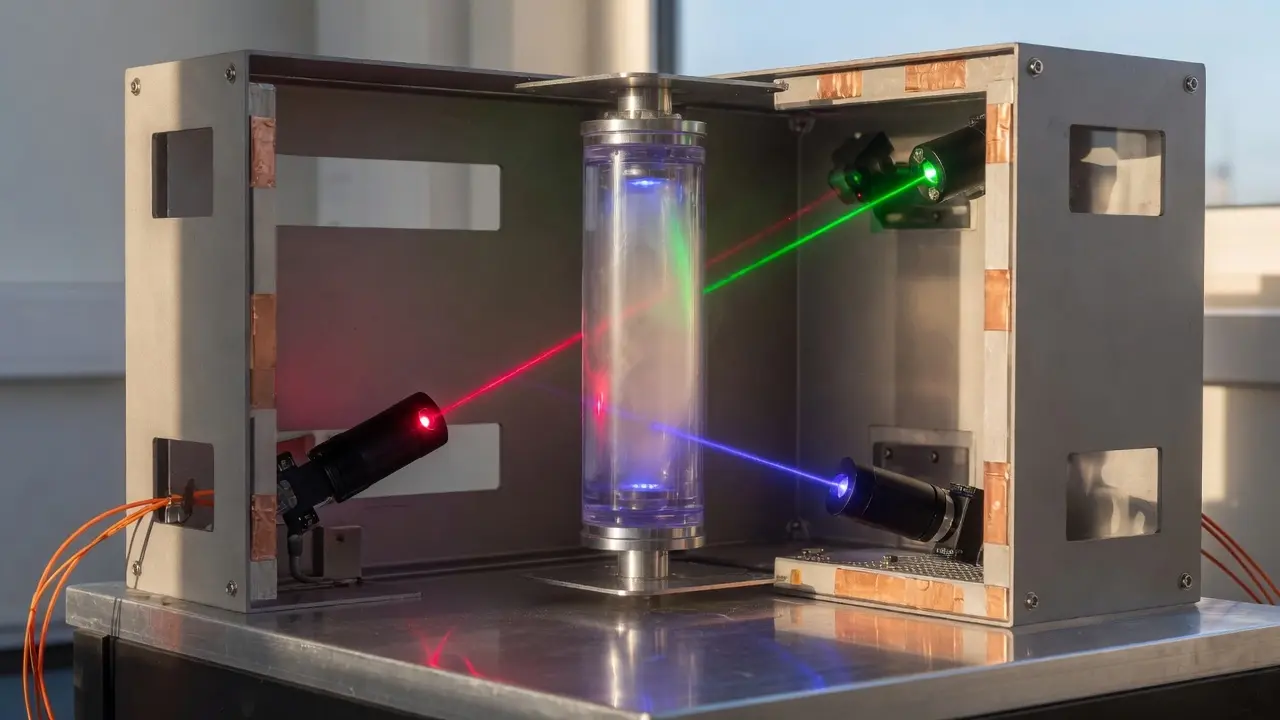
Researchers have achieved 97.6 (+0.8/−1.1)% fidelity in entangled states of laser-cooled molecules, a new record for this direct method of creating entanglement. The team, led by John Doyle, improved upon existing techniques by arranging calcium monofluoride (CaF) molecules in specific three-dimensional geometries, increasing interaction quality by approximately 40% over previous two-dimensional arrangements. A key innovation was a “geometric echo protocol,” rapidly repositioning one molecule to counteract drift in trap positions and boost coherence by a factor of three.
This allowed for the creation of highly stable entangled pairs even with hotter molecules. The work is published as a preprint on arXiv.
Geometric Control Mitigates Thermal and Drift-Induced Decoherence
This improvement directly addresses a primary limitation in generating high-fidelity entangled states within these molecular systems; thermal motion and trap drift typically degrade the coherence of molecular interactions. Researchers found that carefully positioning the molecules minimizes sensitivity to these disturbances, extending the duration of reliable interactions. The team further enhanced coherence by implementing a technique where one molecule is rapidly repositioned to a mirror-image location midway through the interaction period.
Repositioning the molecule quickly counteracts the influence of external disturbances without disrupting the entanglement process itself. This approach allows for sustained, high-quality interactions even with imperfect trap stability. Combining optimized geometry and the geometric echo protocol enabled the generation of maximally entangled Bell pairs of molecules with a fidelity of 97.6 (+0.8/−1.1)%, representing the highest reported entanglement achieved directly with laser-cooled molecules.
This level of fidelity is particularly noteworthy given that the CaF molecules used in the experiment were substantially hotter than those employed in other leading entanglement experiments, which rely on molecules cooled to near their motional ground state. As stated in their work, the researchers believe these methods are broadly applicable to other molecular tweezer platforms, offering a pathway to scalable quantum technologies.
The team projects that further refinements, building on these geometric control techniques, could push molecular entanglement fidelities to 99.9% or higher. The ability to achieve high-fidelity entanglement with relatively warm molecules represents a step toward practical quantum applications, reducing the demands on cooling technology and simplifying experimental setups.
👉 More information
🗞 High-fidelity entanglement of polar molecules by dynamic geometric control
✍️ Scarlett S. Yu, Avikar Periwal, Jiaqi You and John M. Doyle (Department of Physics, Harvard University, Cambridge, MA 02138, USA); Zirui Liu (Institute for Interdisciplinary Information Sciences, Tsinghua University, Beijing 100084, PR China); Qinshu Lyu (Centre for Cold Matter, Blackett Laboratory, Imperial College London, London SW7 2AZ, United Kingdom); Youngju Cho and Eunmi Chae (Department of Physics, Korea University, Seongbuk-gu, Seoul 02841, South Korea); Loïc Anderegg (Department of Physics and Astronomy, University of Southern California, Los Angeles, CA 90089, USA)
🧠 ArXiv: https://arxiv.org/abs/2607.13008
📰 Source: https://cua.mit.edu/news/high-fidelity-entanglement-of-molecules-through-geometric-control


See today’s quantum computing news on Quantum Zeitgeist for the latest breakthroughs in qubits, hardware, algorithms, and industry deals.