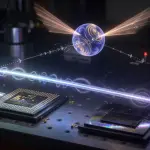
Researchers led by Professor LU Haipeng of The Hong Kong University of Science and Technology’s Department of Chemistry have developed a perovskite chiral multiple quantum-well system that achieves spin polarization lasting approximately 300 times longer at room temperature. This new architecture enables an efficient “spin cascade” process, mitigating energy-related issues that typically limit spin lifetime. The team published their findings in Nature Photonics, detailing how this system overcomes the conventional need for ultralow temperatures to maintain long-lived spin polarization. The study opens new possibilities for future quantum technologies and spin-based applications.
Perovskite Chiral Multiple Quantum Wells Extend Spin Lifetime
This improvement stems from a novel architecture using chiral multiple quantum wells, a departure from conventional single quantum-well designs. Unlike single wells, these multiple systems facilitate a continuous transfer of spin information through intermediate, polarized states, a process the researchers term a cascade. This cascade mitigates energy-related Rashba splitting at interfaces, a phenomenon that typically causes rapid spin decoherence and limits the practical application of spin-based technologies.
Constructing these wells required a two-step seed-assisted crystallization approach, allowing the team to create well-oriented quantum wells with varying widths and intrinsic chirality across different perovskite phases. The resulting structurally coupled quantum wells establish an energy gradient and a fully chiral environment, generating the series of intermediate spin-polarized states critical to the extended spin lifetime.
Materials built with this method also demonstrate spin-dependent charge transport exceeding 80% polarization, and circularly polarized luminescence with a luminescence dissymmetry factor of up to 1.4 × 10 -2. These properties enabled the development of proof-of-concept applications, including efficient X-ray-triggered dissymmetric photopolymerization and high-performance circularly polarized light detection, suggesting potential for asymmetric photocatalysis and advanced optical sensing.
The implications of this work extend beyond fundamental materials science. The team’s findings offer a promising platform for spin accumulation and the development of advanced chiroptical and spintronic devices. “Our study demonstrates that introducing intrinsic chirality across successive quantum-well phases, together with a graded energy landscape, enables efficient spin transfer and prolonged spin polarization in perovskite semiconductors,” said Professor LU Haipeng at HKUST.
Our study demonstrates that introducing intrinsic chirality across successive quantum-well phases, together with a graded energy landscape, enables efficient spin transfer and prolonged spin polarization in perovskite semiconductors.
Prof. LU Haipeng, Professor at The Hong Kong University of Science and Technology (HKUST)
Source: https://hkust.edu.hk/news/hkust-develops-novel-perovskite-chiral-multiple-quantum-well-system

See today’s quantum computing news on Quantum Zeitgeist for the latest breakthroughs in qubits, hardware, algorithms, and industry deals.