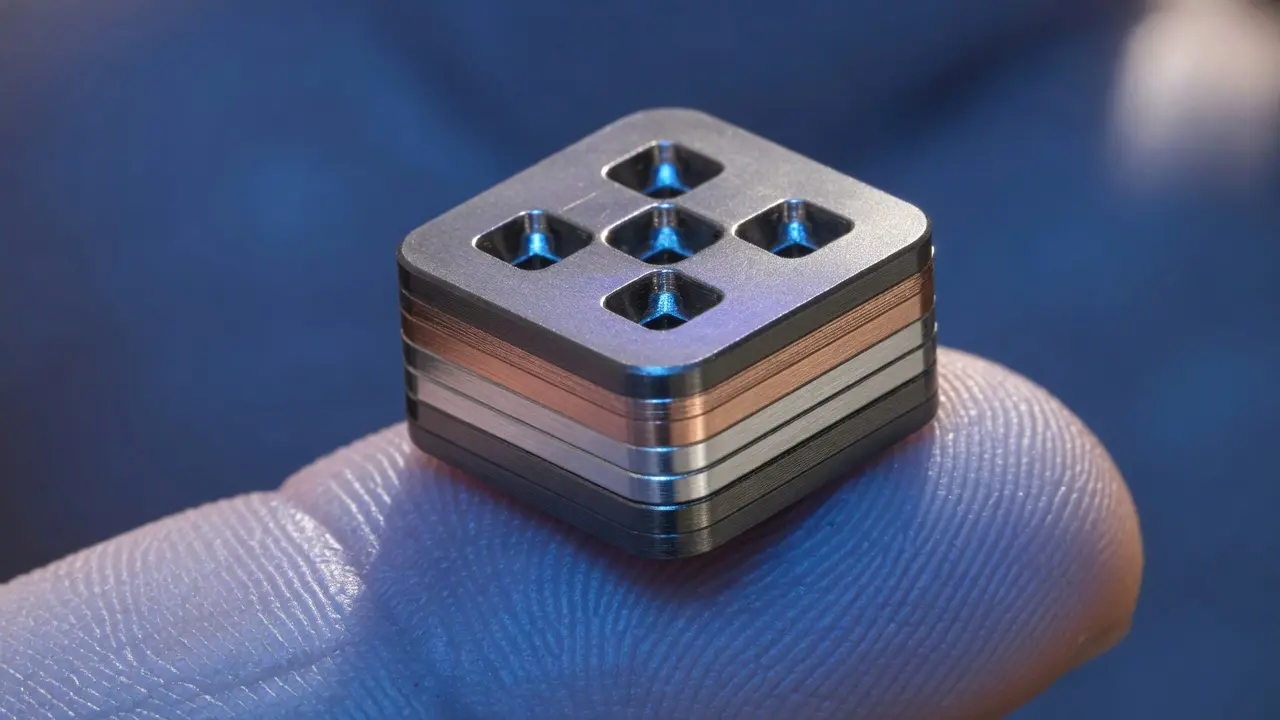
Quantinuum researchers have prepared low-temperature quantum states on the Helios trapped-ion processor using circuits with a maximum depth of 42 two-qubit layers. The team’s new approach, PP-VarQITE, achieves circuits approximately two to ten times shallower than those created by sequential tensor-network compilation for simulating frustrated chain and two-dimensional lattice models. By determining circuit parameters entirely classically, they successfully prepared a 48-site frustrated chain and a 7×7 Ising lattice using 96 and 98 qubits, respectively. This work demonstrates low-temperature state preparation at circuit sizes beyond the reach of conventional simulation methods.
PP-VarQITE: Combining Pauli Propagation and Variational Quantum Imaginary-Time Evolution
Classical circuit design now plays a role in minimizing the execution cost of quantum state preparation alongside accuracy, as demonstrated by a new approach called PP-VarQITE. This method combines Pauli propagation with variational quantum imaginary-time evolution to determine circuit parameters entirely classically, encoding target temperatures within a fixed circuit architecture. Numerical studies using both Ising and frustrated Heisenberg models successfully recovered low-temperature energies and correlations while utilizing up to 100 qubits in simulations.
The technique relies on evaluating a shared set of backward-propagated operators, assembling a metric and evolution vector and then classically updating circuit parameters at each imaginary-time step. Pauli propagation provides the necessary circuit-dependent generator and Hamiltonian actions without constructing the full circuit state or propagating the thermal density matrix, streamlining the process.
Researchers detail the truncation procedure used for PP-VarQITE in Section III of their work, assessing its impact on both accuracy and classical computational cost in Section IV. The choice of ansatz, which defines the state variations available during imaginary-time evolution, directly impacts both the depth of state preparation and the classical cost of Pauli propagation. The researchers state in their paper.
Low-Temperature State Preparation Challenges for Noisy Quantum Hardware
The approach circumvents the need for increasingly complex circuits as temperatures decrease, a common limitation of previous methods. These demonstrations showcase the scalability of PP-VarQITE, moving beyond small systems and approximations toward resolving low-temperature order on actual quantum devices. By updating only the angles of a fixed circuit, the researchers recovered low-temperature order without increasing the state preparation depth or introducing additional hardware noise. PP-VarQITE’s efficiency stems from its evaluation of the McLachlan metric and evolution vector through a shared Gram representation, allowing for truncated Pauli propagation to determine rotation angles.
Classical Limitations of Thermal State Simulations with Tensor Networks
Classical simulations of thermal states, while effective at higher temperatures, face escalating computational costs as temperatures decrease due to the growth in required operator representations. Quantum algorithms offer guarantees for preparing Gibbs states, but achieving these guarantees often demands circuit depths exceeding the capabilities of current noisy quantum processors. Using classical simulations to reduce quantum circuit resources for state preparation is becoming more common, with methods like Matrix Product State (MPS) compilation and differentiable Pauli propagation showing promise.
However, an accurate classical representation alone does not guarantee a shallow circuit for state preparation. The translation from classical data to a viable quantum circuit remains a significant hurdle. Recent work demonstrates that the resulting state preparation depth is a key factor in enabling further dynamical calculations, allowing a larger portion of available circuit resources to be dedicated to real-time evolution.
Demonstrated energy accuracy versus circuit gate count and depth highlights the efficiency of the new approach. Absolute thermal energy-density error, a measure of how closely the prepared state matches the target thermal state, is plotted against two-qubit gate count and circuit depth for both 50-site J₁-J₂ chains and 7×7 transverse-field Ising models. Results show that circuits generated using the PP-VarQITE method achieve comparable accuracy with fewer gates and shallower depths than those generated by traditional methods.
This is particularly evident at lower temperatures, where classical simulations become more demanding. The team’s circuits for the J₁-J₂ chain used L = 1, 2, and 3, while the lattice circuits employed L = 2, 3, and 4, demonstrating a clear reduction in complexity. Beyond equilibrium sampling, these shallow thermal state preparation circuits are valuable as initial states for quantum simulation routines.
Initializing a processor with an approximate thermal state allows for real-time evolution to extract dynamical correlation functions and response spectra. In sample-based Krylov diagonalization, real-time evolutions of an initial reference state generate a subspace for classical diagonalization, with convergence and sampling overhead governed by the overlap between the initial state and the ground state. This suggests that improvements in state preparation directly translate to gains in the efficiency of subsequent quantum simulations.
PP-VarQITE Enables Shallow Circuits Beyond Statevector Simulation
These circuits reproduced the development of dimer order and lattice-wide correlations across a range of temperatures, all while using a maximum of 42 two-qubit layers, a surprisingly low circuit depth for simulating such complex physical models. This reduction in circuit complexity is a key step toward overcoming limitations imposed by noisy quantum hardware. Validation of the state preparation accuracy relied on energies and spin correlations, comparing results to exact matrix product state (MPS) calculations and independent thermal MPS calculations where full statevector simulation became impractical.
MPS references employed bond dimensions of 128 for the J₁-J₂ chain and 256 for the lattice, providing a robust benchmark against which to assess the PP-VarQITE method. The team found that while approximate compression procedures introduce some error, they significantly reduce circuit resources, enabling simulations at scales previously inaccessible. The resulting shallow circuits extend beyond the practical reach of statevector simulation.
Ising and Heisenberg Model Validation with Up to 100 Qubits
Simulating the two-dimensional transverse-field Ising model required 98 qubits on the Quantinuum Helios processor, demonstrating the method’s scalability to systems beyond those accessible with conventional simulation techniques. This achievement relies on a circuit architecture that simultaneously defines the range of possible quantum states and constrains the complexity of classical calculations needed to determine circuit parameters. A single classical trajectory provides parameters across different target temperatures, while continued imaginary-time evolution adjusts circuit angles without increasing the number of gates required for state preparation.
Circuit Parameter Optimization via Gram Matrix and Evolution Vector
The method’s efficiency stems from evaluating generator actions by propagating each component backward through its circuit prefix, merging identical Pauli strings and discarding terms below a defined coefficient threshold. The process involves expressing the Hamiltonian in a transformed frame and substituting these expressions into equations to define the metric and evolution vector, ultimately allowing for the calculation of energy through a simplified expression. Pauli propagation supplies the circuit-dependent generator and Hamiltonian actions, reducing computational cost by reusing vectors across metric and evolution vector calculations.
Pauli propagation supplies the shared vectors used to assemble the Gram metric M and evolution vector v on a classical computer. This technique allows for the efficient evaluation of the metric and evolution vector, critical for determining the circuit parameters and preparing the desired thermal state. The factor U cancels from inner products between derivatives, simplifying calculations and contributing to the overall efficiency of the approach.
Imaginary-Time Evolution for Temperature-Dependent State Preparation
The efficiency of PP-VarQITE stems from a carefully designed circuit architecture, which dictates both the range of achievable states and the computational demands of classical calculations. This approach allows for the preparation of thermal states using fewer computational resources than traditional methods, potentially accelerating progress in quantum simulation. Numerical evaluations of PP-VarQITE were performed on one- and two-dimensional transverse-field Ising models and the frustrated J1, J2 Heisenberg chain, using up to 100 qubits including those dedicated to purification.
This strategy is particularly beneficial for exploring complex quantum systems where accurate initial states are important for meaningful simulations. The chosen circuit architecture therefore determines both the available state variations and the operators that must remain tractable in the classical calculation.
The process begins with an infinite-temperature purification, then evaluates the metric matrix and evolution vector, key components for determining circuit parameter updates, through a shared Gram representation. This method allows for the efficient calculation of these critical elements, reducing the overall computational burden. By constructing the circuit directly using classical computation, the execution cost becomes an integral part of the design process, alongside the accuracy of the resulting prepared state.
👉 More information
🗞 Thermal state preparation with shallow quantum circuits
✍️ Cenk Tüysüz and Michele Grossi (European Organisation for Nuclear Research (CERN), Geneva, Switzerland); Simon Deconihout (École Polytechnique Fédérale de Lausanne (EPFL), Lausanne, Switzerland); Enrico Rinaldi (Quantinuum, Partnership House, London, United Kingdom)
🧠 ArXiv: https://arxiv.org/html/2611.32388v1


See today’s quantum computing news on Quantum Zeitgeist for the latest breakthroughs in qubits, hardware, algorithms, and industry deals.