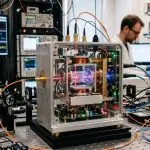
Benjamin Krawciw and James P. Crutchfield of University of California at Davis have constructed an electrical circuit that reproduces individual outcomes of a quantum measurement to within one percent accuracy, achieved over 300 trials. The circuit simulates a single qubit measurement using a deterministic model, challenging the conventional view of measurement as an inherently stochastic process.
Unlike collapse theories relying on intrinsic noise, this model uses a hidden variable to select outcomes while still matching the Born rule’s outcome frequencies to within about 0.02 in probability. The researchers state this work is “a small but provocative step towards modeling quantum measurement with macro-scale machines.”
Deterministic Model of Single-Qubit Projective Measurement
This achievement stems from a deterministic model of single-qubit projective measurement, where the outcome is selected by a hidden variable, denoted as φ, that remains unresolved by the observer. Unlike stochastic collapse theories, this model relies on a predetermined trajectory of differential equations, eliminating the need for intrinsic noise to generate measurement results. The researchers specifically designed the model so that when φ is uniformly distributed, the resulting outcome frequencies align with the predictions of the Born rule.
This approach does not derive the Born rule, but instead demonstrates its compatibility with a deterministic system. The model’s construction ensures that a uniformly distributed hidden variable yields outcome frequencies matching the Born rule, achieving a probability match within approximately 0.02.
The work extends beyond simply reproducing statistics; it offers a framework for understanding measurement as a finite-time trajectory of a deterministic system, rather than invoking a separate rule for the measurement process itself. “We construct a deterministic, nonlinear model of an ideal projective measurement of a single qubit and build an electrical circuit that implements it,” the researchers state, emphasizing the model’s focus on a specific, idealized scenario.
Circuit Reproduction of Measurement Decision Thresholds
The electrical circuit faithfully reproduces individual quantum measurement outcomes to within one percent of the theoretical decision threshold, a level of precision demonstrating the viability of deterministic modeling. This analog simulation, built to mimic a single qubit measurement, achieved this accuracy consistently across over 300 trials, challenging conventional views of quantum collapse as inherently stochastic. The model’s success hinges on a hidden variable, not intrinsic noise, which dictates the measurement outcome, a key distinction from traditional collapse theories.
Schrödinger Evolution vs. Quantum State Collapse
This level of fidelity suggests a path toward modeling quantum measurement using entirely classical, deterministic systems, a departure from the traditionally stochastic view. The model’s architecture deliberately avoids intrinsic noise as a mechanism for outcome selection, instead relying on a hidden variable to determine the measured state. The team’s work builds on the idea that a deterministic dynamical system can implement the Born rule, rather than simply deriving it from underlying principles.
Non-Unitary Measurement in Closed Quantum Systems
This deterministic selection process contrasts with standard quantum measurement, where outcomes are probabilistic and governed by the Schrödinger equation’s unitary evolution, a linear and invertible process. The equations governing this model, while designed to replicate measurement, are acknowledged as ad hoc and not a proposed final theory. Beyond theoretical implications, the analog implementation demonstrates a deterministic dynamical system’s ability to replicate quantum behavior, achieving individual outcome reproduction to within one percent of the decision threshold.
This work revives interest in nonlinear dynamical systems as a framework for addressing the measurement problem, though causality issues remain a significant challenge. The potential for efficiently simulating quantum algorithms without quantum hardware is also hinted at by this classical analog emulation of quantum systems, though scalability remains a hurdle. “Either of these directions, if successful, would have profound implications,” the authors note, adding that failure in one area does not preclude success in the other.
Non-Linearity of Measurement in Open Quantum Systems
The model’s architecture is designed to reduce to Schrödinger evolution when no measurement occurs, effectively bridging the gap between continuous unitary dynamics and discontinuous state collapse. The model’s success in replicating the Born rule, the mathematical relationship between quantum wave functions and measurement probabilities, is particularly noteworthy. When the variable θ is negative, the system is driven toward the state (-c,-s), while a positive θ value directs it toward (c,s). The potential for exploring chaotic dynamics within this framework remains open, with nonlinear quantum dynamics known to be generically chaotic.
Beyond the foundations of physics, the simulation of quantum problems on an analog computer presents a modern technological avenue for exploration. The team acknowledges the scalability challenge inherent in constructing high-dimensional Hilbert spaces for analog simulation, a problem shared with other attempts at non-measurement analogs to quantum computing.
Postulates of Quantum Mechanics: State and Dynamics
The awkward disconnect in the postulates of quantum mechanics between the continuous evolution described by Schrödinger’s equation and the abrupt, stochastic nature of measurement itself has vexed physicists for decades. The model sidesteps the need to derive the Born rule, instead showing it can emerge from a deterministic system when a uniformly distributed hidden variable selects measurement outcomes.
Deterministic Dynamics as an Approach to Measurement Problem
The model’s approach to measurement is not about deriving the Born rule, but rather demonstrating that it can emerge naturally from a deterministic system governed by nonlinear dynamics. The model achieves this by selecting how the outcome depends on a hidden variable φ so that, when φ is uniformly distributed from the observer’s point of view, the outcome frequencies are those of the Born rule. The researchers emphasize that this model does not posit a physical origin for the measurement apparatus itself, but rather focuses on modeling the process once the coupling to such an apparatus is established.
👉 More information
🗞 Analog Explorations of Quantum State Measurement
✍️ Benjamin Krawciw and James P. Crutchfield (Complexity Sciences Center and Department of Astronomy and Physics University of California at Davis, Davis, CA)
🧠 ArXiv: http://arxiv.org/abs/2611.26889v1



See today’s quantum computing news on Quantum Zeitgeist for the latest breakthroughs in qubits, hardware, algorithms, and industry deals.