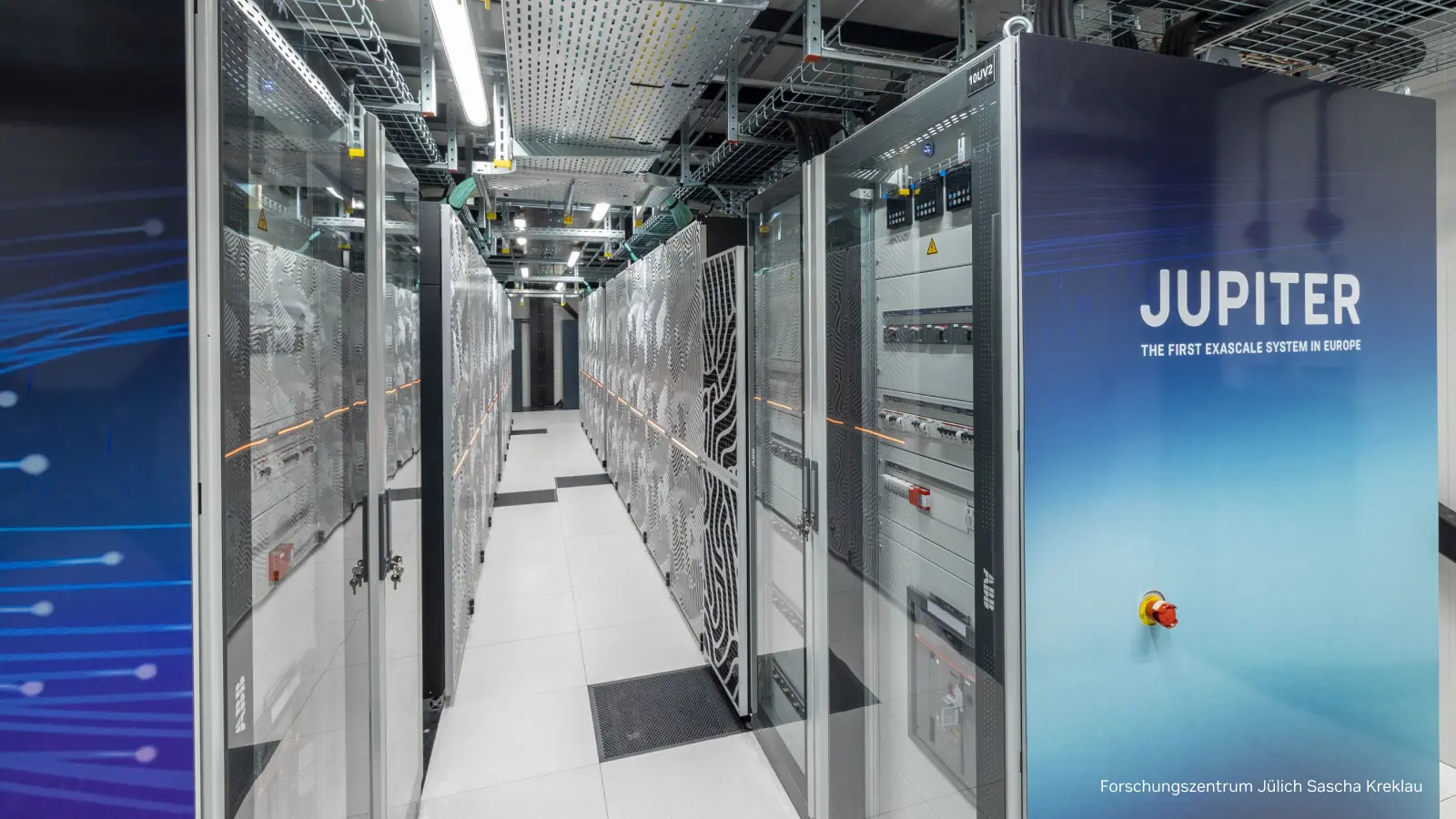
NVIDIA researchers have completed the largest comprehensive simulation of a fault-tolerant quantum processor to date, running a 104-qubit system on JUPITER, Europe’s first exascale supercomputer at Jülich Supercomputing Centre. The simulation validates a quantum computing approach that requires 90% fewer physical qubits than previous methods, potentially accelerating the development of viable quantum computers for applications like drug discovery and financial modeling.
“Useful quantum computing will require fantastically complex, fault-tolerant systems — and understanding how they behave at scale is essential to building them,” said Jensen Huang, founder and CEO of NVIDIA. Kristel Michielsen, director of the Jülich Supercomputing Centre, added that the collaboration is helping scientists make better-informed decisions about quantum computer designs.
JUPITER Supercomputer Validates 104-Qubit Fault-Tolerant Quantum Simulation
This method promises a substantial reduction in the physical qubit count needed for practical applications, potentially accelerating the timeline for viable quantum computers. Researchers used the NVIDIA GB200 NVL72 system at the NVIDIA Accelerated Quantum Research Center to refine simulation methods before deploying them on JUPITER’s 8,192 GPUs. The validation of magic state cultivation is particularly significant because it addresses a critical challenge in fault-tolerant quantum computing: minimizing the resources required to correct errors.
Qubits are inherently susceptible to noise, and maintaining the integrity of quantum computations demands the continuous generation of magic states. By simulating this process under realistic hardware noise conditions, NVIDIA researchers demonstrated the efficiency of this approach, offering tools to improve future designs, the company says. Earlier work at Jülich had simulated 50 qubits, but under ideal, noiseless conditions; this new simulation’s inclusion of realistic noise is a key advancement.
The team’s ability to scale tests from four GPUs to hundreds before using JUPITER’s full capacity emphasises the importance of accelerated computing clusters in developing and validating complex simulation methods. This preparatory work reduced a simulation that previously took weeks to complete to just days, maximizing the effective use of JUPITER’s exascale computing power. The simulation employed NVIDIA cuQuantum software for optimized performance and scalability, alongside the NVIDIA CUDA-Q platform’s fault-tolerant logical layer to define the magic-state circuit, according to the company.
This combination allowed researchers to model the behavior of a 104-qubit processor with high fidelity, providing data important for predicting the performance of future designs. The ability to predict performance before hardware construction reduces reliance on costly and time-consuming trial and error, shortening the path to practical quantum applications in fields like drug discovery, financial modeling and materials science.
The project highlights the growing importance of simulation as quantum computing systems increase in size and complexity, demonstrating how advanced computational resources are essential for pushing the boundaries of quantum research.
Useful quantum computing will require fantastically complex, fault-tolerant systems – and understanding how they behave at scale is essential to building them.
Jensen Huang, founder and CEO of NVIDIA




See today’s quantum computing news on Quantum Zeitgeist for the latest breakthroughs in qubits, hardware, algorithms, and industry deals.