
A security appliance equipped with robust algorithms and protected keys can still fail due to a flawed entropy source, highlighting that truly unpredictable foundational bits are essential for cryptographic security. Original equipment manufacturers building FPGA- or MCU-based products now face an “engineering and assurance decision,” not simply a component purchase, when sourcing quantum entropy.
According to the company, knowing how to source quantum entropy starts with the “quantum physical process” and extends through manufacturing and lifecycle support. The objective is to establish a reliable source of entropy for certifiable products, as raw quantum measurements require extensive characterization of optical elements, detectors and associated electronics.
Quantum Entropy Sources Demand System-Level Requirements Definition
A robust security foundation demands more than sophisticated algorithms. A flawed entropy source can render even the most carefully designed systems vulnerable, according to emerging guidance for manufacturers of field-programmable gate arrays and microcontrollers. While a security appliance might boast approved algorithms, protected keys and a carefully designed hardware root of trust, its cryptographic strength is fundamentally limited by the quality of its random number generation.
The focus is shifting from simply acquiring a quantum entropy component to defining a comprehensive system-level approach encompassing the entire data path, from the initial quantum measurement to long-term operational support. Defining entropy requirements begins with a detailed understanding of cryptographic needs, extending beyond peak throughput to sustained demand and specific use cases. An embedded product’s requirements should explicitly address key generation, deterministic random bit generator seeding, nonce generation, certificate operations, secure boot provisioning and any hardware security module or trusted execution environment integration.
Manufacturers must also delineate the assurance boundary, aligning the entropy source with specific customer security policies or certification paths to provide verifiable evidence of reliability. Procurement should extend beyond technical specifications to include detailed documentation, test results, interface behavior, health-test operation, failure reporting, version control, and ongoing supplier support. Raw quantum measurements, while promising in theory, require extensive processing before they can be used in cryptographic applications.
The process of conditioning converts raw entropy into a usable format, demanding a well-defined construction with clear input assumptions and a transparent relationship between raw sample rate and delivered random bit rate. This conditioning must be distinct from statistical assessment of output; passing a statistical test suite does not guarantee unpredictability, but rather confirms the absence of anomalies during testing. The critical question manufacturers must address, according to the guidance, is “What does our product do when it cannot justify those bits?”
A practical acceptance plan for quantum entropy sources must cover four key areas: entropy claims, including the min-entropy model and conditioning ratio; health-test behavior, including responses to induced faults and host-visible status; environmental operation across temperature, voltage and electromagnetic conditions; and interface failure modes such as reset sequencing, buffer exhaustion, and malformed commands. This approach extends to both production software and field support, ensuring that the system can gracefully handle entropy source failures.
Low-power optical modules are gaining relevance for embedded integration, offering a potential solution for incorporating quantum-derived entropy without extensive board redesigns. The evaluation of any candidate quantum entropy module must consider electrical, mechanical, thermal and lifecycle requirements, but sourcing is not complete upon passing a bench evaluation. Verification must be treated as an ongoing supply-chain activity, ensuring consistent performance and reliability throughout the product’s lifespan.
The ultimate goal is to move beyond simply claiming randomness and instead establish a measurable security dependency with known operating limits and visible fault states. This allows manufacturers to defend their design decisions and provide customers with confidence in the security of their products. The ability to demonstrate a clear path from the quantum physical process through conditioning, health monitoring, and lifecycle support is becoming increasingly critical for securing FPGA- and MCU-based devices in a world where even the most robust algorithms are only as strong as the randomness that underpins them.
Conditioning and Health Tests Validate Entropy Delivery
Conditioning, a step beyond simply obtaining raw quantum data, converts quantified entropy into a format suitable for cryptographic applications. A robust conditioner should employ a well-established method, clearly state its input assumptions, and define the relationship between the rate of raw samples and the rate of delivered random bits. The design must also differentiate between health tests for the source itself and statistical assessments of the output, as statistical suites alone cannot definitively prove unpredictability.
Conversely, a secure quantum entropy source may exhibit predictable patterns in its raw data before conditioning, and these are expected behaviors. Operational safeguards rely on continuous health tests that detect any deviation from validated performance. Evaluation of a candidate module must include verification of startup checks, ongoing tests, error signaling and a defined recovery state, ensuring failures are visible to the host system, latched for diagnostics and retained across resets where appropriate.
Silent fallback behavior, where a system continues operating with compromised randomness, is a significant concern for original equipment manufacturers. If a system experiences a failure, the host system requires clear information regarding the status of the entropy supply. It must determine whether no data is being received, the data is degraded, conditioned output is being sourced from a secondary system, or the data is unusable.
These tests are not limited to evaluation boards; they must be repeated on representative integrated units to account for real-world conditions. Integration can introduce power noise, timing variations, thermal effects from the enclosure, and software concurrency that were not present in the supplier’s initial reference configuration. The form factor of the quantum entropy source must also align with the host architecture.
While a discrete external generator simplifies evaluation and provides a clear assurance boundary, a compact module integrated near an FPGA or MCU can reduce system complexity, power consumption and the attack surface, provided the integration does not compromise the source’s operating conditions. For FPGA designs, assessment must include clock-domain crossing, buffering, interface latency, and how the output integrates with the cryptographic architecture.
The FPGA should not treat the quantum random number generator as an unbounded data stream. Instead, it should implement flow control, explicit fault handling and a clear policy for managing situations where entropy is unavailable.
FPGA/MCU Integration Preserves Quantum Entropy Assurance
The reliability of cryptographic systems extends beyond robust algorithms. OEMs must define both peak and sustained entropy demand, recognizing that devices may require substantial bursts of randomness during startup or credential rotation, alongside consistent throughput for ongoing operations. Establishing a clear assurance boundary is also vital; any entropy source intended for use in a certifiable product needs documented evidence that can be incorporated into the evaluation process.
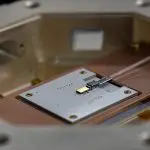
Raw quantum measurements require extensive conditioning to convert them into usable cryptographic material. This proactive approach addresses potential failures and ensures a defined response to entropy source unavailability, a critical consideration for long-term system resilience. Any candidate module, such as Crypta Labs’ Quantum Optics Module, should be assessed against the appliance’s electrical, mechanical, thermal and lifecycle requirements.
The supplier relationship is not concluded upon passing bench evaluation. Traceability over the product lifetime is paramount. Manufacturers should inquire about component revision control, calibration records, serial-number traceability, firmware update policies, end-of-life notifications and the availability of engineering support for design reviews and assurance requests. For regulated or high-assurance deployments, preserving the evidence package from the outset is essential.
This package should capture module versions, configuration settings, driver versions, test reports, board revisions and the conditions under which integration testing was performed. This comprehensive documentation supports a defensible security posture and facilitates ongoing assurance throughout the product’s lifecycle.



See today’s quantum computing news on Quantum Zeitgeist for the latest breakthroughs in qubits, hardware, algorithms, and industry deals.