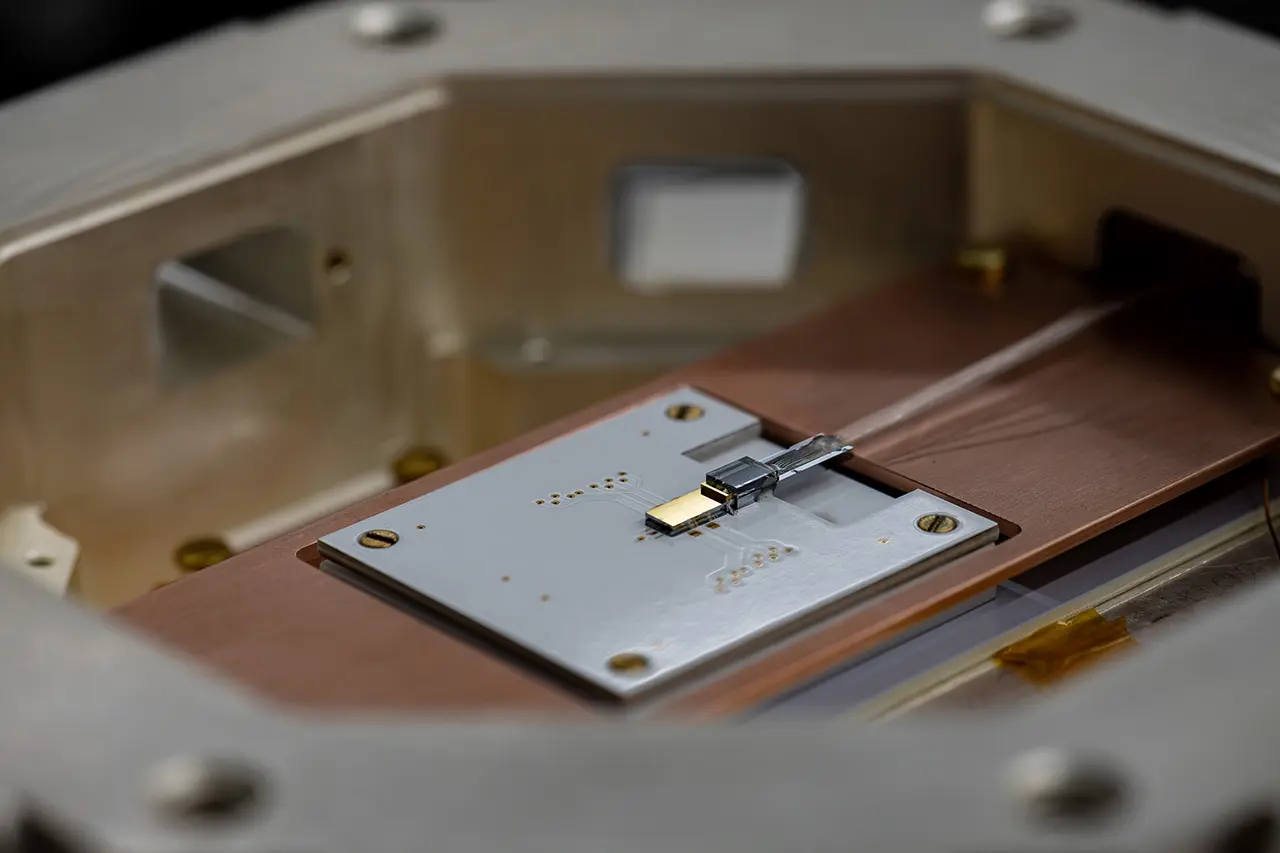
A surprisingly large share of quantum computer operating time is currently consumed by cooling operations, becoming a major bottleneck in leading systems. Researchers at Cornell have developed a laser-cooling technique, detailed November 9th in PRX Quantum, that uses a microfabricated chip to simultaneously cool multiple types of atomic motion.
The team, led by Karan Mehta, assistant professor of electrical and computer engineering, delivers specially designed laser beams through microscopic pathways on the same chip that hosts the trapped ions. “You might think that the logic operations associated with running a computer would be the dominant timescale,” Mehta said.
Integrated Photonics Cool Trapped Ions with Engineered Laser Standing Waves
Engineered standing waves of laser light, delivered via an integrated photonic chip, now simultaneously cool multiple atomic motions within trapped-ion systems, a technique detailed in PRX Quantum. This approach overcomes a common limitation where cooling one degree of freedom in an ion can inadvertently heat another, typically requiring sequential cooling steps. By creating alternating regions of high- and low-light intensity with two counter-propagating laser beams, the researchers targeted calcium ions positioned at points of minimum intensity to remove kinetic energy.
The technique simultaneously cooled all three measured modes of the ion’s motion, spanning a frequency range of approximately 5 megahertz. “Usually it’s challenging to cool all of them with just one single cooling mechanism,” Xing said. The researchers also demonstrated cooling below the conventional Doppler limit, experimentally confirming a longstanding theoretical prediction.
“Usually it’s challenging to cool all of them with just one single cooling mechanism,” Xing said. “But what we demonstrate here is that if those motional frequencies are not too far apart, we can effectively cool them to the ground state.”
Zhenzhong Xing, doctoral student at Cornell
Electromagnetically Induced Transparency Achieves 150 Microsecond Cooling Times
Using electromagnetically induced transparency, Cornell researchers cooled trapped ions to near their quantum ground state in 150 microseconds, a substantial reduction from the 500 microseconds required by conventional laser arrangements. Doctoral student Zhenzhong Xing initially predicted the effectiveness of this approach through theoretical modeling, which co-first authors Hamim Mahmud Rivy and Xing then translated into an experimental demonstration. The team’s success hinged on a custom-built chip capable of handling wavelengths spanning ultraviolet to near-infrared light while operating at cryogenic temperatures.
This cooling speedup addresses a critical limitation in quantum computing, where maintaining qubit coherence demands repeated and rapid reduction of atomic motion. Optical fibers connect to an ion trap device mounted on a carrier board, enabling the delivery of these cooling lasers. The team’s work, published November 9th in PRX Quantum, demonstrates a significant step toward minimizing overhead and maximizing the efficiency of future quantum processors.
“You might think that the logic operations associated with running a computer would be the dominant timescale,” Mehta said. “But cooling operations, particularly to near the quantum ground state, end up being a major bottleneck in leading systems.”
Karan Mehta, assistant professor of electrical and computer engineering at the Cornell Duffield College of Engineering
Simultaneous Multi-Mode Cooling Extends to 5 Megahertz Frequency Range
The new cooling technique achieved simultaneous control across a 5 megahertz frequency range, a critical advancement given that ions oscillate in three dimensions, each potentially at a different frequency. Conventional methods typically require distinct cooling procedures for each mode of motion, increasing operational complexity and time expenditure. This approach uses integrated photonics to guide laser light through microscopic pathways etched onto the same chip housing the trapped ions, enhancing the stability and precision of the cooling process.
“But cooling operations, particularly to near the quantum ground state, end up being a major bottleneck in leading systems.”
Mehta
Source: https://news.cornell.edu/stories/2026/11/researchers-develop-faster-laser-cooling-quantum-computers


See today’s quantum computing news on Quantum Zeitgeist for the latest breakthroughs in qubits, hardware, algorithms, and industry deals.